When you hear “aide” and “aid,” they sound exactly the same. That makes this pair easy to confuse in writing. Should you write “medical aid” or “medical aide”? Is a political assistant an “aid” or an “aide”? The answer depends on what you mean.
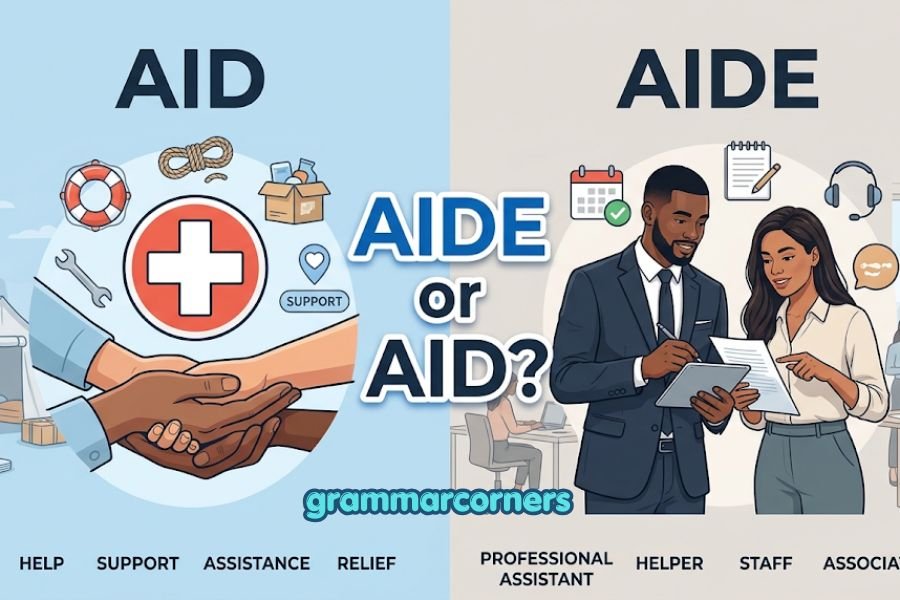
The good news is that the difference is simple. Aid usually means help, assistance, support, or something that provides help. Aide usually means a person who works as an assistant or helper. Both words are correct, but they are not normally interchangeable.
People often search for “aide or aid” because the words are homophones: they have the same pronunciation but different spellings and meanings. This can cause mistakes in emails, schoolwork, business writing, news articles, and professional documents.
This guide explains the difference between aide and aid, their origins, British and American usage, common mistakes, everyday examples, and practical rules. By the end, you will know exactly which word to choose whenever you encounter this confusing pair.
Aide or Aid – Quick Answer
Aid means help, support, or assistance. It can be a noun or a verb.
Aide means a person who helps or assists someone, especially as part of a job.
Examples
- The charity provided aid to families after the disaster.
- The nurse used a walking aid to help the patient.
- The senator’s aide answered the phone.
- She works as a teacher’s aide.
- The organization aided people affected by the flood.
A simple memory trick is:
Aid = help. Aide = helper.
| Word | Main meaning | Example |
|---|---|---|
| aid | Help or assistance | The country sent medical aid. |
| aid | Something that helps | A hearing aid can improve hearing. |
| aid | To help | Volunteers aided the victims. |
| aide | A person who assists | The president’s aide made the announcement. |
| aide | An assistant in a particular job | She is a classroom aide. |
So, if you are talking about help, use aid. If you are talking about a person who helps, use aide.
The Origin of Aide or Aid
The two words are historically related, which helps explain why they sound alike.
Aid entered English through Middle English and Anglo-French from Old French, ultimately tracing back to Latin words related to helping or assisting. Merriam-Webster gives its English history as Middle English eyden, from Anglo-French aider, and ultimately Latin adjutare and adiuvare.
The noun aid developed meanings connected with help, assistance, support, and resources. Over time, it could describe both the act of helping and something that provides assistance.
Aide has a more specific history in English. It comes from the French expression aide-de-camp, meaning an assistant to a military officer. The shortened English noun aide was first recorded in the late 18th century, with Merriam-Webster giving 1777 as its first known use.
Today, aide commonly means an assistant, such as:
- political aide
- presidential aide
- teacher’s aide
- nurse’s aide
- classroom aide
- military aide
The spelling difference therefore developed because English uses the related French-derived form aide for a person who assists, while aid became the standard spelling for help or assistance.
British English vs American English Spelling
There is an important point here: aide and aid are not mainly British-versus-American spellings.
Both forms are used in British English and American English. The main difference is meaning, not national spelling preference.
Collins lists aide in both British and American English as a noun meaning an assistant.
Similarly, aid is used in both varieties for help, assistance, support, and related meanings.
Comparison Table
| Meaning | British English | American English |
|---|---|---|
| Help or assistance | aid | aid |
| Financial assistance | aid | aid |
| Medical assistance | aid | aid |
| Person who assists | aide | aide |
| Political assistant | aide | aide |
| Teacher’s assistant | aide | aide |
| Military assistant | aide | aide |
Examples
British English:
The government provided financial aid.
The minister’s aide spoke to reporters.
American English:
The government provided financial aid.
The senator’s aide spoke to reporters.
The spelling remains the same in both varieties.
Which Spelling Should You Use?
Choose the word based on meaning, not simply on whether you are writing for a British or American audience.
Use “aid” when you mean help
Use aid for:
- assistance
- support
- relief
- financial help
- medical help
- useful equipment or devices
- the act of helping
Examples:
- emergency aid
- financial aid
- foreign aid
- first aid
- hearing aid
- visual aid
- humanitarian aid
You can also use aid as a verb:
The volunteers aided the rescue effort.
Use “aide” for a person
Use aide when referring to someone whose job is to assist another person.
Examples:
- presidential aide
- political aide
- teacher’s aide
- nurse’s aide
- personal aide
- military aide
A useful rule is:
If you can replace the word with “assistant,” choose “aide.”
For example:
She is the governor’s assistant.
Therefore:
She is the governor’s aide.
But:
The governor received financial aid.
You cannot replace aid with aide in that sentence.
Common Mistakes with Aide or Aid
Because the two words sound identical, spelling mistakes are common.
Mistake 1: “The country sent medical aides.”
If you mean medical help, this is incorrect.
Correct:
The country sent medical aid.
However, if you mean people who provide medical assistance, aides could be correct.
The hospital hired several medical aides.
Mistake 2: “The president’s aid made a statement.”
If you mean the president’s assistant, use aide.
Correct:
The president’s aide made a statement.
Mistake 3: “The teacher received a new aide.”
This can be correct if you mean a person.
The teacher received a new aide.
But if you mean something that helps the teacher, use aid.
The teacher received a new teaching aid.
Mistake 4: “Foreign aide”
If you mean financial or humanitarian assistance from another country, the usual expression is:
foreign aid
Not:
foreign aide
Mistake 5: “First aide”
The standard expression is:
first aid
First aid means immediate medical assistance given to someone who is injured or ill.
Quick Correction Table
| Incorrect or confusing | Correct form | Why |
|---|---|---|
| first aide | first aid | Aid means assistance |
| foreign aide | foreign aid | Aid means assistance |
| president’s aid | president’s aide | Aide means assistant |
| teacher’s aid | teacher’s aide | If referring to a person |
| medical aid | medical aid | Medical assistance |
| medical aide | medical aide | A person providing assistance |
Aide or Aid in Everyday Examples
Knowing the difference becomes easier when you see the words in normal writing.
In Emails
Aid:
Thank you for your aid with the project.
Aide:
Please contact the manager’s aide for more information.
In News Writing
Aid:
The government announced additional financial aid for affected communities.
Aide:
A senior presidential aide confirmed the meeting.
News organizations frequently use aide for political and government assistants. Dictionary examples also show common combinations such as “top aide,” “political aide,” and “presidential aide.”
In Social Media
Thanks to everyone who offered aid during the emergency.
The mayor’s aide shared the latest update.
This In Formal Writing
International aid can help communities recover after natural disasters.
The minister’s aide prepared the briefing documents.
In Education
Students can use visual aids during presentations.
The school hired a classroom aide.
These examples show the key distinction clearly: aid is help or a helpful thing; aide is a person who helps.
Aide or Aid – Google Trends & Usage Data
Search interest for “aide or aid” comes mainly from people trying to understand the difference between two homophones.
Google Trends data should be interpreted carefully because Google Trends reports relative search interest, not the total number of searches. A score of 100 represents the highest relative popularity for the selected time and location; it does not mean that a specific number of people searched for the term.
The broader words aid and aide also appear in very different contexts. Aid is common in phrases such as foreign aid, financial aid, first aid, medical aid, and humanitarian aid. Aide is strongly associated with job titles and assistants, including political aide, presidential aide, teacher’s aide, and nurse’s aide. Dictionary usage data supports these distinct patterns.
Interest can also vary by country and context. Searches involving aide are often connected to political, educational, military, or healthcare terminology, while aid appears across everyday, medical, financial, humanitarian, and international contexts.
For writers, the practical lesson is more important than raw search popularity: the words are not competing spellings of the same meaning. Their meanings determine which spelling you need.
Aide vs Aid: Side-by-Side Comparison
| Feature | Aid | Aide |
|---|---|---|
| Pronunciation | /eɪd/ | /eɪd/ |
| Meaning | Help or assistance | A person who assists |
| Part of speech | Noun and verb | Usually noun |
| Refers to a person? | Sometimes, but less common | Yes |
| Refers to help? | Yes | No |
| Example | humanitarian aid | political aide |
| Example | first aid | teacher’s aide |
| Example | hearing aid | nurse’s aide |
| British English | Used | Used |
| American English | Used | Used |
FAQs About Aide or Aid
1. Is it “aide” or “aid”?
Both are correct, but they have different meanings. Aid means help or assistance, while aide means a person who assists.
2. Is an aide a person?
Yes. An aide is an assistant or helper, especially someone whose job involves assisting another person.
3. Is aid a verb?
Yes. Aid can be used as a verb meaning to help or assist.
Example:
Volunteers aided the rescue workers.
4. Is “first aid” or “first aide” correct?
First aid is correct when you mean immediate medical assistance.
5. Is it “teacher’s aide” or “teacher’s aid”?
If you mean a person who assists a teacher, use teacher’s aide.
6. Is “foreign aid” or “foreign aide” correct?
Foreign aid is correct when you mean assistance, money, supplies, or other support provided by one country to another.
7. Do British people spell it “aide” and Americans spell it “aid”?
No. This is a common misconception. Both aide and aid are used in British and American English. The choice depends on meaning, not primarily on the variety of English.
Conclusion
The difference between aide and aid is simple once you focus on meaning. Aid means help, assistance, support, or something that provides help. It can function as both a noun and a verb. Examples include first aid, financial aid, foreign aid, and hearing aid. Aide, on the other hand, normally refers to a person who assists someone. Examples include political aide, presidential aide, teacher’s aide, and nurse’s aide.
The two words are pronounced the same, which is why they cause so many spelling mistakes. However, they are not interchangeable. The distinction is also not mainly a British-versus-American spelling issue. Both forms are used in both varieties of English.
The easiest rule to remember is this: aid means help, while aide means helper. If you can replace the word with “assistance,” choose aid. If you can replace it with “assistant,” choose aide. Remembering this simple test will help you avoid mistakes in emails, essays, professional documents, news writing, and everyday communication.