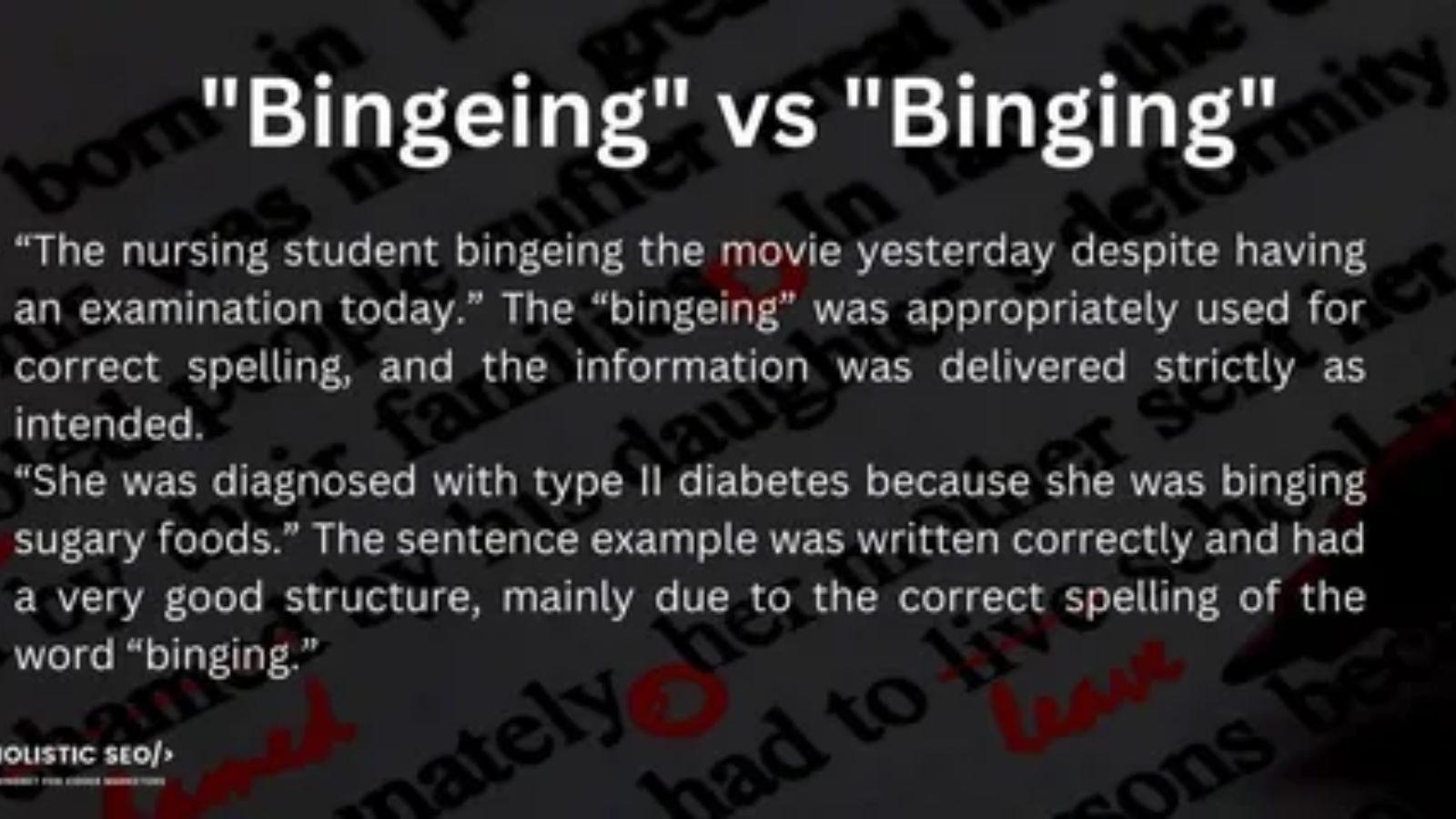
Have you ever typed “bingeing” in a discussion about your fave Netflix series and then paused to think if that’s the right word to use? There are others around you. Because books, media, and online posts use both spellings, many people search for “bingeing or bingeing.” At first look, both versions seem to be accurate, but one seems to be missing the extra “e,” which makes things even more confusing.
This spelling issue stems from English word-formation rules. When transforming verbs into “-ing” forms, some individuals keep the final “e” in place, while others remove it. Because of this, both writers and readers frequently hesitate. It’s crucial to follow the right format while writing essays, business communications, or trying to employ flawless language in blogs and social media.
The confusion will be resolved step-by-step in this essay. The short answer, the word’s origin, British vs. American spelling laws, common errors, real-world usage, and even Google Trends search data will all be covered. You will know exactly whether to write “bingeing” or “bingeing” by the end.
Binging or Bingeing – Quick Answer
- Bingeing is the more traditional spelling, formed by adding “-ing” without dropping the final “e.”
- Binging is also accepted today, especially in American English, where dropping the “e” is more common.
👉 Examples:
- Correct: She is bingeing on chocolate during the holidays.
- Also correct (US): We spent the weekend binging on Netflix.
Both are recognized, but “bingeing” is slightly more formal.
The Origin of Binging or Bingeing
The word “binge” comes from a dialect word meaning “to soak” or “to drink heavily.” Over time, it shifted into modern English, meaning “to overindulge,” first with food or alcohol, later with TV or digital content.
When adding “-ing,” English spelling rules often drop the final “e” (e.g., “make” → “making”). However, with “binge,” dropping the “e” makes it look like the verb “bing” (which exists separately as a search engine name). To avoid confusion, many writers kept the “e,” forming bingeing.
But as usage evolved, especially in US media, “binging” became popular and is now widely accepted.
British English vs American English Spelling
The main difference lies in consistency of spelling rules:
| Word | British English | American English | Example Sentence |
|---|---|---|---|
| Binge (verb + -ing) | Bingeing (preferred) | Binging (common) | She is bingeing/binging on sweets. |
| Age (verb + -ing) | Ageing (preferred) | Aging (preferred) | Population ageing/aging is a concern. |
| Route (verb + -ing) | Routeing (rare) | Routing (common) | The system is routing calls. |
👉 British English tends to retain the “e.”
👉 American English often drops the “e.”
Which Spelling Should You Use?
- For American audiences: Use binging. It looks natural, especially in informal settings like blogs, tweets, or everyday writing.
- For British/Commonwealth audiences: Use bingeing. It follows the same rule as “ageing.”
- For global or academic writing: Prefer bingeing, since it avoids confusion and is still widely understood.
👉 Rule of thumb: Write for your readers. If they’re mostly American, go with “binging.” Otherwise, “bingeing” is safer.
Common Mistakes with Binging or Bingeing
- Using only one as “correct.” Both are acceptable, but context matters.
- Confusing “binging” with Microsoft Bing. Remember, here it means overindulgence, not the search engine.
- Mixing spellings in one text. Stay consistent throughout an article or email.
- Adding an extra “e” where it’s not needed. Wrong: “bingeeing.”
Binging or Bingeing in Everyday Examples

- Emails: “I’ve been bingeing on podcasts lately.”
- News: “The report shows teens are binging on energy drinks.”
- Social Media: “Weekend plans: binging Netflix until Monday.”
- Formal Writing: “Bingeing behavior is often linked to stress.”
Both spellings show up in all contexts, but binging dominates casual digital spaces.
Binging or Bingeing – Google Trends & Usage Data
Google Trends shows:
- Binging is far more popular in the US, especially linked with Netflix or gaming.
- Bingeing still appears in the UK, academic writing, and medical articles (like “bingeing on food” in health studies).
| Country | Preferred Spelling | Usage Context |
|---|---|---|
| USA | Binging | Entertainment, pop culture |
| UK | Bingeing | Academia, formal writing |
| Canada | Both | Mixed usage |
| Australia | Bingeing | Formal writing |
| Global internet | Binging | Social media and casual content |
FAQs
1. Is binging or bingeing correct?
Both are correct. “Bingeing” is traditional; “binging” is more modern and popular in American English.
2. Why does “bingeing” keep the ‘e’?
To avoid confusion with the unrelated word “bing.”
3. Which is used more on the internet?
“Binging” dominates casual content online, especially about TV and streaming.
4. Does Grammarly accept both spellings?
Yes, but Grammarly may suggest one based on your language setting (US vs UK).
5. Is “binging” wrong in formal essays?
Not wrong, but “bingeing” looks more professional in academic or global contexts.
6. Do dictionaries recognize both spellings?
Yes, major dictionaries list both, though they may mark one as the main form.
7. Should businesses use one spelling over the other?
Yes—pick the form that matches your target audience (US = binging, UK/global = bingeing).
Conclusion
The argument over “bingeing or bingeing” boils down to spelling conventions in English. The modern, American-preferred spelling is bingeing, even though the older version, which retains the “e” to prevent misunderstanding, is bingeing.
For clarity:
- Binging = casual, American, online-friendly.
- Bingeing = formal, British, academic.
Both are right; the important thing is to be consistent. Use “bingeing” when writing for a US readership. Select “bingeing” if you’re aiming for international professionals or UK readers. In the end, both spellings convey the same meaning: overindulging in food, television, or digital information.