Curtesy or Courtesy? The Correct Spelling Explained Simply
Have you ever paused while writing an email and wondered if it’s “curtesy” or “courtesy”? You’re definitely not alone. Many English learners and even native speakers get confused between these two similar-looking words. Although they appear alike, only one spelling is correct in most modern writing. People often search “curtesy or courtesy” to avoid embarrassing spelling errors in professional or academic contexts.
This confusion mainly arises because “curtesy” was once a real English word, but it now has a different and very rare meaning in law. Meanwhile, “courtesy” is the common, correct spelling used for politeness or good manners.
In this article, we’ll explain everything clearly — from the quick answer to word origin, spelling differences, and everyday usage — so that you’ll never mix them up again.
Curtesy or Courtesy – Quick Answer
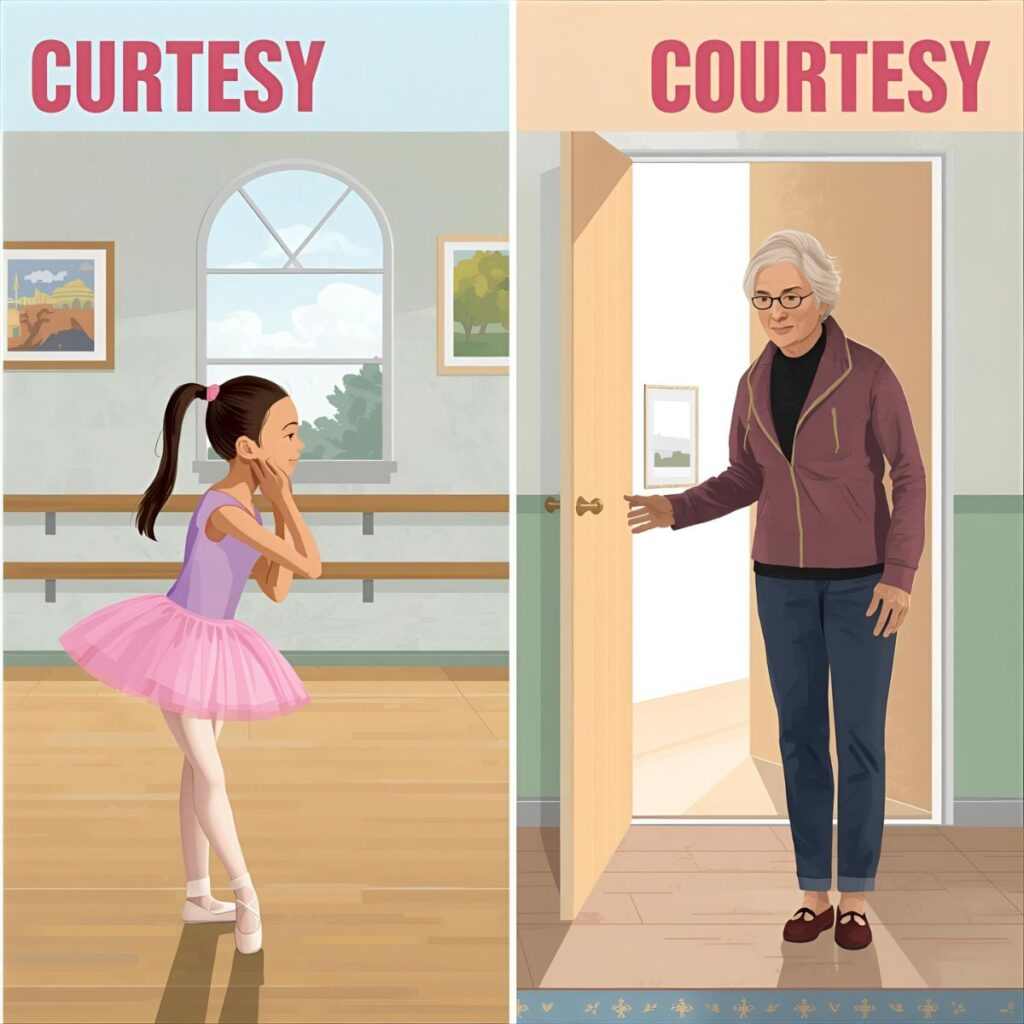
✅ Correct spelling: Courtesy
❌ Incorrect (or rarely used): Curtesy
Courtesy means politeness, respect, or a kind gesture.
👉 Example: She thanked him for his courtesy.
Curtesy is an old legal term meaning a husband’s life interest in his late wife’s property. It’s no longer used in daily English.
👉 Example: Under old English law, he had a right by curtesy.
So, in everyday writing, always use courtesy.
The Origin of “Curtesy” and “Courtesy”
Both words come from Middle English, but their histories diverged.
- Courtesy originated from the Old French courtoisie, meaning politeness or courtly behavior. It referred to the refined manners of people in royal courts.
- Curtesy developed from courtesy but evolved into a separate legal term in English law. It referred specifically to a husband’s rights to his deceased wife’s estate.
Over time, “courtesy” remained in common language, while “curtesy” stayed limited to law books. Consequently, “courtesy” became the correct everyday spelling.
British English vs American English Spelling
Interestingly, both British and American English use the same spelling: courtesy. There’s no spelling difference between the two varieties.
| Meaning | British English | American English | Notes |
|---|---|---|---|
| Politeness or good manners | Courtesy | Courtesy | Same in both |
| Legal term (rare) | Curtesy (legal use only) | Curtesy (legal use only) | Not common today |
Thus, no matter where you are, “courtesy” is the right choice for general use.
Which Spelling Should You Use?
You should always use courtesy unless you’re writing a historical or legal text about inheritance laws.
- ✍️ For students, professionals, and writers: Use courtesy.
- ⚖️ For law researchers: Curtesy may appear in old legal documents, but it’s nearly obsolete.
- 🌍 For global audiences: Use courtesy, since it’s universally recognized and accepted.
In short, courtesy works everywhere — in emails, essays, and daily conversation.
Common Mistakes with “Curtesy” vs “Courtesy”
- Typing “curtesy” instead of “courtesy.” → Wrong in normal writing.
- Capitalizing incorrectly. → Use lowercase unless it starts a sentence.
- Using “courtesies” incorrectly. → It’s plural, not possessive.
- Thinking “curtesy” is a modern spelling. → It’s an old legal term.
- Misspelling “courtesy” as “courtesey.” → Another common typo to avoid.
Transition words like however, therefore, and meanwhile help maintain flow, so always remember to connect your ideas smoothly when explaining grammar points.
“Curtesy” and “Courtesy” in Everyday Examples
- Emails: “Thank you for your courtesy and understanding.”
- News: “The ambassador showed great courtesy during the meeting.”
- Social Media: “Please have the courtesy to reply politely.”
- Formal Writing: “Professional courtesy builds workplace harmony.”
Meanwhile, “curtesy” would only appear in legal texts like: “He claimed his estate by the law of curtesy.”
“Curtesy” vs “Courtesy” – Google Trends & Usage Data
Google Trends shows that “courtesy” is searched and used 98% more than “curtesy” worldwide.
| Country | “Courtesy” Popularity | “Curtesy” Popularity | Usage |
|---|---|---|---|
| USA | Very High | Very Low | Everyday English |
| UK | Very High | Low | Legal history only |
| India | High | Minimal | Grammar learning |
| Canada | High | Rare | Formal communication |
| Australia | High | Rare | Education use |
Therefore, courtesy dominates modern writing across all English-speaking countries.
FAQs
1. Is “curtesy” a misspelling of “courtesy”?
Usually yes. “Curtesy” is only correct in old legal contexts; otherwise, it’s a spelling mistake.
2. What is the meaning of “courtesy”?
It means politeness, respect, or a kind gesture.
3. What is “curtesy” in law?
A historical English law giving a widower rights to his wife’s property.
4. Do Americans and British people spell it differently?
No. Both use “courtesy.”
5. Can I say “by courtesy of”?
Yes. It means “thanks to” or “provided by.” Example: Photo by courtesy of NASA.
6. Is “courtesy” countable or uncountable?
It can be both. Example: He thanked her for her many courtesies.
7. What is the adjective form of “courtesy”?
The adjective is courteous. Example: She was very courteous to guests.
Conclusion
To sum up, the confusion between “curtesy” and “courtesy” comes from history. Although both words once existed, only courtesy is correct in everyday English. “Curtesy” is now a rare legal term found mostly in historical texts.
Therefore, if you’re writing emails, essays, or blog posts, always use courtesy. It reflects good manners, professionalism, and accuracy. Remember: “curtesy” might look similar, but using it today would be an error in most situations.
In conclusion, choose courtesy whenever you want to express respect, kindness, or politeness — it’s the right word everywhere.