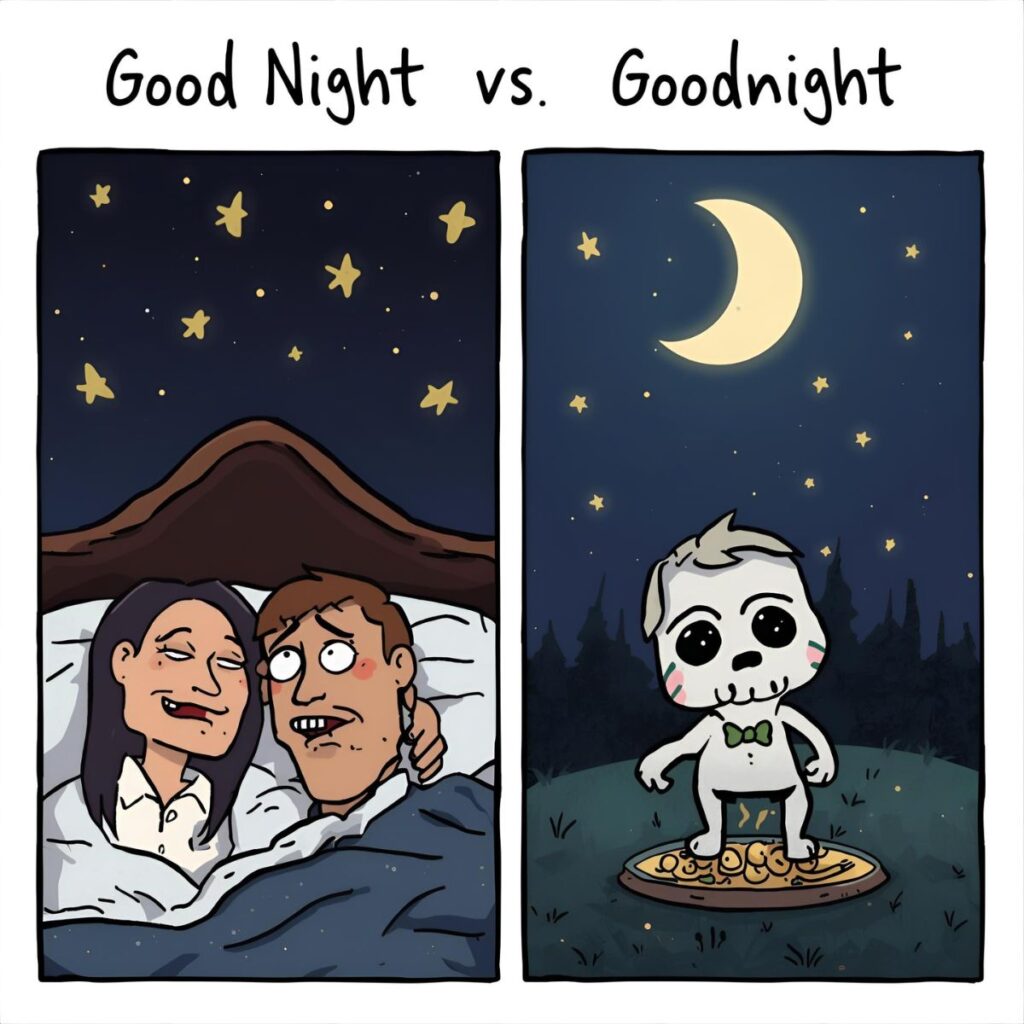
Good Night or Goodnight?A Guide to Correct Usage(2026)
Have you ever paused before sending a text or writing a message, wondering whether to write “good night” or “goodnight”? You’re not alone. Millions of people type this phrase every day, but many are unsure which spelling is correct.
The confusion exists because both forms appear in books, movies, emails, and even greeting cards. While one is technically a phrase and the other a single word, both carry similar meanings. People search for “good night or goodnight” to avoid making grammar mistakes in personal or professional communication.
This article explains the difference between “good night” and “goodnight”, explores their origins, usage in British and American English, common mistakes, and which form to use depending on the context. By the end, you’ll feel confident about writing it the right way—whether in a text to a friend, a business email, or a social media post.
The Difference Between “Good Night” and “Goodnight”
🔹 Good Night (Two Words)
- Standard usage: “Good night” is the traditional and grammatically correct form when used as an interjection or farewell.
- Examples:
- Good night, Mom.
- We had a really good night at the concert.
- Why it matters: Dictionaries and style guides recognize “Good night” as the safer choice in formal writing.
🔹 Goodnight (One Word)
- Informal usage: “Goodnight” is often used casually in text messages, greeting cards, or as a compound modifier.
- Examples:
- Goodnight, everyone!
- She gave me a goodnight hug.
- Why it matters: While acceptable in informal contexts, “Goodnight” is less common in academic or professional writing.
Good Night or Goodnight? – Quick Answer
- Good night (two words) → A phrase used as a farewell before sleep.
- Example: “Good night, see you tomorrow.”
- Goodnight (one word) → A less formal version, often used casually in writing.
- Example: “Goodnight! Don’t stay up too late.”
👉 Rule of thumb: Use “good night” in formal writing, and “goodnight” in casual texts or greetings.
The Origin of “Good Night” and “Goodnight”
The phrase “good night” comes from Old English, where people combined “good” (meaning pleasant or kind) with “night” (the period of darkness). Over time, the two words were spoken quickly together, leading to the one-word spelling “goodnight.”
The two-word form has been the traditional and grammatically correct version in English literature for centuries. The single-word spelling became popular in casual writing, especially with the rise of text messaging and digital communication.
British English vs American English Spelling
Both British English and American English accept the two forms, but preferences differ.
| Usage | British English | American English | Notes |
|---|---|---|---|
| Formal writing | Good night | Good night | Preferred in books, newspapers, and official texts |
| Informal writing | Goodnight | Goodnight | Common in messages, social media, and casual notes |
| Greeting cards | Both forms | Both forms | Often chosen for style and space |
So, while grammar guides prefer “good night,” both spellings are widely understood across regions.
Which Spelling Should You Use?
- For formal contexts (essays, business emails, reports): Use good night (two words).
- For informal contexts (texts, chats, personal notes): Use goodnight (one word).
- For global audiences: Stick to good night, since it is universally correct and safe.
Common Mistakes with “Good Night” vs “Goodnight”

- Using “goodnight” in essays or professional writing → Avoid; use “good night.”
- Capitalizing incorrectly → Only capitalize at the start of a sentence or in titles.
- Adding unnecessary punctuation → Example: “Good night!!” looks informal.
- Mixing the two forms in one document → Stay consistent.
“Good Night” and “Goodnight” in Everyday Examples
- Emails: “Good night, I’ll finish the report tomorrow.”
- Social Media: “Goodnight everyone 🌙💤”
- News Articles: “The president wished the nation a good night after the speech.”
- Books/Poetry: Writers often use goodnight for stylistic effect.
“Good Night” vs “Goodnight” – Google Trends & Usage Data
Google Trends shows:
- “Good night” is searched more in formal and professional contexts.
- “Goodnight” spikes in casual settings, like texting phrases and social media hashtags.
- In the US and UK, both are common, but good night dominates in written publications.
| Country | Most Popular Form | Common Use |
|---|---|---|
| USA | Good night | News, books |
| UK | Good night | News, schools |
| Canada | Both equal | Texts and writing |
| India | Goodnight | Social media posts |
| Australia | Both equal | Mixed usage |
FAQs
1. Is it correct to write “goodnight” as one word?
Yes, but it’s informal. “Good night” is preferred in formal writing.
2. Is “good night” a greeting or a farewell?
It is a farewell used before sleep or at the end of the day.
3. Do both spellings mean the same thing?
Yes, both mean the same, but formality differs.
4. Can I use “goodnight” in professional emails?
No. Use “good night” instead for a professional tone.
5. Why do people write “goodnight” more online?
Because texting and social media encourage shorter, quicker spellings.
6. Is “good night” two separate words in dictionaries?
Yes. Standard dictionaries list “good night” as the primary entry.
7. Which spelling is better for global communication?
“Good night” is the safest choice worldwide.
Conclusion
The question “good night or goodnight?” is common because both forms appear everywhere—from novels and greeting cards to texts and social media. While the meaning is the same, the difference lies in formality.
Use “good night” in professional or formal writing, as it is the grammatically correct form accepted worldwide. Use “goodnight” in casual communication, where informality and personal style matter more.
When in doubt, choose “good night.” It’s safe, correct, and works across cultures and audiences. With this knowledge, you can confidently end your messages, texts, or emails the right way—every time.