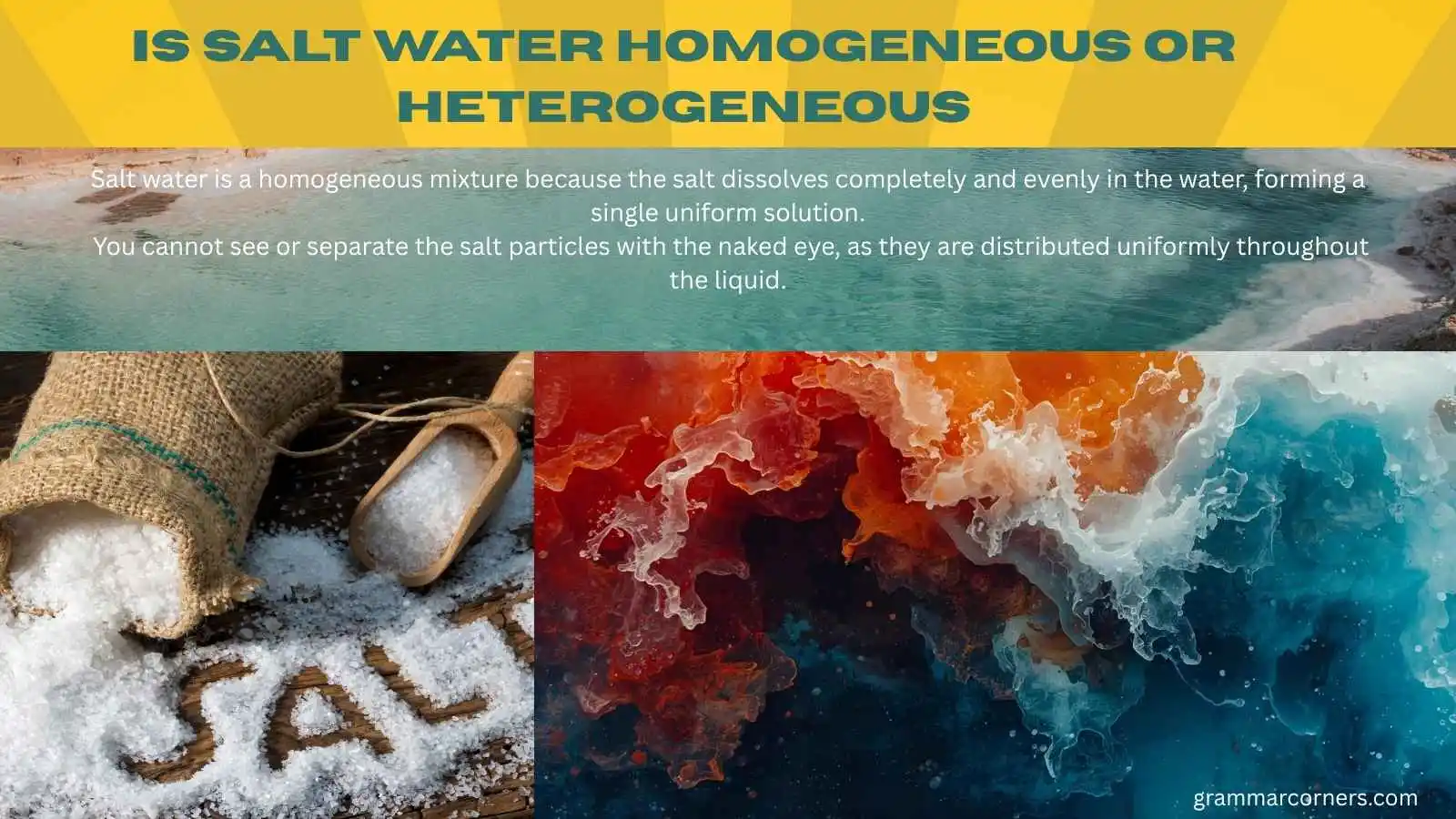
Is Salt Water Homogeneous or Heterogeneous?A Science Guide
Have you ever looked at the ocean and wondered, “Is salt water homogeneous or heterogeneous?” You’re not alone. Many students, teachers, and science enthusiasts search this question every day. The confusion comes from how salt seems to “disappear” in water — making people unsure whether it becomes one substance or stays mixed.
Understanding whether salt water is homogeneous or heterogeneous helps you learn how mixtures work in chemistry. In simple terms, it teaches how substances combine, separate, and interact. Since both “homogeneous” and “heterogeneous” are common terms in science, it’s easy to mix them up.
In this article, we’ll explore what these terms mean, the science behind salt water, and how it compares in real life. By the end, you’ll know exactly which type of mixture salt water is — and why!
🌊 What Are Homogeneous and Heterogeneous Mixtures?
🔹 Homogeneous Mixtures
Homogeneous mixtures have a uniform composition throughout. Their components are evenly distributed, making them indistinguishable from one another. Examples include:
- Salt water
- Vinegar
- Air
🔹 Heterogeneous Mixtures
Heterogeneous mixtures contain visibly different substances or phases. Their composition varies from one part to another. Examples include:
- Salad
- Sand and water
- Trail mix
💧 Why Is Salt Water Considered Homogeneous?
🔹 Complete Dissolution
When salt dissolves in water, it breaks into sodium and chloride ions. These ions disperse uniformly, making the solution consistent throughout.
🔹 No Visible Separation
Unlike heterogeneous mixtures, salt water does not show any visible separation between its components. Every sample taken from the solution has the same ratio of salt to water.
🔹 Stable Composition
Unless the solution becomes saturated or additional substances are introduced, the composition of salt water remains stable and uniform.
🧠 Real-World Applications of Salt Water
🔹 Environmental Science
Salt water plays a crucial role in studying ocean salinity and its impact on marine ecosystems.
🔹 Engineering
It’s essential in desalination processes and water treatment technologies.
🔹 Education
Salt water serves as a foundational example in chemistry and physics curricula.
Is Salt Water Homogeneous or Heterogeneous? – Quick Answer
Salt water is a homogeneous mixture.
When salt (sodium chloride) dissolves in water, it spreads evenly throughout the liquid. Because of this even distribution, you cannot see or separate the salt by simple observation.
Example:
- Sea water is homogeneous because the salt is evenly dissolved.
- Muddy water, however, is heterogeneous because you can see particles floating.
So, salt water is homogeneous, not heterogeneous.
The Origin of the Terms “Homogeneous” and “Heterogeneous”
The words come from Greek roots:
- “Homo” means same.
- “Genos” means kind or type.
Together, “homogeneous” means of the same kind.
Similarly,
- “Hetero” means different.
So, “heterogeneous” means of different kinds.
Scientists began using these words in the 17th century to describe how substances mix. Over time, they became standard terms in chemistry and materials science.
British English vs American English Usage
Although both terms are scientific and universal, slight spelling and usage preferences exist between regions.
| Term | British English | American English | Notes |
|---|---|---|---|
| Homogeneous | Homogeneous | Homogeneous | Same spelling globally |
| Heterogeneous | Heterogeneous | Heterogeneous | Same spelling globally |
| Usage Example | “A homogeneous solution.” | “A homogeneous mixture.” | American English often uses “mixture.” |
Therefore, while the spelling is identical in both dialects, American science textbooks tend to use “mixture,” whereas British texts often use “solution.”
Which Term Should You Use?
If you are:
- A student: Use “homogeneous mixture” — it’s accurate and widely accepted in science.
- A teacher or writer: Prefer “homogeneous solution” for clarity in lessons or reports.
- From the US or UK: Both “homogeneous” and “heterogeneous” are correct and recognized worldwide.
So, no matter where you are, “salt water is a homogeneous mixture” remains the best and most precise explanation.
Common Mistakes with “Is Salt Water Homogeneous or Heterogeneous”
- Assuming visible clarity equals homogeneity:
Some believe that if water looks clear, it’s homogeneous — not always true! For example, sugar water is homogeneous, but oil in water isn’t. - Thinking all natural water is homogeneous:
Ocean water is homogeneous in small samples but can be slightly heterogeneous across large regions due to varying salinity. - Confusing solution vs mixture:
Every solution is a mixture, but not every mixture is a solution. Salt water is both. - Mixing up spelling:
Some people mistakenly write “homogenous” (missing the extra ‘e’). The correct form is homogeneous.
“Is Salt Water Homogeneous or Heterogeneous” in Everyday Examples
- In Science Classes: Teachers use salt water to explain how solutions form.
- In Labs: Students dissolve salt to study solubility and evaporation.
- In Real Life: Cooks use salt water for brining, where the salt stays evenly mixed.
- In Industry: Factories use saline solutions for chemical and cleaning processes.
Salt water, therefore, is a great real-world example of a homogeneous mixture used everywhere.
“Is Salt Water Homogeneous or Heterogeneous” – Google Trends & Usage Data
Google Trends shows that the question “Is salt water homogeneous or heterogeneous” is searched most often by students and educators in:
- United States
- India
- Philippines
- Nigeria
- United Kingdom
Interest peaks during exam seasons, especially in March–May and September–November.
| Country | Popular Term | Search Intent |
|---|---|---|
| USA | homogeneous | Academic queries |
| India | homogeneous mixture | School-level science |
| UK | salt solution | Chemistry courses |
| Canada | homogeneous or heterogeneous | General learning |
| Australia | homogeneous | Textbook searches |
FAQs
1. What does homogeneous mean?
It means evenly mixed, where the components cannot be easily separated.
2. What does heterogeneous mean?
It means unevenly mixed, where different parts are visible or can be separated.
3. Why is salt water homogeneous?
Because salt dissolves completely and spreads evenly through the water.
4. Can salt water ever be heterogeneous?
Yes, if it contains undissolved salt crystals or sand, it becomes heterogeneous.
5. Is ocean water always homogeneous?
Mostly yes, but large areas can vary slightly in salinity, making it semi-homogeneous.
6. What type of mixture is muddy water?
Muddy water is heterogeneous because particles are visible and unevenly distributed.
7. Is sugar water homogeneous too?
Yes, sugar water is another good example of a homogeneous mixture.
Conclusion
To sum up, when people ask, “Is salt water homogeneous or heterogeneous?”, the correct answer is homogeneous. Salt dissolves completely, forming a uniform mixture. You cannot see or separate the salt once it dissolves — that’s what makes it homogeneous.
Although the terms sound complex, they’re simple once you understand their meanings. “Homogeneous” means same throughout, while “heterogeneous” means different throughout. Whether you’re studying chemistry, cooking, or exploring nature, this knowledge helps you understand how substances combine and interact.
So next time you see the ocean or add salt to water, you’ll know the science behind it — it’s perfectly homogeneous!