Like or As: The Complete Grammar Guide to Using Them Correctly
Have you ever paused while writing a sentence and wondered whether to use “like” or “as”? You’re not alone! Many English learners — and even native speakers — get confused about which one to choose. This confusion happens because both words are used to make comparisons. However, they follow different grammar rules.
People often search for “like or as” when they want to sound more professional, accurate, and fluent in writing or speaking. Using the wrong word can make a sentence sound awkward or even incorrect. For example, should you say “He runs like a cheetah” or “He runs as a cheetah”?
This article will clearly explain the difference between “like” and “as”, how to use them correctly, and common mistakes to avoid. We’ll also show examples, trends, and grammar tips to make your writing smoother and more natural.
Like or As – Quick Answer
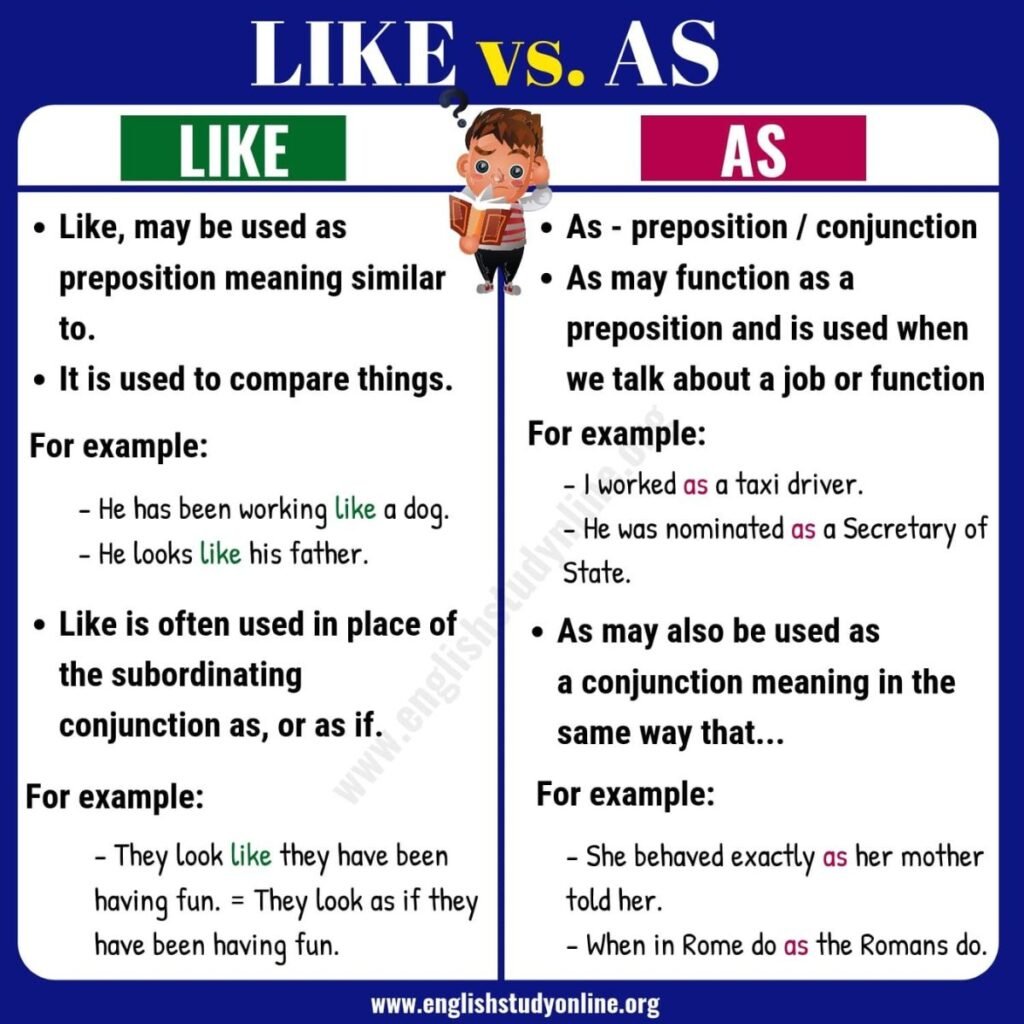
- Like → Used to compare nouns or pronouns.
- Example: She sings like an angel.
- As → Used to compare clauses (with verbs).
- Example: She sings as an angel would sing.
👉 Quick Tip:
Use “like” before a noun, and “as” before a clause (subject + verb).
| Word | Used With | Example |
|---|---|---|
| Like | Noun or pronoun | He runs like a lion. |
| As | Clause (subject + verb) | He runs as a lion does. |
The Origin of “Like” and “As”
The word “like” comes from Old English lician, meaning “similar” or “pleasing.” It has been used for centuries to compare people, things, or actions.
The word “as” originates from Old English alswa (meaning “also” or “in the same way”). Over time, it became a conjunction used to connect clauses that show comparison or equality.
Both words evolved differently but often overlap in modern speech, which is why many people confuse them.
British English vs American English Usage
Both British and American English use “like” and “as”, but there are slight preferences.
| Usage | British English | American English | Example |
|---|---|---|---|
| Formal writing | prefers “as” | flexible use of “like” | As I said before… |
| Informal speech | often uses “like” | frequently uses “like” | He talks like his dad. |
| Grammar rules | traditional | more relaxed | Americans may say “Do it like I did” instead of “as I did.” |
In short, Americans use “like” more often, even when “as” would be grammatically correct, especially in casual speech.
Which Should You Use?
✅ Use “like” when you are comparing nouns or pronouns only.
Example: He works like a machine.
✅ Use “as” when the comparison includes a verb or a clause.
Example: He works as his father taught him.
✅ For formal writing, “as” is safer and more grammatically correct.
✅ For casual speech, “like” sounds more natural and conversational.
If you’re writing for a global audience, follow grammar rules:
- “Like” → for nouns
- “As” → for clauses
Common Mistakes with Like or As
- ❌ He talks like he knows everything. → ✅ He talks as if he knows everything.
- ❌ Do it as me. → ✅ Do it like me.
- ❌ As a teacher, you must listen. → ✅ Correct if you are a teacher. Wrong if you mean “like a teacher.”
- ❌ He dances as a professional dancer. → ✅ He dances like a professional dancer.
👉 Tip: If there’s a verb after it, use “as.” If not, use “like.”
Like or As in Everyday Examples
- Emails: “As mentioned earlier, the meeting is at 10 AM.”
- News: “He fought like a hero during the crisis.”
- Social Media: “Feeling like a boss today!”
- Formal Writing: “As you know, the results were positive.”
- Conversation: “She sings like Adele.”
Like or As – Google Trends & Usage Data
According to Google Trends:
- “Like” is searched more often worldwide due to its informal and flexible use.
- “As” has steady interest in academic and business contexts.
- English learners often search “like or as grammar rule” to clarify the difference.
| Country | More Common | Context |
|---|---|---|
| USA | Like | Informal speech, pop culture |
| UK | As | Formal writing, education |
| Canada | Like | Balanced usage |
| India | As | Academic writing |
| Australia | Like | Casual conversation |
FAQs
1. What is the main difference between “like” and “as”?
“Like” compares nouns; “as” compares clauses with verbs.
2. Can I use “like” instead of “as”?
Sometimes, yes, in informal speech. But avoid it in formal writing.
3. Is “as if” the same as “like”?
No. “As if” introduces an imaginary situation, while “like” shows similarity.
4. Is “like” a preposition or conjunction?
“Like” is a preposition. “As” is usually a conjunction.
5. Which one is more common in daily English?
“Like” is more common in spoken English; “as” is used more in writing.
6. Can I start a sentence with “As”?
Yes. Example: As I mentioned earlier, we’ll meet tomorrow.
7. Is it wrong to say “Do it like I did”?
It’s acceptable in American English, but formal grammar prefers “as I did.”
Conclusion
The confusion between “like” and “as” is common but easy to fix. Both words compare things, yet they follow different grammar rules. Use “like” before a noun or pronoun and “as” before a clause or verb.
In formal writing, “as” keeps your grammar precise, while “like” works best in friendly and conversational settings. Additionally, understanding this difference improves clarity, professionalism, and fluency.
Remember: He runs like a cheetah, as his coach taught him. Once you learn the rule, using both words correctly will feel natural and effortless.