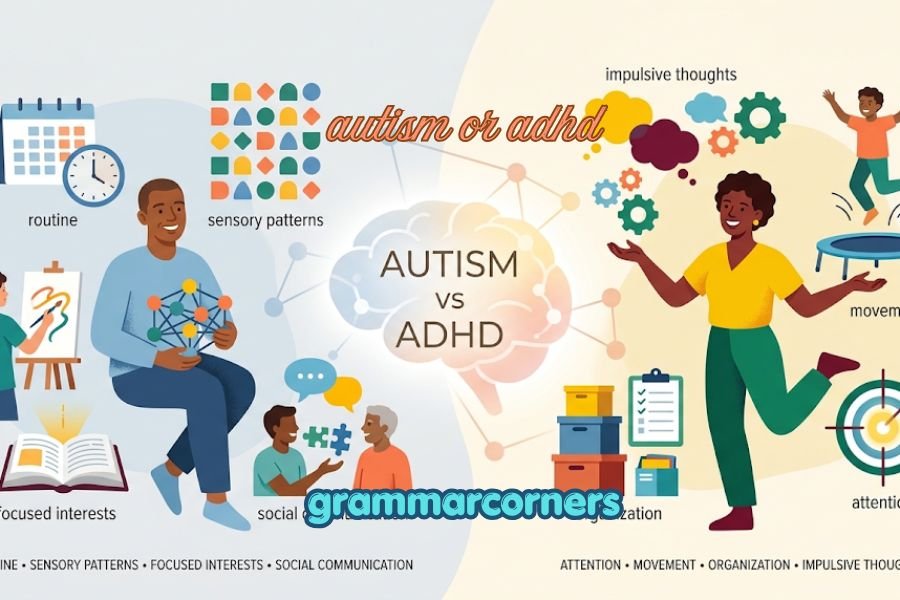
When a person struggles with focus, social situations, routines, or everyday tasks, it can be hard to know what is going on. Is it autism or ADHD? This is a common question from parents, adults, teachers, and people trying to understand their own experiences.
Autism and ADHD are both neurodevelopmental conditions, but they are not the same. Autism mainly affects social communication, interaction, behavior patterns, interests, and sensory experiences. ADHD mainly affects attention, activity level, and impulse control. However, the signs can overlap. Some people can also have both conditions.
People often search for “autism or ADHD” because some traits look similar. For example, both can affect school, work, friendships, organization, and daily life. Understanding the main differences can make the topic much easier to follow.
This guide explains autism or ADHD, their differences, their history, common mistakes, everyday usage, and frequently asked questions. It is educational information, not a diagnosis.
Autism or ADHD – Quick Answer
Autisms and ADHD are different neurodevelopmental conditions, but a person can have either one or both.
Autism, also called autism spectrum disorder (ASD), is linked to differences in social communication, interaction, restricted interests, repetitive behaviors, routines, and sensory experiences.
ADHD, or attention-deficit/hyperactivity disorder, is linked to ongoing patterns of inattention, hyperactivity, and impulsivity. Some people mainly have inattentive symptoms, while others have hyperactive-impulsive symptoms or both.
| Feature | Autism | ADHD |
|---|---|---|
| Main area | Social communication, behavior, interests, and sensory differences | Attention, activity, and impulse control |
| Focus | May become deeply focused on special interests | May have difficulty staying focused or may shift attention often |
| Routine | Changes may feel difficult | Organization and routines may be difficult to maintain |
| Social interaction | Differences in reading or using social cues may occur | Impulsivity or inattention may affect conversations |
| Repetitive behavior | Repetitive movements or behaviors may occur | Repetitive actions may happen, but they are not a core diagnostic feature |
| Sensory differences | Common | Can occur but are not a core ADHD feature |
| Can occur together? | Yes | Yes |
The key point is simple: similar behavior does not always mean the same condition.
The Origin of Autism or ADHD
The words autism and ADHD have different histories.
The word autism comes from the Greek word autos, meaning “self.” The term developed in medical language in the early 20th century and later became associated with the modern understanding of autism spectrum disorder.
The term ADHD is an abbreviation for attention-deficit/hyperactivity disorder. Its name describes the main areas of difficulty: attention, hyperactivity, and impulsivity.
There is no spelling difference between “autism” and “ADHD” based on British versus American English. The difference is mainly in the terminology and abbreviation used to describe each condition.
Modern medical sources describe autism as a neurological and developmental disorder and ADHD as a developmental disorder involving persistent inattention, hyperactivity, and/or impulsivity.
It is also important to remember that medical terms can change over time. Older books may use terms that are no longer the preferred diagnostic terminology.
British English vs American English Spelling
Unlike words such as colour/color or realised/realized, autism has the same spelling in British and American English.
Likewise, the abbreviation ADHD is the same in both forms of English.
The full term is:
- American English: attention-deficit/hyperactivity disorder
- British English: attention deficit hyperactivity disorder is also commonly used, with differences in punctuation and style possible.
- Abbreviation: ADHD
Comparison Table
| Term | American English | British English |
|---|---|---|
| Autism | autism | autism |
| Autism spectrum disorder | autism spectrum disorder | autism spectrum disorder |
| ADHD | ADHD | ADHD |
| Full ADHD term | attention-deficit/hyperactivity disorder | attention deficit hyperactivity disorder |
| Main spelling difference | None | None |
So, if you are searching for the correct spelling, autism and ADHD are both correct.
Which Spelling Should You Use?
Use autism and ADHD regardless of whether your audience is American, British, Canadian, Australian, or international.
For US audiences, ADHD is the standard abbreviation.
For UK and Commonwealth audiences, ADHD is also widely understood.
If you are writing for a medical, academic, or professional audience, follow the style guide used by your organization. Keep the terminology consistent throughout your article.
For general writing, these forms are safe:
- “Autism can affect social communication.”
- “ADHD can affect attention and impulse control.”
- “Some people have both autism and ADHD.”
- “Autism spectrum disorder is often shortened to ASD.”
- “Attention-deficit/hyperactivity disorder is usually shortened to ADHD.”
Common Mistakes with Autism or ADHD
Mistake 1: Thinking autism and ADHD are the same
Incorrect idea: Autism is simply another name for ADHD.
Better: Autism and ADHD are different conditions with different core features.
Mistake 2: Assuming poor attention always means ADHD
Many things can affect attention. Sleep problems, stress, anxiety, depression, and other conditions can cause symptoms that look similar to ADHD.
Mistake 3: Assuming social difficulty always means autism
Social problems can have many causes. Autism involves a broader pattern that includes social communication differences and restricted or repetitive behaviors or interests.
Mistake 4: Thinking a person cannot have both
A person can have both autism and ADHD. Research has found substantial overlap between the two conditions.
Mistake 5: Trying to diagnose yourself from one symptom
One behavior is not enough for a diagnosis. Professionals look at patterns, history, development, and how symptoms affect everyday life.
Autism or ADHD in Everyday Examples
The phrase “autism or ADHD” often appears in questions and informal conversations.
In an Email
“We are trying to understand whether the child’s difficulties may relate to autism or ADHD and would like to discuss an evaluation.”
In News Writing
“Researchers continue to study how autism and ADHD can overlap.”
On Social Media
“I have been learning about autism or ADHD because some of the traits sound familiar.”
In Formal Writing
“Autism spectrum disorder and attention-deficit/hyperactivity disorder are distinct neurodevelopmental conditions that may share some features.”
In Everyday Conversation
“Could this be autism or ADHD?”
That question is understandable, but only a qualified professional can determine whether someone meets diagnostic criteria.
Autism or ADHD – Google Trends & Usage Data
“Autism or ADHD” is a useful search phrase because people often want to compare the two conditions. Searches can come from parents, educators, adults, caregivers, and people researching symptoms.
Search interest can change over time because of:
- Increased public awareness
- New research
- Social media discussions
- Changes in diagnostic awareness
- School and workplace discussions
- Interest in adult diagnosis
- New information about overlapping traits
Google Trends interest also varies by country and time. A search term may become more popular after a major news story, research publication, or viral social-media discussion.
For reliable health information, search popularity should not be confused with medical importance. Search volume does not tell us whether a person has autism or ADHD.
Current NIMH information describes autism as a spectrum with a wide range of characteristics and ADHD as a condition involving persistent patterns of inattention, hyperactivity, and/or impulsivity.
Autism vs ADHD: Side-by-Side Comparison
| Question | Autism | ADHD |
|---|---|---|
| What is it? | A neurodevelopmental condition | A neurodevelopmental condition |
| Common core traits | Social communication differences, restricted interests, repetitive behaviors | Inattention, hyperactivity, impulsivity |
| Can attention be unusual? | Yes | Yes, especially difficulty regulating attention |
| Can social problems occur? | Yes | Yes |
| Can sensory differences occur? | Yes, commonly reported | They may occur, but they are not a core diagnostic feature |
| Can routines matter? | Changes in routine may be difficult | Organization and routine can be difficult |
| Can adults have it? | Yes | Yes |
| Can someone have both? | Yes | Yes |
| Is one symptom enough for diagnosis? | No | No |
The overlap explains why the question “autism or ADHD?” can be difficult to answer from symptoms alone.
FAQs About Autism or ADHD
1. Is autism the same as ADHD?
No. Autism and ADHD are separate neurodevelopmental conditions. Their symptoms can overlap, but their core features are different.
2. Can someone have autism and ADHD?
Yes. A person can have both conditions. Research has documented significant co-occurrence between autism and ADHD.
3. Which is more common, autism or ADHD?
The answer depends on the age group, country, study, and diagnostic methods. Prevalence estimates should be compared carefully rather than using one number for every population. NIMH publishes current US autism prevalence information based on CDC surveillance data.
4. Can ADHD look like autism?
Some ADHD traits can overlap with autistic traits, especially in areas such as social interaction, organization, attention, and behavior. However, the underlying diagnostic patterns are different.
5. Can autism look like ADHD?
Some autistic people may have difficulty with attention, transitions, or sitting still. These behaviors can sometimes look similar to ADHD. A professional evaluation looks at the full pattern.
6. Can adults have autism or ADHD?
Yes. Both conditions can be diagnosed in adults. ADHD symptoms must have begun during childhood, even when the diagnosis happens later.
7. How can I know whether I have autism or ADHD?
A qualified healthcare professional can perform an evaluation. For ADHD, assessment may include clinical interviews, symptom checklists, medical history, and information about childhood behavior. Autism evaluations may examine social communication, repetitive behaviors, sensory experiences, and developmental history.
Conclusion
The question “autism or ADHD?” is common because the two conditions can share some traits. Both can affect school, work, relationships, organization, and everyday life. However, they are different neurodevelopmental conditions.
Autism is mainly associated with differences in social communication and interaction, restricted interests, repetitive behaviors, routines, and sensory experiences. ADHD is mainly associated with persistent difficulties involving attention, hyperactivity, and impulsivity.
A person can also have both autism and ADHD, which can make the picture more complex.
There is no British-versus-American spelling issue with autism or ADHD. Both terms are spelled the same in standard English.
If you are concerned about yourself or someone else, avoid making a diagnosis from a single symptom or online checklist. A qualified professional can consider developmental history, current behavior, and daily functioning to provide a proper evaluation.