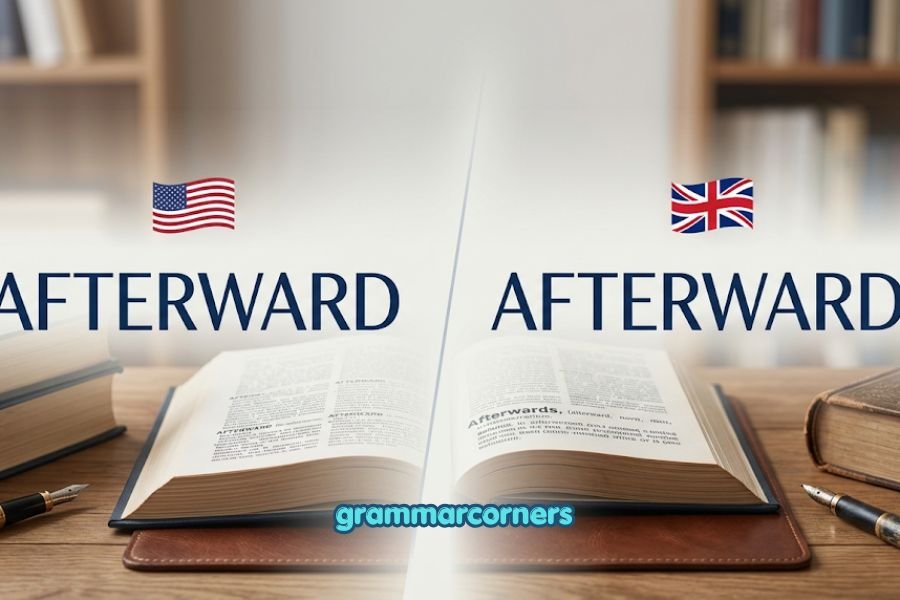
Choosing between afterwards or afterward can feel tricky because both words are correct. The good news is that the difference is simple: afterwards is more common in British English, while afterward is more common in American English. Both words mean “at a later time” or “after something happens.” For example, you can say, “We went for coffee afterwards” or “We went for coffee afterward.”
People often search for afterwards or afterward because the two forms look almost identical. The extra s can make writers wonder if one spelling is wrong. It is not. The choice mainly depends on the type of English you use and your audience.
This guide explains the meaning, history, spelling, and everyday use of both forms. It also shows which version works best in American, British, and international English. By the end, you will know which spelling to choose and how to use it with confidence.
Afterwards or Afterward – Quick Answer
Both afterwards and afterward are correct.
They have the same meaning:
afterwards/afterward = at a later time; after something has happened
The main difference is regional usage:
- Afterwards → more common in British English
- Afterward → more common in American English
- Both → understood and accepted in both varieties
Oxford lists afterwards as especially British and says North American English usually uses afterward.
Examples
British English:
- We went home afterwards.
- She felt tired afterwards.
- We had dinner and talked afterwards.
American English:
- We went home afterward.
- She felt tired afterward.
- We had dinner and talked afterward.
There is no difference in meaning. The choice is mostly about regional style.
The Origin of Afterwards or Afterward
The word has a long history in English.
Afterwards comes from an older form related to after and the suffix -wards. Oxford traces afterwards to Old English æftewearde, from æftan (“aft”), with influence from after.
The ending -wards is used to show movement or direction in time or space. We see the same pattern in words such as:
- towards
- backwards
- forwards
- homewards
- afterwards
Over time, afterward developed as a shorter form without the final s.
Both forms became established in English. Today, the difference is mainly regional rather than grammatical.
Cambridge identifies afterwards as mainly British and afterward as the usual American form.
So, the extra s does not make afterwards wrong. It is simply part of the spelling preferred in many British English contexts.
British English vs American English Spelling
The biggest difference is regional preference.
| Feature | British English | American English |
|---|---|---|
| Common spelling | afterwards | afterward |
| Meaning | At a later time | At a later time |
| Grammar | Adverb | Adverb |
| Correct? | Yes | Yes |
| Typical example | We left afterwards. | We left afterward. |
| Common in formal writing | Yes | Yes |
| Other form understood? | Yes | Yes |
Cambridge states that afterwards is the UK spelling, while afterward is the US spelling.
More examples
| British English | American English |
|---|---|
| I’ll call you afterwards. | I’ll call you afterward. |
| We went shopping afterwards. | We went shopping afterward. |
| She apologized afterwards. | She apologized afterward. |
| What happened afterwards? | What happened afterward? |
| They met again shortly afterwards. | They met again shortly afterward. |
Neither version changes the meaning of the sentence.
Which Spelling Should You Use?
The best choice depends on your audience.
If You Write for a US Audience
Use afterward.
Examples:
- I’ll speak to you afterward.
- We went out for dinner afterward.
- She called me afterward.
This form matches normal American English usage.
If You Write for a UK Audience
Use afterwards.
Examples:
- I’ll speak to you afterwards.
- We went out for dinner afterwards.
- She called me afterwards.
This is the more natural British English choice.
If You Write for Commonwealth Audiences
Afterwards is generally a safe choice in British-influenced varieties of English.
For example, it is common in writing influenced by British English in places such as Australia and New Zealand.
If You Write for a Global Audience
Either form is correct. The most important rule is consistency.
If your website uses American English, use afterward throughout. If it uses British English, use afterwards throughout.
Common Mistakes with Afterwards or Afterward
Mistake 1: Thinking one spelling is wrong
Incorrect idea:
“Afterwards is always wrong because afterward is the correct spelling.”
This is false.
Both spellings are correct.
Mistake 2: Mixing styles without a reason
You might write:
We went home afterwards. We talked about it afterward.
The sentence is not grammatically wrong, but switching forms can make your writing look inconsistent.
Better:
British style:
We went home afterwards. We talked about it afterwards.
American style:
We went home afterward. We talked about it afterward.
Mistake 3: Using “after” when “afterwards” is needed
Cambridge notes that afterwards is commonly used as an adverb, while after can also be used as an adverb in some contexts.
For example:
We had dinner and went home afterwards.
This clearly means that going home happened later.
Mistake 4: Confusing “afterward” with “afterword”
These words are different.
- Afterward = later
- Afterword = a section at the end of a book
Example:
We talked about the book afterward.
But:
The author wrote an afterword for the new edition.
Oxford defines afterword as a section at the end of a book.
Afterwards or Afterward in Everyday Examples
Both forms work naturally in everyday English.
In Emails
British English:
Thank you for the meeting. I will send the documents afterwards.
American English:
Thank you for the meeting. I will send the documents afterward.
In News Writing
British style:
The team won the match and celebrated afterwards.
American style:
The team won the game and celebrated afterward.
On Social Media
British style:
We had such a great time and grabbed coffee afterwards!
American style:
We had such a great time and grabbed coffee afterward!
In Formal Writing
Both forms are acceptable:
The study was published and was widely discussed afterwards.
or:
The study was published and was widely discussed afterward.
For very formal writing, subsequently can sometimes be used instead. Oxford defines subsequently as meaning “afterwards” or “later,” and marks it as formal.
Afterwards or Afterward – Google Trends & Usage Data
Google Trends can show search interest by location and time, but it should not be treated as a complete measure of how often a word is used in everyday speech or writing.
For afterwards or afterward, the clearest pattern comes from major English dictionaries:
- Afterwards is mainly associated with British English.
- Afterward is usually associated with American English.
- Both forms are standard and widely understood.
- Regional preference is more important than correctness.
Cambridge explicitly labels afterwards as mainly UK and afterward as usually US.
This means writers should focus less on which form is “more correct” and more on which English variety they are writing.
Usage Comparison
| Word | Main association | Meaning | Best use |
|---|---|---|---|
| afterwards | UK/British English | Later | British-style writing |
| afterward | US/American English | Later | American-style writing |
| after | General English | Later than | Specific grammatical contexts |
| subsequently | Formal English | Later | Formal or academic writing |
| later | General English | At a later time | Everyday English |
Afterwards or Afterward: Comparison at a Glance
| Question | Afterwards | Afterward |
|---|---|---|
| Is it correct? | Yes | Yes |
| Is it an adverb? | Yes | Yes |
| Meaning | At a later time | At a later time |
| British English | Very common | Less common |
| American English | Used | More common |
| Formal writing | Correct | Correct |
| Informal writing | Correct | Correct |
| Spelling difference | Ends in -s | No final -s |
FAQs About Afterwards or Afterward
1. Is “afterwards” correct?
Yes. Afterwards is completely correct. It is especially common in British English.
2. Is “afterward” correct?
Yes. Afterward is correct and is especially common in American English.
3. What is the difference between afterwards and afterward?
There is no difference in meaning. Both mean at a later time. The main difference is regional preference.
4. Which is more common in American English?
Afterward is the usual American form. Cambridge and Oxford both identify it as the common North American form.
5. Which is more common in British English?
Afterwards is more common in British English. Cambridge describes it as mainly UK usage.
6. Can I use “afterwards” in American English?
Yes. Americans understand afterwards, and it is not an incorrect word. However, afterward is generally the more typical American choice.
7. Should I use “afterwards” or “afterward” in formal writing?
Either is correct. Choose the form that matches your English style guide and audience. The key is to remain consistent.
Conclusion
So, afterwards or afterward? The simple answer is that both are correct. They have the same meaning: at a later time or after something has happened.
The main difference is regional style. Afterwards is more common in British English, while afterward is more common in American English. Major dictionaries such as Oxford and Cambridge support this distinction.
If you write for American readers, afterward is usually the best choice. If you write for British readers, afterwards will sound more natural. For international readers, either spelling is clear.
The most important rule is consistency. Pick one form that matches your audience and use it throughout your article, website, email, or document.
Remember: afterwards is not wrong, and afterward is not wrong. The final s is mainly a matter of regional English style, not grammar. Once you know this, choosing the right form becomes easy.