If you have ever wondered whether the correct spelling is “dumby” or “dummy,” you are not alone. The two forms look similar, and the confusion often comes from the word “dumb.” Since dummy sounds like “dum-ee,” it can be tempting to write dumby based on pronunciation or the spelling of its root.
The good news is simple: “dummy” is the standard spelling in modern English. It is used for a model or imitation, a practice object, placeholder data, a crash-test figure, and, in informal language, a foolish person. Major dictionaries recognize dummy as the established form.
“Dumby” does appear occasionally, including as a rare historical or nonstandard variant, but it is not the spelling you should normally use in school, business, professional, or formal writing.
This guide explains the difference between dumby and dummy, where the word came from, how British and American English use it, common mistakes, and which spelling is best for your writing.
Dumby or Dummy – Quick Answer
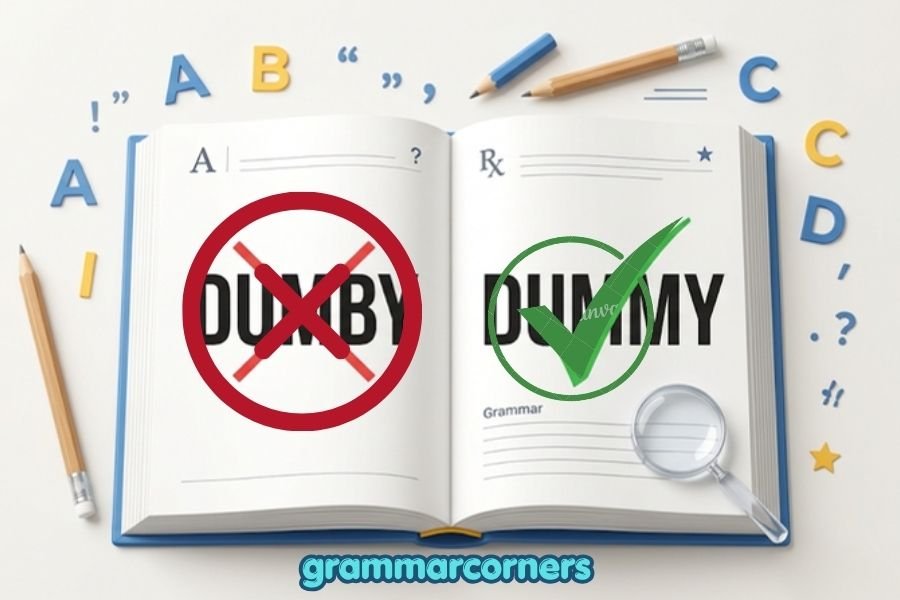
Dummy is the correct standard spelling.
- ✅ dummy — standard English spelling
- ❌ dumby — generally incorrect or nonstandard in modern English
Examples:
- ✅ The engineer tested the car with a dummy.
- ❌ The engineer tested the car with a dumby.
- ✅ This is a dummy account for testing.
- ❌ This is a dumby account for testing.
The word dummy can have several meanings. It can describe a model or imitation, such as a crash-test dummy. It can also mean a placeholder or something designed for practice. In informal speech, it can describe someone as foolish, although this use can sound insulting depending on context.
Quick comparison
| Spelling | Standard English? | Recommended? |
|---|---|---|
| dummy | Yes | ✅ Yes |
| dumby | Rare/nonstandard variant | ❌ Usually no |
| dumy | No | ❌ No |
| dummie | No for singular | ❌ No |
| dummies | Yes, plural of dummy | ✅ Yes |
Easy rule: If you mean the standard English word, choose dummy.
The Origin of Dumby or Dummy
The history of dummy helps explain why the spelling does not contain the b found in dumb.
Mummy—no, dummy—comes historically from dumb + -y. Merriam-Webster gives dumb as the root and lists the first known use of dummy as the late 16th century.
Etymonline dates the noun to the 1590s, originally referring to a person who could not speak. Later, the word developed additional meanings, including a figure representing a person and eventually an imitation or substitute object.
Over time, dummy developed many meanings:
- A person who could not speak — an older usage.
- A foolish person — an informal usage.
- A model or imitation.
- A crash-test figure.
- A practice or training object.
- A fake or nonfunctional object.
- Placeholder information in computing or design.
- A pacifier in British English.
Why isn’t it spelled “dumby”?
The spelling can seem strange because dummy is historically connected with dumb. However, English spelling and pronunciation have changed over time.
The b in dumb is silent, and dummy became established as its own spelling. The form dumby has existed historically, but it is now rare and should not normally replace dummy.
British English vs American English Spelling
There is no major British-versus-American spelling difference between dummy and dumby.
Both British and American English normally use:
dummy
Cambridge Dictionary gives the same spelling and pronunciation for British and American English.
The bigger difference is sometimes meaning, not spelling.
For example, in British English, dummy can mean a baby’s pacifier. In American English, pacifier is normally used for this object.
British vs American comparison
| Feature | British English | American English |
|---|---|---|
| Standard spelling | dummy | dummy |
| “Dumby” | Generally nonstandard | Generally nonstandard |
| Model/mannequin | dummy | dummy |
| Crash-test figure | dummy | dummy |
| Foolish person | dummy | dummy |
| Baby’s pacifier | dummy | pacifier |
| Plural | dummies | dummies |
So, unlike words such as colour/color or centre/center, dummy does not normally change spelling between British and American English.
Which Spelling Should You Use?
For almost every situation, use dummy.
If you write American English
Use dummy:
The company created a dummy account for testing.
Engineers placed a crash-test dummy inside the vehicle.
If you write British English
Use dummy as well:
The shop displayed the clothes on a dummy.
The baby dropped its dummy.
For international English
Dummy is the safest choice because it is the standard dictionary spelling across major varieties of English.
If you are writing for an international audience, avoid dumby unless you are deliberately reproducing a name, quotation, historical text, or unusual spelling.
Common Mistakes with Dumby or Dummy
The most common mistake is adding b because of the relationship between dummy and dumb.
Mistake 1: Writing “dumby”
❌ He used a dumby account.
✅ He used a dummy account.
Mistake 2: Writing “dumy”
❌ The company created a dumy version.
✅ The company created a dummy version.
Mistake 3: Using “dummie” as the singular
❌ The child dropped his dummie.
✅ The child dropped his dummy.
The plural, however, is:
✅ dummies
For example:
The store has several dummies in the window.
Mistake 4: Confusing “dummy” and “dumb”
Dumb and dummy are related words, but they are not interchangeable.
- dumb → usually an adjective
- dummy → commonly a noun or adjective
Examples:
That was a dumb mistake.
The engineer used a dummy model.
Mistake 5: Assuming “dumby” is the British spelling
It is not. British English also uses dummy as the normal spelling.
Dumby or Dummy in Everyday Examples
Here are practical examples showing how dummy should be used.
In emails
Please use the dummy account to test the new software.
A In business
The team prepared a dummy report before creating the final version.
A In technology
We used dummy data while developing the application.
In education
The teacher provided a dummy example so students could understand the process.
The news in writing
Investigators found that the device was a dummy rather than a functioning unit.
In social media
I created a dummy account to test the new feature.
A In formal writing
The researchers used a dummy variable in their statistical model.
In safety testing
The vehicle was tested using a crash-test dummy.
The word therefore appears in many fields, including technology, business, statistics, publishing, education, sports, and safety testing.
Dumby or Dummy – Google Trends & Usage Data
Search interest can help explain why people encounter both spellings online, but there is an important limitation: Google Trends does not provide an absolute number of searches. Its data are normalized on a relative scale, where the highest point within the selected comparison is represented by 100.
For the spelling question “dumby or dummy,” the practical pattern is clear:
- Dummy is the established dictionary spelling.
- Dumby has much more limited usage and is generally encountered as a spelling variant, historical form, username, name, or mistake.
- Searches for dummy can represent many different meanings, including crash-test dummies, mannequins, dummy data, dummy accounts, sports, pacifiers, and informal references to people.
- Search interest can therefore vary by country and context rather than representing one single meaning.
There are also examples of regional usage differences in the meaning of dummy. For instance, dummy is commonly used for a baby’s pacifier in British English, while American English generally uses pacifier.
A 2024 discussion of the word dummy also documented a noticeable Google Trends spike in Bangladesh when the term became prominent in political discussion, illustrating how context can dramatically affect search interest.
SEO takeaway
If your goal is to target the spelling question, use the main keyword naturally:
“dumby or dummy”
But throughout the article, product descriptions, educational content, and professional writing, use dummy as the standard form.
Comparison Table: Dumby vs Dummy
| Word | Correct Standard Spelling? | Meaning | Best Use |
|---|---|---|---|
| dummy | ✅ Yes | Model, imitation, placeholder, or foolish person | Standard writing |
| dumby | ⚠️ Rare/nonstandard | Historical or alternative form | Avoid normally |
| dumy | ❌ No | Misspelling | Avoid |
| dummie | ❌ Usually no | Common spelling error | Avoid |
| dummies | ✅ Yes | Plural of dummy | Standard plural |
FAQs About Dumby or Dummy
1. Is “dumby” or “dummy” correct?
Dummy is the standard and recommended spelling. Dumby is rare and should generally be treated as a nonstandard or historical variant.
2. Is “dumby” a real word?
It has appeared as a rare alternative form of dummy, including in historical sources, but it is not the normal modern spelling.
3. Why is “dummy” spelled without the b?
Although dummy is historically related to dumb, the established modern spelling is dummy. English spelling does not always preserve every letter of a word’s historical root.
4. Is “dummy” correct in British English?
Yes. Dummy is the standard British spelling. British English also uses dummy for a baby’s pacifier, while American English generally uses pacifier.
5. Is “dummy” correct in American English?
Yes. Dummy is the standard American spelling.
6. What is the plural of dummy?
The plural is dummies.
For example:
The store displayed several dummies.
7. Should I use “dumby” in formal writing?
No. Use dummy in essays, business documents, websites, emails, reports, and other professional writing unless Dumby is intentionally being used as a proper name or quoted material.
Conclusion
When choosing between dumby or dummy, the answer is straightforward: dummy is the correct standard spelling in modern English. It is the form you should use in school assignments, professional documents, websites, emails, technical writing, and everyday communication.
The confusion mainly comes from the word’s historical connection with dumb. Because dumb contains a silent b, writers may assume that dummy should also contain a b. However, the established spelling is dummy, not dumby. Major dictionaries recognize dummy and give it a wide range of meanings, from a model or imitation to a crash-test figure, placeholder, or informal description of a foolish person.
British and American English generally agree on the spelling. Their main difference is that British English can use dummy to mean a baby’s pacifier, while American English normally uses pacifier.
So remember the simple rule: dummy = standard; dumby = usually incorrect.