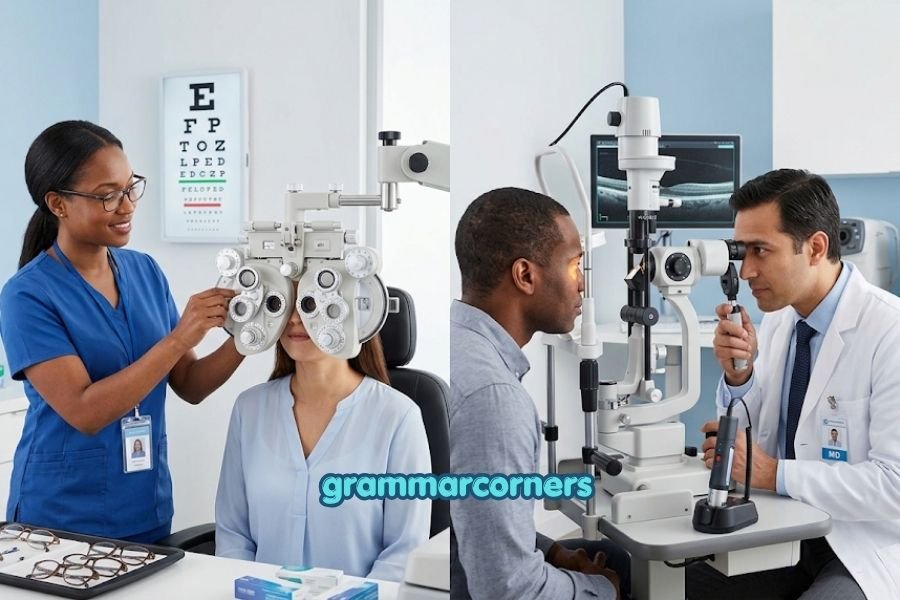
When you need eye care, one question often causes confusion: should you see an optometrist or ophthalmologist? Both professionals care for your eyes, but their training, roles, and scope of practice are different. Knowing the difference can help you choose the right professional for a routine eye exam, glasses or contact lenses, an eye disease, or surgery.
An optometrist is an eye-care professional who examines vision and eye health and, depending on local laws, diagnoses and treats many eye conditions. An ophthalmologist is a medical doctor who specializes in eye care and can provide medical and surgical treatment.
People commonly search for “optometrist or ophthalmologist” because the names sound similar and both may be called “eye doctors.” The right choice depends on your symptoms, diagnosis, location, and the type of care you need. This guide explains the difference in simple terms and helps you understand when each professional may be appropriate.
Optometrist or Ophthalmologist – Quick Answer
The simplest answer is:
- Optometrist: Provides eye exams, checks vision and eye health, prescribes glasses and contact lenses, and can diagnose and manage many eye conditions. The exact scope of treatment varies by jurisdiction.
- Ophthalmologist: A medical doctor specializing in the eyes who can diagnose and treat eye diseases and perform eye surgery.
Quick examples
| Your need | Usually appropriate |
|---|---|
| Routine eye examination | Optometrist |
| New glasses prescription | Optometrist |
| Contact lenses | Optometrist |
| Checking for glaucoma | Optometrist or ophthalmologist |
| Cataract evaluation | Optometrist or ophthalmologist |
| Complex eye disease | Ophthalmologist |
| Eye surgery | Ophthalmologist |
| Serious eye injury | Ophthalmologist or emergency eye service |
The exact roles can differ between countries and even between regions. For example, UK guidance describes optometrists as professionals who examine eyes, detect abnormalities, prescribe lenses, and refer patients when specialist treatment is needed.
The Origin of Optometrist or Ophthalmologist
The two words come from different roots but both relate to the eyes.
Optometrist comes from Greek roots associated with opsis/optos, meaning sight or vision, and metron, meaning measure. The word reflects the professional’s role in examining and measuring vision.
Ophthalmologist comes from Greek ophthalmos, meaning “eye,” combined with -logist, referring to someone who studies or specializes in a field.
The words developed to describe different areas of eye care. Over time, healthcare systems established different professional roles for people who examine vision, manage eye conditions, and perform medical or surgical treatment.
Today, an optometrist and ophthalmologist may work together. For example, an optometrist may discover an abnormality during an eye examination and refer the patient to an ophthalmologist for specialized medical or surgical care. Moorfields Eye Hospital describes this type of collaborative care between optometrists and ophthalmologists.
British English vs American English Spelling
Unlike spelling pairs such as colour/color or realised/realized, there is generally no major British-versus-American spelling difference between optometrist and ophthalmologist.
The standard spellings are:
- optometrist
- ophthalmologist
Both terms are used in British and American English.
However, the meaning and professional role can differ by healthcare system. In the UK, for example, optometrists commonly provide sight tests and may refer patients to hospital eye services when necessary. Ophthalmologists are medical doctors specializing in eye care and surgery.
| Term | American English | British English |
|---|---|---|
| Optometrist | Optometrist | Optometrist |
| Ophthalmologist | Ophthalmologist | Ophthalmologist |
| Eye doctor | Common informal term | Common informal term |
| Optician | Often means dispensing professional | Can refer to an optical practice or dispensing optician |
| Eye surgeon | Usually ophthalmologist | Usually ophthalmologist |
Important spelling point
The spelling “opthamologist” is a common misspelling of ophthalmologist.
The correct spelling contains phth:
O-P-H-T-H-A-L-M-O-L-O-G-I-S-T
Which Spelling Should You Use?
If you are writing for a general English-speaking audience, use:
optometrist and ophthalmologist
These spellings are accepted in both American and British English.
For American audiences
Use optometrist for an optometry professional and ophthalmologist for a medical doctor specializing in eye care.
For British audiences
The same spellings are correct. However, be aware that the UK healthcare system uses related terms such as optometrist, ophthalmologist, ophthalmic practitioner, and dispensing optician for different roles.
For global content
If you are writing a website, article, or health guide for an international audience, explain the difference rather than assuming the terms mean exactly the same thing everywhere.
Common Mistakes with Optometrist or Ophthalmologist
Several mistakes appear frequently when people use these words.
1. Writing “opthamologist”
❌ Opthamologist
✅ Ophthalmologist
The correct spelling includes phth.
2. Assuming an optometrist only sells glasses
This is outdated and incomplete. Optometrists can perform eye examinations and, depending on jurisdiction, diagnose, treat, and manage various eye conditions.
3. Assuming every eye problem requires an ophthalmologist
Not necessarily. An optometrist can provide comprehensive eye examinations and may manage many common vision and eye-health problems. They can also refer patients to an ophthalmologist when specialist medical or surgical treatment is needed.
4. Using “optician” and “optometrist” as exact synonyms
They are not always the same profession. In the UK, for example, a dispensing optician primarily helps fit and dispense glasses and contact lenses and does not perform eye tests in the same role.
5. Thinking an eye screening replaces a comprehensive exam
A basic vision screening does not necessarily provide the same assessment as a comprehensive eye examination. Comprehensive examinations can evaluate both vision and eye health.
Optometrist or Ophthalmologist in Everyday Examples
Understanding how these terms appear in real writing makes them easier to use correctly.
A In an email
“I have scheduled an appointment with an optometrist for a comprehensive eye examination.”
In a medical context
“The optometrist detected an abnormality and referred the patient to an ophthalmologist.”
In a news article
“The ophthalmologist performed surgery to treat the patient’s serious eye condition.”
On social media
“I finally visited an optometrist for a new glasses prescription.”
In formal writing
“Patients with suspected complex eye disease may require assessment by an ophthalmologist.”
In everyday conversation
“I need to see an eye doctor.”
“Eye doctor” is a general phrase. If you need to be precise, use optometrist or ophthalmologist depending on the professional involved.
Optometrist or Ophthalmologist – Google Trends & Usage Data
Search interest for “optometrist” and “ophthalmologist” can vary by country, healthcare system, and the reason people are searching.
Generally, optometrist is a common consumer-facing term because people search for optometrists for routine eye exams, prescriptions, and contact lenses. In the United States, the American Optometric Association describes doctors of optometry as primary eye-care providers.
Ophthalmologist tends to appear more often in searches involving medical eye conditions, specialist care, and surgery. The American Academy of Ophthalmology describes ophthalmologists as eye doctors with advanced medical and surgical training.
Search patterns also differ geographically. In the UK, people may encounter terms such as optometrist, ophthalmologist, and optician, reflecting differences in the healthcare system and professional roles.
SEO note: Google Trends interest changes over time and depends on the country, date range, and search category selected. It should be treated as a relative measure of search interest rather than an exact count of searches.
Optometrist vs Ophthalmologist: Comparison Table
| Feature | Optometrist | Ophthalmologist |
|---|---|---|
| Eye examinations | Yes | Yes |
| Vision testing | Yes | Yes |
| Glasses prescriptions | Yes | Yes |
| Contact lenses | Yes | Yes |
| Detects eye disease | Yes | Yes |
| Treats many eye conditions | Yes, depending on local scope | Yes |
| Medical doctor | Depends on country; in the U.S., an OD is a doctor of optometry rather than an MD/DO | Yes |
| Performs eye surgery | Limited/depends on jurisdiction | Yes |
| Handles complex surgical conditions | Usually refers | Yes |
| Can refer patients to specialists | Yes | Yes |
| Common role | Primary eye and vision care | Medical and surgical eye care |
The scope of optometry varies by jurisdiction, so patients should check the rules and services available where they live. In the U.S., the AOA states that doctors of optometry examine, diagnose, treat, and manage eye diseases and disorders, while ophthalmologists have medical and surgical training.
When Should You See an Optometrist?
An optometrist may be a good starting point when you need:
- A routine comprehensive eye exam
- A new glasses prescription
- Contact-lens evaluation
- Assessment of blurry vision
- Evaluation of common vision problems
- Eye-health monitoring
- Assessment for certain eye diseases
Optometrists can also identify abnormalities and refer patients when additional specialist care is needed.
When Should You See an Ophthalmologist?
An ophthalmologist is particularly important when you need medical or surgical eye care.
Examples include:
- Cataract surgery
- Complex glaucoma treatment
- Retinal disease
- Serious eye injuries
- Certain eye infections or inflammatory conditions
- Complex eye disease
- Surgical treatment
- Specialist evaluation following a referral
Ophthalmologists are medical doctors trained to diagnose and treat eye conditions and perform eye surgery.
If you experience sudden vision loss, new flashes or a curtain-like shadow in your vision, severe eye pain, or a significant eye injury, seek urgent medical attention rather than waiting for a routine appointment. NHS guidance lists sudden visual changes and severe eye symptoms among situations that can indicate serious eye problems.
FAQs About Optometrist or Ophthalmologist
1. Is an optometrist the same as an ophthalmologist?
No. They are different eye-care professions. An optometrist provides eye and vision care, while an ophthalmologist is a medical doctor specializing in medical and surgical eye care.
2. Is an optometrist a doctor?
This depends on the country and professional qualification. In the United States, optometrists earn a Doctor of Optometry (OD) degree. They are doctors of optometry, but they are distinct from medical doctors such as ophthalmologists.
3. Should I see an optometrist or ophthalmologist for glasses?
For a routine glasses prescription, an optometrist is commonly an appropriate choice. An ophthalmologist can also examine your eyes and prescribe corrective lenses.
4. Who should I see for cataracts?
An optometrist can identify or monitor cataracts and may refer you to an ophthalmologist. An ophthalmologist provides medical and surgical treatment, including cataract surgery.
5. Who is better for glaucoma?
Neither is simply “better.” An optometrist may detect and manage glaucoma depending on local scope and the patient’s needs, while an ophthalmologist can provide specialist medical and surgical treatment. Your symptoms and diagnosis determine the appropriate professional.
6. Is “ophthalmologist” spelled correctly?
Yes. Ophthalmologist is the correct spelling. Opthamologist is a common misspelling.
7. Can an optometrist refer me to an ophthalmologist?
Yes. Referrals are a normal part of eye care. When an optometrist identifies a problem requiring specialist medical or surgical treatment, they may refer the patient to an ophthalmologist.
Conclusion
Choosing between an optometrist or ophthalmologist becomes easier once you understand their different roles. An optometrist commonly provides comprehensive eye examinations, vision testing, corrective-lens prescriptions, and diagnosis or management of many eye conditions. An ophthalmologist is a medical doctor with specialized training in eye care who can provide medical treatment and perform eye surgery.
For routine vision care, glasses, contact lenses, and many eye-health checks, an optometrist may be an appropriate first choice. If you have a complex eye condition, need surgery, or require specialized medical treatment, an ophthalmologist may be the right professional.
However, professional roles differ between countries and local regulations. The UK, for example, has specific roles for optometrists, ophthalmologists, and dispensing opticians.
Most importantly, do not ignore significant changes in your vision. A comprehensive eye examination can help detect problems that may not cause obvious symptoms. When in doubt, starting with a qualified eye-care professional can help you get the right evaluation and referral.