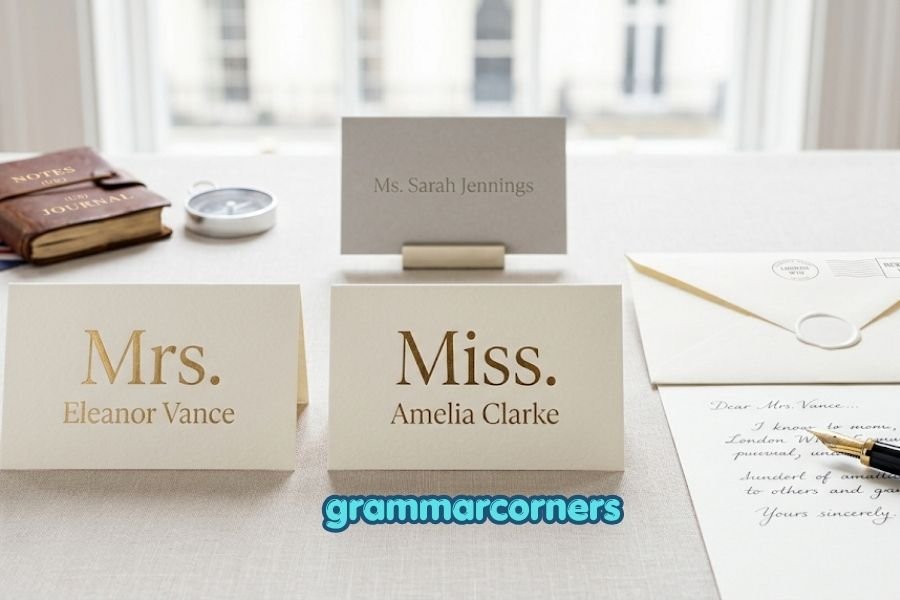
Choosing between Mrs or Misses can feel confusing, especially when writing a formal email, invitation, letter, application, or business document. Both are traditional English titles used before a woman’s name, but they do not mean the same thing today.
The main difference is simple: Mrs is traditionally used for a married woman, while Misses is traditionally used for an unmarried woman or girl. However, modern English also includes Ms, which does not indicate marital status and is often the safest choice when you do not know or do not need to mention a woman’s marital status.
People search for “Mrs or Misses” because choosing the wrong title can feel awkward or disrespectful. The confusion becomes greater because British and American English use slightly different punctuation rules, and social conventions have changed over time.
In this guide, you will learn the difference between Mrs and Misses, where these titles came from, how they are used in British and American English, common mistakes, practical examples, and how to choose the right title in professional and everyday situations.
Mrs or Misses – Quick Answer
Mrs is traditionally used for a married woman, while Misses is traditionally used for an unmarried woman or girl.
| Title | Traditional meaning | Example |
|---|---|---|
| Mrs | Married woman | Mrs Smith |
| Miss | Unmarried woman or girl | Miss Smith |
| Ms | Does not specify marital status | Ms Smith |
Examples
- Mrs Johnson is married.
- Misses Johnson is unmarried.
- Ms Johnson could be married or unmarried.
They you know that a woman is married and she uses the title Mrs, use it.
If she is unmarried and prefers Misses, use Misses.
you do not know her marital status, Ms is usually the safest professional option.
One important point: a person’s own preference should come first. Some women use Ms regardless of whether they are married.
The Origin of Mrs or Miss
Both Mrs and Miss have an interesting history. They developed from the older word mistress, which was historically a female equivalent of master.
The abbreviation Mrs began appearing centuries ago as a shortened form of mistress. Historical evidence shows that Mrs was not originally limited to married women. It could refer to adult women of social or professional standing, including unmarried women.
Miss also developed from mistress. Over time, it became associated with girls and unmarried women. Its use for adult unmarried women became more common during the 18th century.
The modern distinction between Mrs = married and Miss = unmarried developed gradually rather than appearing all at once. Historical research shows that marital status was not always the main factor determining whether a woman was called Mrs.
This history explains why the titles can seem strange today. Their meanings have changed considerably over hundreds of years.
British English vs American English Spelling
The biggest difference between British and American English is usually punctuation, not the meaning of the titles.
In American English, abbreviations traditionally use a period:
- Mrs.
- Miss
- Ms.
In British English, periods are commonly omitted when the abbreviation ends with the same letter as the complete word:
- Mrs
- Miss
- Ms
For example:
| Meaning | American English | British English |
|---|---|---|
| Married woman | Mrs. Smith | Mrs Smith |
| Unmarried woman | Miss Smith | Miss Smith |
| Marital-status-neutral | Ms. Smith | Ms Smith |
The difference is therefore mostly a matter of style and punctuation. The basic meanings remain the same.
Important spelling point
Miss is normally written as Miss, not Miss. in standard American usage. The word is already a complete title rather than an abbreviation in the same way as Mrs.
Mrs is an abbreviation historically derived from mistress. Dictionaries identify its origin as an abbreviation of mistress.
Which Spelling Should You Use?
The best choice depends on your audience, the woman’s preference, and the style guide you are following.
For American English
Use:
- Mrs. for a married woman who uses that title.
- Miss for an unmarried woman or girl.
- Ms. when marital status is unknown or irrelevant.
Example:
Dear Mrs. Anderson,
For British English
Use:
- Mrs for a married woman who uses that title.
- Miss for an unmarried woman or girl.
- Ms when marital status is not specified.
Example:
Dear Mrs Anderson,
For international or professional communication
Ms is often the best choice when you do not know someone’s preferred title or marital status.
For example:
Dear Ms Taylor,
This avoids making assumptions and is especially useful for business emails, applications, formal correspondence, and professional introductions.
Follow the person’s preference
If someone signs an email as Ms. Sarah Brown, use Ms.
If she signs as Mrs. Sarah Brown, use Mrs.
Personal preference is more important than guessing based on age or appearance.
Common Mistakes with Mrs or Miss
Mistake 1: Using Mrs for every adult woman
Incorrect:
Mrs Taylor — when you do not know whether she is married or uses that title.
Better:
Ms Taylor
Mistake 2: Assuming Miss means “young”
Miss traditionally refers to an unmarried woman or girl, but you should not automatically choose it based only on someone’s apparent age.
Mistake 3: Thinking Mrs always means the woman uses her husband’s name
A married woman may use her own surname, her spouse’s surname, a hyphenated surname, or another name.
For example:
Mrs Sarah Williams
does not necessarily tell you what surname her spouse has.
Mistake 4: Using Mrs when the person prefers Ms
A woman may be married but still prefer Ms. The title should follow her stated preference.
Mistake 5: Confusing Mrs and Miss with Ms
These three titles are different:
- Mrs → traditionally married
- Miss → traditionally unmarried
- Ms → marital status not specified
Mistake 6: Writing “Mrs.” in every English variety
In American English, Mrs. is common.
In British English, Mrs is generally preferred.
The difference is punctuation, not pronunciation or meaning.
Mrs or Miss in Everyday Examples
Understanding the difference is easier when you see the titles in real situations.
In an email
Married woman who uses Mrs:
Dear Mrs. Wilson,
Thank you for contacting us.
Unmarried woman who uses Miss:
Dear Miss Wilson,
We are pleased to confirm your appointment.
When marital status is unknown:
Dear Ms. Wilson,
Thank you for your application.
In a formal letter
Dear Mrs. Carter,
This is appropriate when the recipient uses Mrs.
In an invitation
A formal invitation might say:
Mrs. Emily Brown requests the pleasure of your company…
The exact format depends on the event’s style.
In news writing
News organizations may use a person’s preferred title, although many modern publications use names without traditional honorifics after the first reference.
On social media
People generally do not need to use Mrs or Miss unless the person chooses to use a title.
For example:
Congratulations, Mrs. Khan!
could be appropriate if Khan uses Mrs and the context is informal or celebratory.
In professional writing
When you do not know someone’s preferred title:
Dear Ms. Ahmed,
is usually safer than guessing whether she is married or unmarried.
Mrs or Miss – Google Trends & Usage Data
Search interest for “Mrs or Miss” reflects a common language question: people want to know which title is appropriate before addressing a woman.
Google Trends comparisons can change over time and can vary by country, so exact search popularity should not be treated as a permanent measurement of language usage. Search interest also does not directly show how frequently people use the words in everyday speech.
Generally, searches involving Mrs, Miss, and Ms are influenced by:
- Formal email writing
- Job applications
- Wedding invitations
- School and university forms
- Business correspondence
- International English learners
- Questions about marital status
- British vs American English conventions
In the United States, users commonly encounter the forms Mrs., Miss, and Ms. American style traditionally uses periods with abbreviations such as Mrs.
In British English, Mrs is commonly written without a period.
The important lesson is that search popularity does not determine which title is correct. Context and personal preference matter more than search volume.
Mrs vs Miss vs Ms: Comparison Table
| Feature | Mrs | Miss | Ms |
|---|---|---|---|
| Traditional meaning | Married woman | Unmarried woman/girl | Marital status not specified |
| Indicates marriage? | Usually yes | Usually no | No |
| Used for unmarried women? | Traditionally no | Yes | Yes |
| Used for married women? | Yes | Usually no | Yes |
| Professional use | Yes | Yes | Very common |
| American punctuation | Mrs. | Miss | Ms. |
| British punctuation | Mrs | Miss | Ms |
| Best when marital status is unknown | No | No | Yes |
FAQs About Mrs or Miss
1. Is Mrs for married women?
Yes. In modern English, Mrs is traditionally used as a title for a married woman who chooses to use it.
2. Is Miss for unmarried women?
Yes. Miss is traditionally used for an unmarried woman or girl.
3. Should I use Mrs or Miss if I do not know whether a woman is married?
If you do not know her preference, Ms is usually the better professional choice because it does not specify marital status.
4. Can a married woman use Miss?
A person’s preferred title should be respected. Although Miss traditionally indicates an unmarried woman, individuals may choose how they are addressed.
5. Is Mrs or Miss more formal?
Both are formal titles. The appropriate choice depends on the person’s preference and circumstances.
6. Is Mrs. American or British?
Mrs. with a period is common in American English. Mrs without a period is commonly used in British English.
7. What is the difference between Mrs and Ms?
Mrs traditionally identifies a married woman, while Ms does not reveal marital status.
Conclusion: Mrs or Miss — Which One Is Correct?
The difference between Mrs or Miss is simple in modern English: Mrs is traditionally used for a married woman, while Miss is traditionally used for an unmarried woman or girl. However, choosing the right title is not only about grammar. Personal preference is important.
If a woman tells you that she prefers Mrs, use Mrs. If she prefers Miss, use Miss. If you do not know her marital status or preferred title, Ms is often the safest choice, especially in professional communication.
British and American English also differ slightly in punctuation. American English commonly writes Mrs., while British English generally writes Mrs. The meaning remains the same.
The history of these titles is surprisingly complex. Both Mrs and Miss developed from mistress, and their meanings changed over several centuries.
So, when deciding between Mrs or Miss, focus on the woman’s preference, the communication context, and your English style guide. When in doubt, Ms is usually the most neutral professional option.