Have you ever written “hisselfs” and wondered if it should be “himself”? You are not alone. Many English learners and even native speakers come across both forms in speech, books, social media, and regional writing. The confusion often happens because “hisselfs” sounds natural in some dialects, while “himself” is the standard form used in modern formal English.
If you are searching for “hisselfs or himself,” you likely want to know which spelling is correct, whether “hisselfs” is a real word, and when each form can be used. The short answer is simple: “himself” is the standard English pronoun, while “hisselfs” is generally considered nonstandard or dialectal.
This guide explains the difference in plain English. You will learn where these words came from, how British and American English treat them, common mistakes to avoid, and how to choose the right form for school, work, websites, and everyday communication.
Hisselfs or Himself – Quick Answer
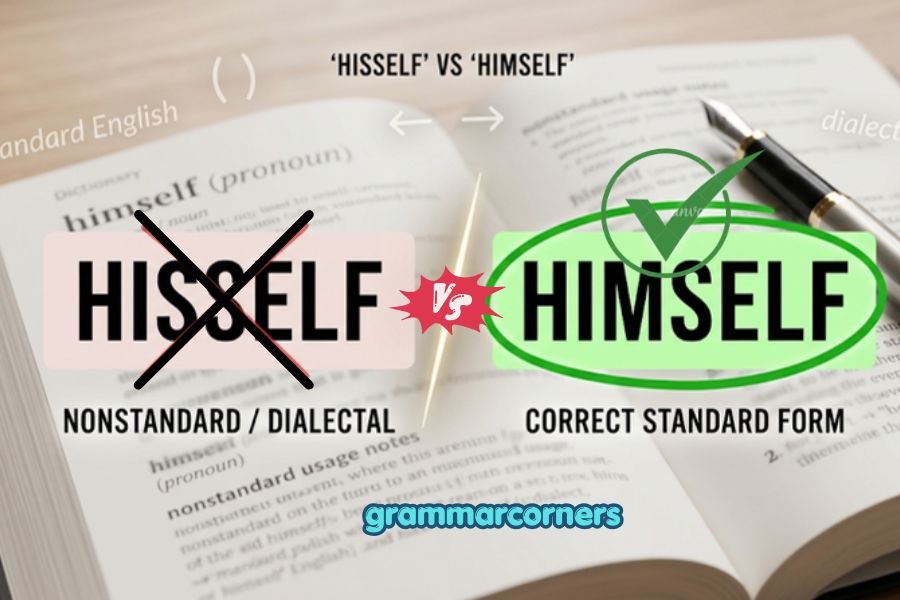
Himself is the correct standard form in modern English.
Hisselfs is generally considered nonstandard. It can appear in some regional dialects, informal speech, historical writing, or dialogue meant to represent a particular way of speaking.
Examples
- Correct standard English: He fixed the car himself.
- Nonstandard/dialectal: He fixed the car hisselfs.
Use himself in professional writing, school assignments, formal emails, news writing, and most published content.
Quick comparison
| Form | Standard English? | Typical use |
|---|---|---|
| himself | Yes | Formal and everyday English |
| hisself | No | Dialectal or nonstandard speech |
| his self | Usually no | Only when “self” has a separate meaning |
The easiest rule is: When you need the reflexive pronoun, write “himself.”
The Origin of Hisself or Himself
The difference between hisself and himself comes from the history of English pronouns.
Modern English uses reflexive pronouns such as:
- myself
- yourself
- himself
- herself
- itself
- ourselves
- yourselves
- themselves
The form himself combines him with self. Over time, this became the established standard reflexive form.
Hisself developed as a nonstandard variation. It can be found in some dialects and historical varieties of English. The form makes sense because his is already a familiar possessive form, and speakers may naturally combine his + self.
However, standard English did not adopt hisself as the normal reflexive pronoun.
This is similar to the way some English dialects create alternative pronoun forms. A word can exist in real speech without being the preferred form in formal standard English.
So, “hisself” is not simply a spelling mistake invented recently. It has a history of dialect use, but “himself” remains the standard form.
British English vs American English Spelling
British and American English both use himself as the standard reflexive pronoun.
There is no major British-versus-American spelling difference here.
For example:
- British English: He did it himself.
- American English: He did it himself.
Both varieties normally reject hisself in formal standard writing.
Comparison table
| Expression | British English | American English | Standard? |
|---|---|---|---|
| himself | Common | Common | Yes |
| hisself | Dialectal/nonstandard | Dialectal/nonstandard | No |
| his self | Rare, special meaning | Rare, special meaning | Depends on context |
The important point is that choosing himself is not a matter of choosing British or American spelling. It is a matter of following standard English grammar.
Which Spelling Should You Use?
For almost every normal writing situation, use himself.
For American English
Use himself in:
- School assignments
- Business emails
- Resumes
- Articles
- Websites
- Reports
- Formal messages
For British English
The same advice applies. Use himself in standard British English.
For Commonwealth English
Countries that commonly use British-based English standards also generally use himself.
For global English
If your audience includes international readers, himself is the safest choice. It is immediately recognizable and accepted in standard English.
When can “hisself” appear?
You may see hisself when:
- A writer is reproducing regional speech.
- A character speaks in a particular dialect.
- Someone is intentionally using informal language.
- A historical text uses the form.
- A dictionary or linguistic discussion is describing nonstandard English.
For normal professional writing, avoid it.
Common Mistakes with Hisself or Himself
Mistake 1: Using “hisself” in formal writing
Incorrect for standard English:
John completed the project hisself.
Better:
John completed the project himself.
Mistake 2: Thinking “his” must combine with “self”
It may seem logical to write hisself because we say his book or his car.
But reflexive pronouns follow established grammatical forms.
We say:
He hurt himself.
Not:
He hurt hisself.
Mistake 3: Assuming “hisself” is always a spelling error
“Hisself” does occur in real English. It can be a dialect form or a deliberate representation of speech.
So it is better to call it nonstandard or dialectal, rather than saying it never exists.
Mistake 4: Changing “himself” to “his self”
These are not normally interchangeable.
He did it himself.
Here, himself is a reflexive pronoun.
But self can sometimes be a separate noun:
He wanted to understand his self better.
This construction is unusual and depends heavily on context. It should not be used as a replacement for himself.
Hisself or Himself in Everyday Examples
Here are examples showing how the standard form works in different situations.
In an email
Mark will handle the presentation himself.
This is the appropriate form for professional communication.
In a school assignment
The character solved the problem himself.
Use himself, not hisself, in academic writing.
In news writing
The president said he would investigate the matter himself.
Standard news writing uses himself.
In social media
He built the entire thing himself!
Even in casual online writing, himself is the normal form.
In dialogue
A writer may intentionally use hisself to show a character’s dialect:
“He done it hisself.”
This can work in fiction when the unusual form is intentional. It should not be treated as standard grammar.
Hisself or Himself – Google Trends & Usage Data
Search interest in “hisself or himself” usually comes from people who encounter the unusual form and want to know whether it is correct.
The search pattern reflects a broader type of English question: people often compare a familiar-sounding spoken form with the standard written form.
Himself is overwhelmingly the more common form in standard English because it is the established reflexive pronoun.
Hisself has a much narrower use. It can appear in regional speech, informal writing, historical texts, and fictional dialogue.
Usage can also vary by location and community. A person may hear hisself regularly and therefore assume it is standard. Another speaker may rarely encounter it outside dialect writing.
When evaluating Google search trends, remember that search volume measures interest, not grammatical correctness. A high number of searches for “hisself” does not mean that “hisself” is the preferred standard spelling.
For current search-interest data, Google Trends can be used to compare the relative popularity of the two search terms by country and time period.
Hisself vs Himself: Side-by-Side Comparison
| Feature | Himself | Hisself |
|---|---|---|
| Standard English | Yes | No |
| Reflexive pronoun | Yes | Nonstandard variant |
| Used in formal writing | Yes | Generally no |
| Used in everyday speech | Yes | Some dialects |
| Used in fiction | Yes | Sometimes for dialect |
| Used in academic writing | Yes | Avoid |
| Used in professional emails | Yes | Avoid |
| British English | Standard | Dialectal/nonstandard |
| American English | Standard | Dialectal/nonstandard |
FAQs About Hisself or Himself
1. Is “hisself” a correct word?
Hisself exists as a dialectal or nonstandard form, but it is not the standard reflexive pronoun in modern English.
2. Is “himself” always correct?
Himself is the standard reflexive pronoun for a male person or someone referred to with he/him pronouns.
3. Can I use “hisself” in an essay?
It is best to avoid hisself in a standard academic essay unless you are discussing language or deliberately quoting a dialect.
4. Why do people say “hisself”?
Some speakers use hisself because it developed as a dialectal variation of the standard himself. It can also reflect regional or informal speech.
5. Is “hisself” British or American?
It is not the standard form in either British or American English. It can occur in dialects in different English-speaking communities.
6. Which is correct: “He did it himself” or “He did it hisself”?
For standard English, write:
He did it himself.
7. Is “hisself” a spelling mistake?
Not necessarily. In standard writing, it is considered nonstandard, but it can be intentional when representing dialect or informal speech.
Conclusion
The answer to “hisself or himself” is simple: use “himself” in standard English. It is the accepted reflexive pronoun used after he and him. For example, “He fixed it himself” is correct in both British and American English.
Hisself is different. Although it appears in some dialects, informal speech, historical sources, and fictional dialogue, it is not the standard form used in professional or academic writing. This explains why you may hear or see it and still find himself recommended by English dictionaries and style guides.
If you are writing an email, essay, article, report, resume, or other formal text, choose himself. If you are writing dialogue or studying a regional dialect, hisself may appear intentionally.
The safest rule is easy to remember: He → himself. When in doubt, choose himself.