Choosing between amid or amidst can feel tricky because both words look almost identical and usually mean the same thing. If you have ever wondered whether one is more correct, more formal, or more British than the other, you are not alone. Writers often search for “amid or amidst” when editing essays, emails, articles, or professional documents because the two words can often be used in exactly the same sentence.
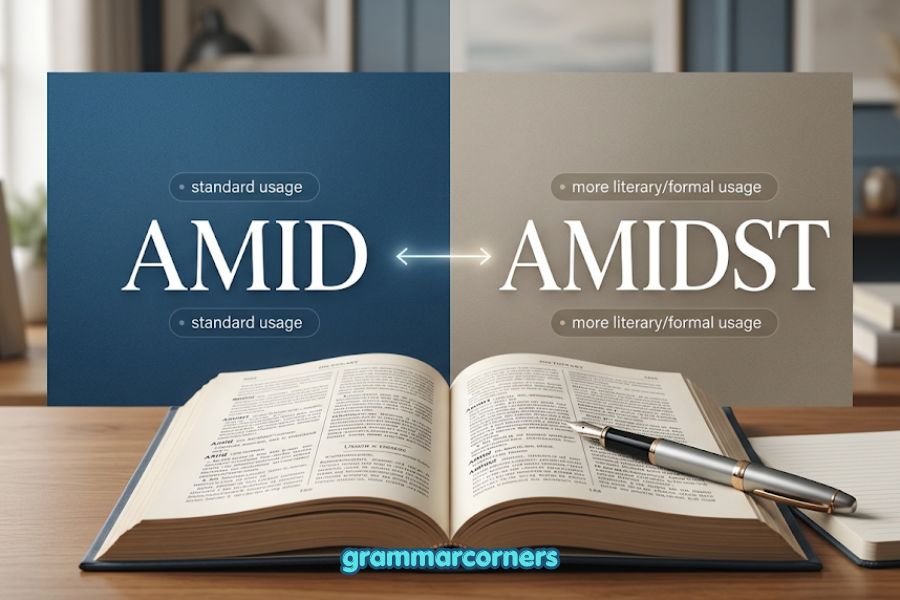
The good news is simple: both “amid” and “amidst” are correct English words. They are prepositions that mean “in the middle of,” “surrounded by,” or “during.” The main difference is style. Amid is more common and usually sounds cleaner and more natural in modern writing. Amidst is also correct, but it can sound slightly more literary, formal, or old-fashioned.
This guide explains the difference between amid or amidst, their origins, British and American usage, common mistakes, real-world examples, and which form you should choose. Whether you are writing casually, professionally, or academically, you will know exactly when to use each word.
Amid or Amidst – Quick Answer
Amid and amidst are both correct. They have nearly the same meaning and can often replace each other.
- Amid = in the middle of or surrounded by something.
- Amidst = in the middle of or surrounded by something.
Examples
The team remained calm amid the crisis.
The team remained calm amidst the crisis.
Both sentences are grammatically correct.
However, amid is generally the better choice for modern, simple, and professional writing.
| Word | Meaning | Typical style |
|---|---|---|
| Amid | In the middle of; surrounded by | Modern, concise |
| Amidst | In the middle of; surrounded by | Literary, formal, slightly old-fashioned |
Quick tip: When you are unsure, choose amid.
The Origin of Amid or Amidst
The words amid and amidst have the same basic historical origin.
Amid comes from Middle English and developed from older forms meaning “in the middle” or “among.” It is related to the idea of being surrounded by something.
Amidst developed as an extended form of amid, with the -st ending appearing in English words such as “amongst,” “whilst,” and “whence.”
The additional -st does not create a major difference in meaning.
For example:
- amid the noise
- amidst the noise
Both mean that something happens while surrounded by or occurring within the noise.
Over time, English has kept both forms. Modern writing, however, tends to favor the shorter amid.
It is important to remember that amidst is not a misspelling of amid. It is a legitimate English word.
British English vs American English Spelling
Both amid and amidst are used in British and American English.
Unlike words such as colour/color or centre/center, this is not mainly a British-versus-American spelling difference.
The distinction is more about style, frequency, and tone.
| Feature | Amid | Amidst |
|---|---|---|
| Correct spelling | Yes | Yes |
| British English | Common | Used |
| American English | Common | Used |
| Meaning | In the middle of; surrounded by | In the middle of; surrounded by |
| Modern writing | Very common | Less common |
| Literary tone | Sometimes | More noticeable |
| Professional writing | Excellent choice | Correct, but can sound formal |
| Casual writing | Natural | Less common |
British English Examples
The announcement came amid growing concerns.
The announcement came amidst growing concerns.
Both work in British English.
American English Examples
The company grew amid economic uncertainty.
The company grew amidst economic uncertainty.
Again, both are grammatically correct.
So, if you are writing for an American or British audience, you do not need to change the word simply because of regional spelling rules.
Which Spelling Should You Use?
For most writers, amid is the safest choice.
Use “amid” when:
- You want clear modern English.
- You are writing professionally.
- You are writing an academic paper.
- You are creating website content.
- You want concise wording.
- You are writing for an international audience.
For example:
The decision was made amid public concern.
This sounds natural and professional.
Use “amidst” when:
- You want a more literary tone.
- You are writing creatively.
- You want a slightly formal or traditional style.
- The rhythm of the sentence sounds better with “amidst.”
For example:
Amidst the silence of the forest, she heard a distant voice.
Here, amidst can give the sentence a more poetic feeling.
Best choice for global audiences
If your goal is clarity, choose amid.
It is shorter, widely understood, and common in both British and American English.
Common Mistakes with Amid or Amidst
Mistake 1: Thinking “amidst” is incorrect
Incorrect idea:
Amidst is not a real English word.
Correction:
Amidst is a correct English word.
It simply has a somewhat more literary or traditional tone.
Mistake 2: Treating them as different meanings
Some writers assume that amid and amidst have different meanings.
Usually, they do not.
She smiled amid the crowd.
She smiled amidst the crowd.
Both describe someone surrounded by a crowd.
Mistake 3: Using “amid” as a verb
Amid is normally used as a preposition, not a verb.
Correct:
The company expanded amid difficult conditions.
Incorrect:
The company amided difficult conditions.
Mistake 4: Confusing “amid” with “among”
These words can overlap, but they are not always interchangeable.
Amid often emphasizes being surrounded by a situation, condition, or mass.
The announcement came amid confusion.
Among is often used when referring to members of a group.
She was standing among her friends.
Mistake 5: Adding unnecessary words
You usually do not need phrases such as “in the midst amid.”
Use one expression:
The country struggled amid political uncertainty.
Or:
The country struggled in the midst of political uncertainty.
Amid or Amidst in Everyday Examples
Both forms can appear in many types of writing.
In emails
Professional writing usually sounds better with amid:
The meeting was postponed amid scheduling difficulties.
In news writing
Amid is especially common in headlines and news reports:
Markets fell amid concerns about inflation.
On social media
Both are possible:
Staying positive amid the chaos.
Finding peace amidst the chaos.
The second version may feel more expressive or poetic.
In academic writing
Amid is usually the cleaner option:
The study was conducted amid significant social changes.
In creative writing
Amidst can create a more literary tone:
Amidst the falling snow, the village grew quiet.
In formal writing
Both are correct:
The policy was introduced amid widespread debate.
The policy was introduced amidst widespread debate.
For most professional documents, amid is preferable because it is concise.
Amid or Amidst – Google Trends & Usage Data
Search interest for “amid or amidst” generally reflects a spelling and usage question rather than two words with different definitions. People commonly search the phrase when they are unsure which form is grammatically correct.
In actual English usage, amid is generally more frequent than amidst. This is especially noticeable in modern journalism, business writing, online publishing, and concise professional communication.
Usage can also vary by context. Amid often appears in news headlines and formal reports because it is shorter:
Government responds amid protests.
Amidst appears more often when writers want a literary, descriptive, or traditional tone.
Google Trends can change over time and can vary by country, so trend comparisons should be treated as indicators of search interest rather than exact measurements of word frequency. Search interest also does not necessarily mean that one form is grammatically better.
The practical takeaway is simple: both are correct, but amid is usually the more common modern choice.
Amid vs Amidst Comparison Table
| Category | Amid | Amidst |
|---|---|---|
| Grammar | Preposition | Preposition |
| Meaning | In the middle of; surrounded by | In the middle of; surrounded by |
| Correct? | Yes | Yes |
| Common today | Yes | Less common |
| British English | Yes | Yes |
| American English | Yes | Yes |
| Professional writing | Recommended | Acceptable |
| Academic writing | Recommended | Acceptable |
| Creative writing | Good | Often stylistically appealing |
| Casual writing | Natural | Less common |
| Literary feeling | Moderate | Stronger |
| Best default | Yes | No |
FAQs About Amid or Amidst
1. Is “amidst” grammatically correct?
Yes. Amidst is grammatically correct and has the same basic meaning as amid.
2. Is amid or amidst more common?
Amid is generally more common in modern English, especially in professional and news writing.
3. Is “amid” American or British English?
Both. Amid is used in both American and British English.
4. Is “amidst” British English?
Amidst is used in British English, but it is not exclusively British. American English also uses it.
5. Is amid more formal than amidst?
Not necessarily. Amid is often preferred in formal writing because it is concise. Amidst can sound more literary or traditional.
6. Can I use amid and amidst interchangeably?
In most sentences, yes. They usually have the same meaning.
She remained calm amid the confusion.
She remained calm amidst the confusion.
Both are correct.
7. Which should I use in an essay?
Use amid unless you have a specific reason to prefer amidst. It is clear, concise, and widely accepted.
Conclusion
When choosing between amid or amidst, you do not need to worry about choosing a correct word versus an incorrect one. Both are grammatically correct, and both mean “in the middle of,” “surrounded by,” or “during.” The main difference is style rather than meaning.
Amid is usually the best default. It is shorter, common in modern English, and works well in professional, academic, journalistic, and everyday writing. Amidst is also correct, but it can give your sentence a more literary, formal, or traditional feeling.
The difference is not a simple British-versus-American spelling rule. Both words appear in both varieties of English. Therefore, your choice should depend mainly on tone and audience.
If you want simple and modern wording, choose amid. If you are writing creatively and prefer a more expressive sound, amidst can work well. When in doubt, amid is the safest choice for clear, professional communication.