When you see a chemistry question asking whether a molecule is polar or nonpolar, the answer depends on more than the atoms in the molecule. You also need to look at how those atoms are arranged in space. This is why students often find molecules such as CO₂, H₂O, NH₃, and CCl₄ confusing. Some contain polar bonds but are still nonpolar overall.
The key idea is simple: polarity depends on electronegativity and molecular shape. A bond becomes polar when electrons are shared unequally. But the bond dipoles can either add together or cancel out. If they cancel, the molecule is nonpolar. If they do not cancel, the molecule is polar.
People search for “polar or nonpolar” because they want a quick way to identify molecular polarity, predict solubility, understand intermolecular forces, or solve chemistry homework and exams. This guide explains the difference in simple terms and gives you practical rules, examples, common mistakes, and a quick method you can use for almost any molecule.
Polar or Nonpolar – Quick Answer
Polar molecules have an uneven distribution of electrical charge. Nonpolar molecules have an even distribution of charge.
A molecule can contain polar bonds but still be nonpolar if its shape causes the bond dipoles to cancel.
Quick examples
| Molecule | Polar or Nonpolar? | Why? |
|---|---|---|
| H₂O | Polar | Bent shape; dipoles do not cancel |
| CO₂ | Nonpolar | Linear shape; dipoles cancel |
| NH₃ | Polar | Trigonal pyramidal shape |
| CH₄ | Nonpolar | Symmetrical tetrahedral shape |
| HCl | Polar | Different electronegativities |
| O₂ | Nonpolar | Same atoms share electrons equally |
| CCl₄ | Nonpolar | Symmetrical shape cancels dipoles |
| SO₂ | Polar | Bent shape prevents cancellation |
The easiest rule
Ask two questions:
- Are the bonds polar?
- Does the molecular shape make the bond dipoles cancel?
If the bonds are polar and the dipoles do not cancel, the molecule is polar.
If the dipoles cancel, the molecule is nonpolar.
The Origin of Polar or Nonpolar
The words polar and nonpolar come from the idea of poles.
In science, a pole is a region associated with a particular property. In chemistry, a polar molecule has two different electrical regions: a slightly positive side and a slightly negative side.
The word polar comes from the idea of poles, ultimately related to the Greek polos, meaning an axis or pivot. The term became useful in science because certain molecules behave as though they have two electrical ends.
The prefix non- means “not.” Therefore, nonpolar literally means “not polar.”
In chemistry, polarity became especially important as scientists developed a better understanding of electrons and chemical bonding. The discovery and study of electronegativity helped explain why atoms can pull shared electrons with different strengths.
For example, chlorine attracts bonding electrons more strongly than hydrogen. In HCl, this creates partial charges:
Hδ⁺ — Clδ⁻
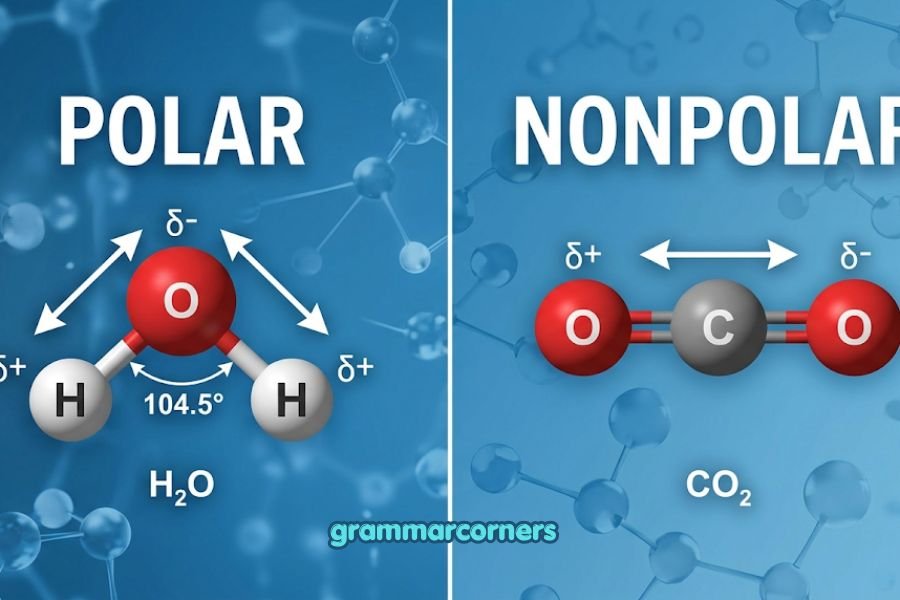
Water provides another important example. Each O–H bond is polar, and because water has a bent shape, the bond dipoles do not cancel. The entire molecule is therefore polar.
British English vs American English Spelling
Unlike many common spelling differences between British and American English, polar and nonpolar do not normally have separate British and American spellings.
Both British and American English generally use:
- polar
- nonpolar
- polarity
- polar molecule
- nonpolar molecule
The main issue is not regional spelling. It is usually whether “nonpolar” should be written as one word or as “non-polar.”
Comparison table
| Usage | Common form | Notes |
|---|---|---|
| American English | nonpolar | Common scientific spelling |
| British English | nonpolar | Also widely used |
| Alternative form | non-polar | Sometimes seen, especially in older writing |
| Scientific noun | polarity | Refers to the separation of charge |
| Scientific adjective | polar | Describes a molecule or bond |
Modern scientific writing commonly favors nonpolar as one word.
For example:
Water is a polar molecule.
Methane is a nonpolar molecule.
There is no need to change polar to another spelling based on whether your audience uses British or American English.
Which Spelling Should You Use?
For chemistry assignments, scientific articles, laboratory reports, and educational content, polar and nonpolar are the safest forms.
For American English
Use:
- polar molecule
- nonpolar molecule
- polar bond
- nonpolar compound
For British English
You can also use:
- polar molecule
- nonpolar molecule
- polar bond
- nonpolar compound
You may occasionally see non-polar, but nonpolar is clear and widely accepted in modern scientific writing.
For global audiences
Use polar and nonpolar consistently. More important than regional spelling is explaining what you mean.
For example:
CO₂ contains polar C=O bonds, but the molecule itself is nonpolar because of its linear, symmetrical shape.
That sentence removes the most common source of confusion.
Common Mistakes with Polar or Nonpolar
1. Assuming polar bonds always make a polar molecule
This is one of the biggest mistakes.
CO₂ contains polar C=O bonds. However, the molecule is linear:
O=C=O
The two bond dipoles point in opposite directions and cancel.
Therefore, CO₂ is nonpolar.
2. Ignoring molecular shape
You cannot always determine molecular polarity by looking only at the chemical formula.
Compare:
- CO₂ → nonpolar
- H₂O → polar
Both contain bonds involving oxygen, but their shapes are different.
3. Thinking symmetrical molecules are always polar
Symmetry often causes dipoles to cancel.
For example:
CCl₄ → nonpolar
The four C–Cl bonds are polar, but their symmetrical tetrahedral arrangement causes the overall dipole to cancel.
4. Confusing a polar bond with a polar molecule
A polar bond involves unequal electron sharing.
A polar molecule has an overall uneven charge distribution.
These are related concepts, but they are not identical.
5. Forgetting lone pairs
Lone pairs can change molecular shape.
For example, H₂O has two lone pairs on oxygen. These help give water its bent shape, which makes the molecule polar.
Polar or Nonpolar in Everyday Examples
Polarity appears in many everyday chemistry situations.
In emails
A student might write:
“Could you please confirm whether CO₂ is polar or nonpolar?”
A clear answer would be:
“CO₂ is nonpolar because its linear shape causes the polar C=O bond dipoles to cancel.”
In news and science writing
You might see:
“The polar nature of water allows it to dissolve many ionic and polar substances.”
This explains an important property of water.
In social media
A short educational post might say:
Quick chemistry tip: Polar bonds do not always mean a polar molecule. CO₂ has polar bonds but is nonpolar overall.
In formal writing
A laboratory report might state:
“The molecular geometry of water is bent, resulting in a net molecular dipole. Therefore, H₂O is classified as polar.”
In everyday chemistry
Polarity helps explain why some substances mix well and others do not.
Water is polar, while many oils are largely nonpolar. This is related to the common chemistry principle:
“Like dissolves like.”
Polar substances tend to interact well with other polar substances, while nonpolar substances tend to interact well with other nonpolar substances.
Polar or Nonpolar – Google Trends & Usage Data
Search interest in “polar or nonpolar” is closely tied to chemistry education. The phrase commonly appears in searches related to molecular polarity, Lewis structures, electronegativity, molecular geometry, and homework questions.
Interest can also vary by:
- school and university academic calendars
- chemistry examination periods
- introductory chemistry courses
- searches for individual molecules
- educational videos and study guides
The keyword is especially useful because it reflects a direct question students ask when learning molecular structure.
Search behavior also commonly expands into questions such as:
- “Is H₂O polar or nonpolar?”
- “Is CO₂ polar or nonpolar?”
- “Is NH₃ polar or nonpolar?”
- “How do I know if a molecule is polar?”
- “What makes a molecule nonpolar?”
For current regional search-volume comparisons, Google Trends can be used to compare “polar or nonpolar” with specific molecule queries and filter results by country or time period. Search popularity should be treated as an indicator of search interest, not as a measure of scientific importance.
Polar vs Nonpolar: Comparison Table
| Feature | Polar | Nonpolar |
|---|---|---|
| Charge distribution | Uneven | More even |
| Partial charges | Usually present | Usually absent or cancel |
| Net dipole | Usually nonzero | Usually zero |
| Bond electrons | Often shared unequally | Often shared equally or dipoles cancel |
| Molecular symmetry | Often asymmetric | Often symmetrical |
| Example | H₂O | CO₂ |
| Other example | NH₃ | CH₄ |
| Interaction with water | Often favorable | Often poor |
| Key factor | Bond polarity + shape | Symmetry + cancellation |
A useful comparison
H₂O
- O–H bonds are polar.
- The molecule is bent.
- Dipoles do not cancel.
- H₂O is polar.
CO₂
- C=O bonds are polar.
- The molecule is linear.
- Dipoles point in opposite directions.
- CO₂ is nonpolar.
This comparison shows why molecular geometry matters.
How to Tell If a Molecule Is Polar
Use this simple four-step method.
Step 1: Draw the Lewis structure
Identify the atoms, bonds, and lone pairs.
Step 2: Determine bond polarity
Check whether the bonded atoms have different electronegativities.
A large enough electronegativity difference usually produces a polar bond.
Step 3: Determine molecular geometry
Use VSEPR theory to identify the shape.
Common shapes include:
- linear
- bent
- trigonal planar
- trigonal pyramidal
- tetrahedral
Step 4: Check whether dipoles cancel
This is the final test.
If the bond dipoles cancel:
Nonpolar molecule
If they do not cancel:
Polar molecule
Example: CH₄
Methane has four C–H bonds arranged symmetrically in a tetrahedral shape. The individual bond effects largely cancel.
CH₄ is nonpolar.
Example: NH₃
Ammonia has a trigonal pyramidal shape because nitrogen has a lone pair. Its bond dipoles do not cancel.
NH₃ is polar.
FAQs About Polar or Nonpolar
1. What does polar mean in chemistry?
Polar means that a molecule has an uneven distribution of electrical charge, creating a positive region and a negative region.
2. What does nonpolar mean?
Nonpolar means that a molecule has no significant overall separation of charge. Its bond dipoles may be absent or may cancel each other.
3. Is water polar or nonpolar?
Water (H₂O) is polar. Its O–H bonds are polar, and its bent shape prevents the bond dipoles from canceling.
4. Is CO₂ polar or nonpolar?
CO₂ is nonpolar. Its C=O bonds are polar, but the molecule is linear and the bond dipoles cancel.
5. Is methane polar or nonpolar?
Methane (CH₄) is nonpolar. Its tetrahedral structure is symmetrical enough for the bond dipoles to cancel overall.
6. Is NH₃ polar or nonpolar?
NH₃ is polar. Its trigonal pyramidal shape gives it a net dipole.
7. Are polar molecules soluble in water?
Many polar substances dissolve well in water because water is polar. However, solubility depends on the specific substance and the strength of its interactions with water.
8. Can a molecule have polar bonds but be nonpolar?
Yes. CO₂ and CCl₄ are classic examples. Their individual bonds are polar, but their symmetrical structures cause the dipoles to cancel.
Conclusion
Knowing whether a molecule is polar or nonpolar becomes much easier when you remember one main rule: look at both the bonds and the molecular shape. A polar bond alone does not guarantee that the entire molecule is polar. You must determine whether the individual bond dipoles cancel or produce a net molecular dipole.
Water is a useful example of a polar molecule because its bent shape prevents its O–H bond dipoles from canceling. CO₂ provides the opposite lesson. Its C=O bonds are polar, but its linear and symmetrical structure makes the molecule nonpolar overall.
For chemistry assignments and professional scientific writing, use polar and nonpolar consistently. The distinction is not a British-versus-American spelling issue. The real challenge is understanding molecular geometry, electronegativity, symmetry, and dipole cancellation.
If you are unsure about a molecule, draw its Lewis structure, identify its shape, examine its bond polarity, and then check whether the dipoles cancel. This method works for most introductory chemistry problems and gives you a reliable answer rather than a guess.