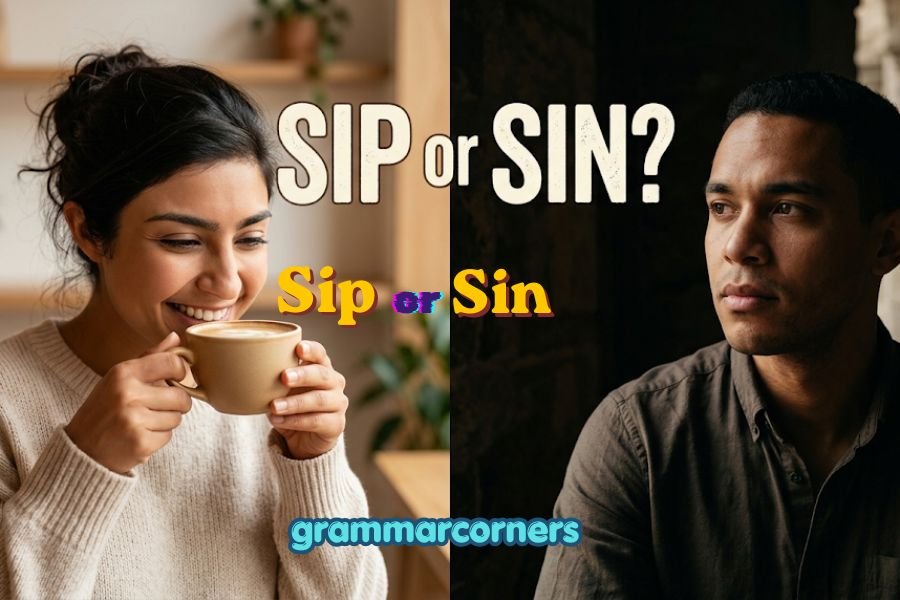
Have you ever wondered whether the right word is “sip or sin”? These two short words look and sound very similar, but they have completely different meanings. This makes them easy to confuse when writing or learning English. Sip is related to drinking. Sin is related to doing something considered morally or religiously wrong. For example, you can sip tea, but you can also commit a sin. The difference is only one letter, yet that letter changes the meaning of the whole sentence.
People often search for “sip or sin” because the words have similar sounds and spellings. They may also hear one word in conversation and wonder which spelling to use. This guide explains the difference in simple terms. You will learn where both words came from, how they are used in British and American English, common mistakes to avoid, and examples from everyday writing. By the end, choosing between sip and sin should be easy.
Sip or Sin – Quick Answer
Sip means to drink a small amount of something at a time.
- I took a sip of water.
- She likes to sip her coffee slowly.
- He sipped his tea.
Sin means an act that is considered morally or religiously wrong. It can also mean a serious fault or wrongdoing.
- Lying is considered a sin in many religious traditions.
- He confessed his sins.
- Wasting good food can be seen as a sin in a figurative sense.
Quick comparison
| Word | Meaning | Example |
|---|---|---|
| Sip | Drink a small amount | Take a sip of water. |
| Sin | A moral or religious wrongdoing | He believed the act was a sin. |
The easiest memory trick is: sip = drink; sin = wrongdoing.
The Origin of Sip or Sin
Although sip and sin look similar, they do not come from the same word.
Sip is an old English word connected with the idea of drinking a small amount. The verb appears in Middle English forms dating to around the late 14th century. Its exact earlier origin is uncertain, but it may be related to Germanic words associated with drinking. The noun sip developed from the verb and refers to a small amount of liquid.
Sin has a much older history. It comes from Old English synn, meaning an offense, wrongdoing, or transgression. It is related to similar words in other Germanic languages. The word became strongly associated with religious ideas, especially wrongdoing against divine or moral laws.
So, there is no British-versus-American spelling difference here. Sip and sin are separate words with separate meanings and histories.
British English vs American English Spelling
There is no spelling difference between British and American English for these two words.
British writers use sip and sin.
American writers also use sip and sin.
The main difference is not spelling. It is meaning and context.
| Word | British English | American English | Meaning |
|---|---|---|---|
| sip | sip | sip | Drink a small amount |
| sipped | sipped | sipped | Drank slowly or in small amounts |
| sipping | sipping | sipping | Drinking slowly |
| sin | sin | sin | Moral or religious wrongdoing |
| sinned | sinned | sinned | Committed a sin |
| sinning | sinning | sinning | Committing a sin |
For example:
- British: She took a sip of tea.
- American: She took a sip of tea.
And:
- British: He believed he had sinned.
- American: He believed he had sinned.
Unlike words such as colour/color or realise/realize, sip and sin do not change spelling based on English variety.
Which Spelling Should You Use?
Use the word that matches your meaning.
Use “sip” when talking about drinking
Choose sip when someone drinks a small amount.
She took a sip of juice.
I like to sip my coffee while I work.
Use “sin” when talking about wrongdoing
Choose sin when discussing moral or religious wrongdoing.
He believed that lying was a sin.
Use “sin” figuratively
The word can also describe something viewed as a serious mistake or fault.
Leaving such a beautiful cake unfinished should be a sin!
This is usually humorous or exaggerated.
For a global English audience, the same spelling rules apply. There is no need to choose a British or American version.
Common Mistakes with Sip or Sin
The most common mistake is choosing the wrong word because the words look or sound similar.
Mistake 1: “Take a sin of water”
Incorrect:
Please take a sin of water.
Correct:
Please take a sip of water.
A sip is a small drink.
Mistake 2: “Drinking alcohol is a sip”
Incorrect:
Drinking alcohol is a sip.
Correct:
Drinking alcohol may be considered a sin in some religious traditions.
Here, sin refers to wrongdoing, not drinking.
Mistake 3: Confusing “sip” with “sin” when speaking
The final consonant changes the word:
- sip ends with the /p/ sound.
- sin ends with the /n/ sound.
This small sound difference changes the word completely.
Mistake 4: Treating them as spelling variants
Sip is not an alternative spelling of sin, and sin is not an alternative spelling of sip.
They are two different words.
Sip or Sin in Everyday Examples
Understanding the words becomes easier when you see them in real sentences.
In emails
I will take a quick sip of coffee before the meeting.
A professional email could use sip when discussing drinks.
In news writing
The athlete took a sip of water during the break.
The word describes drinking a small amount.
In social media
Just enjoying a quiet sip of coffee this morning.
Here, sip creates a relaxed, casual tone.
In formal writing
The text discusses the concept of sin in religious thought.
Here, sin refers to a moral or religious concept.
In conversation
“Would you like a sip of my drink?”
“No, thanks.”
And:
“He thought his actions were a sin.”
The context makes the meaning clear.
Sip or Sin – Google Trends & Usage Data
Search interest for “sip or sin” usually comes from people trying to understand the difference between two easily confused words. The phrase is more of a word-confusion search than a normal everyday expression.
Google Trends measures relative search interest rather than giving a universal number of searches. Interest can also change by country, season, language, and search intent. For that reason, a single worldwide search-volume number for “sip or sin” should not be treated as a permanent figure.
The individual words have very different search contexts:
| Search term | Typical search intent | Common context |
|---|---|---|
| sip | Meaning, usage, drinks | Coffee, tea, water, beverages |
| sin | Meaning, religion, morality | Religion, ethics, wrongdoing |
| sip or sin | Word confusion | Spelling and vocabulary questions |
| sip meaning | Definition | English learning |
| sin meaning | Definition | English learning and religion |
For SEO content, the strongest approach is to answer the confusion directly. Readers searching “sip or sin” usually want a quick answer first, followed by examples and an explanation of the difference.
Sip vs Sin: Comparison Table
| Feature | Sip | Sin |
|---|---|---|
| Part of speech | Noun and verb | Noun and verb |
| Main meaning | A small drink; to drink slowly | A moral or religious wrongdoing |
| Related idea | Drinking | Morality and wrongdoing |
| Example noun | Take a sip. | That was a sin. |
| Example verb | Sip your tea. | Do not sin. |
| Past tense | Sipped | Sinned |
| -ing form | Sipping | Sinning |
| British spelling | Sip | Sin |
| American spelling | Sip | Sin |
| Same meaning? | No | No |
FAQs About Sip or Sin
1. Is it “sip” or “sin”?
Both are correct words, but they have different meanings. Sip means to drink a small amount. Sin means a moral or religious wrongdoing.
2. What is a sip?
A sip is a small amount of liquid taken into the mouth. It can also be a verb meaning to drink slowly or in small amounts.
3. What does sin mean?
A sin is an act considered morally or religiously wrong. The exact meaning can vary among religions and belief systems.
4. Are sip and sin pronounced the same?
No. They begin with the same sound, but the final sounds differ. Sip ends with /p/, while sin ends with /n/.
5. Is “sip” British or American English?
Sip is used in both British and American English. Its spelling does not change.
6. Is “sin” British or American English?
Sin is also used in both British and American English with the same spelling.
7. How can I remember the difference?
Think of P in sip as “pour”: you sip something you drink. Think of N in sin as “wrong”: a sin can describe wrongdoing.
Conclusion: Sip or Sin
The difference between sip or sin is simple once you connect each word with its meaning. Sip is about drinking a small amount. You can sip water, coffee, tea, juice, or another drink. Sin is about wrongdoing, especially in a moral or religious sense. You can commit a sin, confess a sin, or talk about sins.
These words are not British and American spelling variants. Both British and American English use sip and sin in the same way. The confusion comes mainly from their short spelling and similar pronunciation. Remember the final sound: sip ends in /p/, while sin ends in /n/.
If you are writing an email, article, social media post, or formal document, choose the word based on its meaning. When you mean a small drink, use sip. When you mean wrongdoing, use sin. Once you learn this simple distinction, you should have little trouble choosing the correct word.