Whos or Whose? The Simple Guide to Using the Correct Word
Have you ever stopped while writing and wondered, “Should I use whos or whose?” You are not alone. Many people search for this because the two words look almost the same. One is correct in standard English, while the other is usually a spelling mistake.
Knowing the difference is important. It helps you write better emails, school papers, blog posts, social media updates, and business messages. Using the wrong word can make your writing look less professional. The good news is that the rule is very easy to remember.
In this guide, you will learn the meaning of whos and whose, where they came from, how British and American English use them, common mistakes to avoid, and real-life examples. You will also see comparison tables, FAQs, and usage tips that make the difference clear.
If you only need a quick answer, here it is: “Whose” is the correct word. “Whos” is almost always a misspelling unless it is used as a contraction without the apostrophe by mistake.
Whos or Whose – Quick Answer
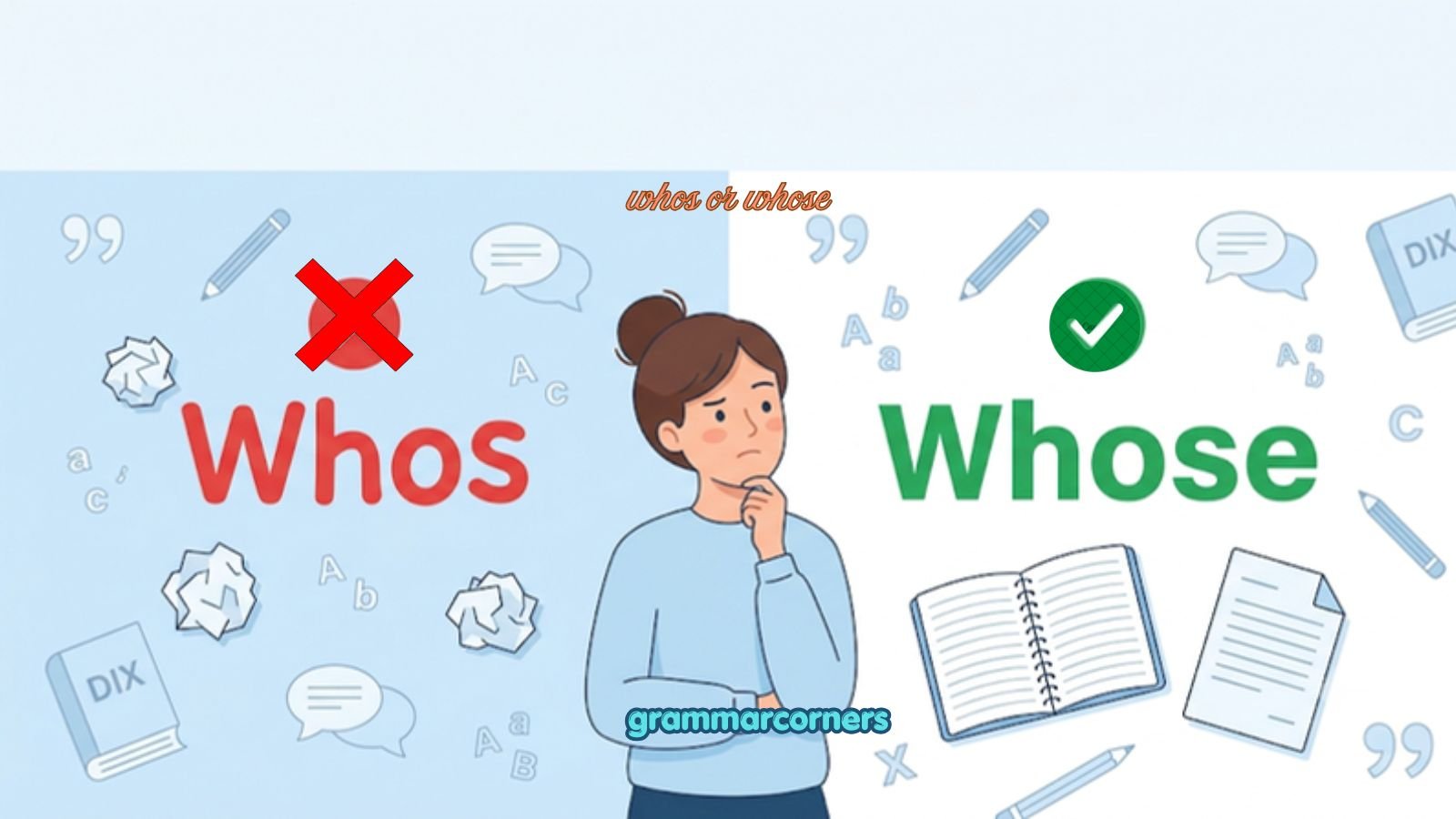
The correct word is whose.
- Whose shows possession. It means belonging to whom.
- Whos is not a standard English word. Most of the time, it is simply a misspelling of whose or who’s.
Examples
✅ Whose backpack is on the chair?
✅ Do you know whose phone this is?
❌ Whos backpack is on the chair?
❌ Whos coming to dinner?
Tip: If you mean who is or who has, use who’s with an apostrophe. If you mean belonging to someone, use whose.
The Origin of Whos or Whose
The word whose comes from Old English hwæs, the possessive form of who.
English has used whose for hundreds of years to show ownership or belonging.
Examples include:
- Whose idea was this?
- Whose jacket is hanging there?
The word whos has no official meaning in English dictionaries. It usually appears because someone forgets to add the apostrophe in who’s or accidentally removes the “e” from whose.
British English vs American English Spelling
Unlike many spelling differences, British English and American English use exactly the same spelling: whose.
There is no regional difference.
| British English | American English | Correct? |
|---|---|---|
| Whose | Whose | ✅ Yes |
| Whos | Whos | ❌ No |
Examples
British English:
- Whose holiday plans changed?
American English:
- Whose car is parked outside?
Both countries follow the same grammar rule.
Which Spelling Should You Use?
Always use whose when talking about ownership.
If you write for an American audience
Use whose.
If you write for a British audience
Use whose.
If you write for a global audience
Use whose.
There is no situation where whos is considered correct in formal writing.
Common Mistakes with Whos or Whose
Many writers confuse whose, who’s, and whos.
| Incorrect | Correct | Why |
|---|---|---|
| Whos book is this? | Whose book is this? | Shows ownership |
| Whos coming today? | Who’s coming today? | Means “who is” |
| Whose going first? | Who’s going first? | Means “who is” |
| Do you know whos car this is? | Do you know whose car this is? | Shows possession |
Easy Trick
- Whose = belongs to someone
- Who’s = who is or who has
- Whos = spelling mistake
Whos or Whose in Everyday Examples
Here are simple examples from daily life.
- Could you tell me whose report this is?
News
- Police are trying to find whose vehicle was involved.
Social Media
- Whose dog is this? It is adorable!
School
- Whose homework is on the teacher’s desk?
Workplace
- Does anyone know whose laptop is in the meeting room?
Whos or Whose – Google Trends & Usage Data
Searches for “whos or whose” remain popular because people often confuse whose with who’s.
Here is what search behavior shows:
- The United States has a high number of grammar-related searches.
- The United Kingdom also searches this topic often.
- Canada, Australia, and New Zealand show similar search interest.
- Students, writers, and English learners are the most common searchers.
- Most people want a quick grammar rule and easy examples.
The confusion happens because the words sound exactly alike but have different meanings.
Comparison Table
| Word | Meaning | Correct Usage | Example |
|---|---|---|---|
| Whose | Belonging to whom | ✅ Yes | Whose keys are these? |
| Who’s | Who is or who has | ✅ Yes | Who’s ready? |
| Whos | Not a standard word | ❌ No | Incorrect spelling |
Frequently Asked Questions
1. Is “whos” a real word?
No. It is generally considered a spelling mistake.
2. What does “whose” mean?
It means belonging to whom.
3. Is “whose” used in both British and American English?
Yes. Both use the same spelling.
4. What is the difference between “whose” and “who’s”?
Whose shows ownership.
Who’s means who is or who has.
5. How can I remember the difference?
Think of whose as the word for ownership.
If you can replace the word with who is, use who’s.
6. Is “whos” ever correct?
No. In standard English writing, it is not correct.
7. Why do so many people search for “whos or whose”?
Because the words sound the same, making them easy to confuse.
Conclusion
Understanding the difference between whos and whose is simple once you know the rule. Whose is the correct word when you want to show ownership or ask who something belongs to. Whos is not accepted in standard English and is almost always a spelling mistake. Many writers also confuse whose with who’s, but remembering that who’s means who is or who has makes choosing the right word much easier.
The best way to avoid mistakes is to stop for a moment before writing. Ask yourself whether you are talking about ownership or using the words who is. If it is ownership, choose whose. If it means who is or who has, choose who’s. This simple habit will improve your grammar and make your writing clearer and more professional.
Whether you are writing an email, an article, a report, or a social media post, using whose correctly helps readers understand your message. Now that you know the difference, you can write with greater confidence and avoid one of the most common English grammar mistakes.