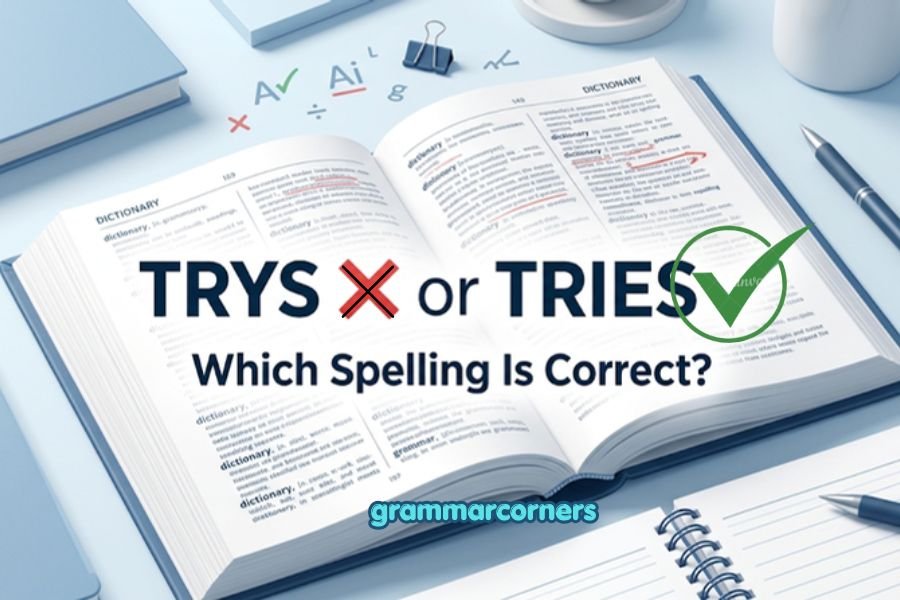
Have you ever typed “trys” and wondered if it should be “tries” instead? You are not alone. This is a common spelling mistake because the word try changes its spelling when it becomes the third-person singular form.
The correct spelling is “tries.” The word “trys” is generally incorrect in standard English. For example, you should write, “She tries to help,” not “She trys to help.”
People often search for “trys or tries” because English has several spelling rules for words ending in -y. Sometimes the y stays the same, while in other cases it changes to -ies. Knowing which rule applies can make your writing more accurate.
This guide explains why tries is correct, how the spelling rule works, and when to use it. You will also see examples from everyday, professional, and formal writing. By the end, you will know exactly when to use tries and why trys should be avoided.
Trys or Tries – Quick Answer
“Tries” is the correct spelling. “Trys” is incorrect in standard English.
Try is a verb meaning to make an effort to do something.
When try becomes the third-person singular present-tense form, the y changes to i and -es is added:
- I try.
- You try.
- We try.
- They try.
- He tries.
- She tries.
- It tries.
Examples
- She tries to finish her work early.
- He tries his best every day.
- The dog tries to open the door.
- My brother tries new foods.
- The student tries to solve the problem.
❌ She trys to help.
✅ She tries to help.
So, if you are choosing between trys or tries, always choose tries when you need the third-person singular form of try.
The Origin of Trys or Tries
The word try has a long history in English. It developed from older French and Latin-related linguistic roots and entered Middle English through Anglo-French influence.
The spelling tries follows a common English spelling pattern. When a verb ends in a consonant + y, the y usually changes to i before certain endings.
For example:
- try → tries
- cry → cries
- carry → carries
- study → studies
- worry → worries
However, when a verb ends in a vowel + y, the y normally remains:
- play → plays
- enjoy → enjoys
- stay → stays
- obey → obeys
This explains why English uses tries rather than trys.
The difference is not related to British or American English. Both varieties use tries as the standard spelling.
British English vs American English Spelling
There is no British-versus-American spelling difference between tries and trys.
Both British English and American English use tries.
| Form | British English | American English | Correct? |
|---|---|---|---|
| try | try | try | Yes |
| tries | tries | tries | Yes |
| trys | trys | trys | No |
| trying | trying | trying | Yes |
| tried | tried | tried | Yes |
The Spelling Rule
When a verb ends in consonant + y, change the y to i and add -es for the third-person singular form.
try → tries
Other examples include:
- fly → flies
- reply → replies
- copy → copies
- apply → applies
- deny → denies
But if the word ends in vowel + y, keep the y:
- play → plays
- say → says
- enjoy → enjoys
- buy → buys
Therefore, trys is not an alternative American or British spelling. It is simply a spelling error in standard English.
Which Spelling Should You Use?
Use tries in virtually all standard English writing.
For American English
Use tries:
She tries to arrive on time.
For British English
Use tries:
He tries to complete the task before lunch.
For Commonwealth English
English varieties used in countries such as Canada, Australia, and New Zealand also generally use tries.
For Professional Writing
Always use tries in:
- Emails
- Reports
- Resumes
- Business documents
- Academic writing
- Websites
- Articles
- Formal correspondence
If you are writing for a global audience, tries is the clear and standard choice.
Common Mistakes with Trys or Tries
The most common mistake is writing trys instead of tries.
Mistake 1: Adding Only -s
❌ He trys to understand.
✅ He tries to understand.
The word does not simply take -s. Because try ends in consonant + y, the y changes to i and -es is added.
Mistake 2: Confusing “Try” and “Tries”
Use try with I, you, we, and they:
They try to help.
Use tries with he, she, and it:
She tries to help.
Mistake 3: Confusing “Tries” and “Tried”
Tries is present tense:
She tries every day.
Tried is past tense:
She tried yesterday.
Mistake 4: Using “Tries” After “Does”
After does, use the base form try, not tries.
❌ She does tries to help.
✅ She does try to help.
This happens because does already carries the third-person singular grammatical marking.
Trys or Tries in Everyday Examples
Understanding the word in real sentences makes the rule easier to remember.
In Emails
She tries to respond to every customer within 24 hours.
This in Business Writing
The company tries to improve its service each year.
In News Writing
The team tries to recover after a difficult start.
On Social Media
He always tries to make people laugh.
A Academic Writing
The study tries to explain why the results changed.
In Formal Writing
The organization tries to provide equal opportunities for all applicants.
In Everyday Conversation
My friend tries to call me every weekend.
The key point remains the same: when try is used with he, she, or it in the present tense, write tries.
Trys or Tries – Google Trends & Usage Data
Searches for “trys or tries” usually come from people checking whether trys is a valid spelling. The confusion is understandable because many English verbs simply take -s in the third-person singular.
For example:
- walk → walks
- run → runs
- jump → jumps
But verbs ending in consonant + y follow a different spelling pattern:
- try → tries
- cry → cries
- study → studies
- carry → carries
Search interest for spelling questions can vary by country and by the type of English being studied. Learners, students, writers, and people proofreading online content are especially likely to search for this type of word comparison.
Importantly, the existence of searches for “trys” does not make it a standard spelling. Search frequency can reflect confusion, mistakes, or questions rather than correct usage.
For professional writing, dictionaries, grammar references, and established English usage all support tries as the standard form.
Trys vs Tries: Comparison Table
| Word | Meaning/Use | Correct? | Example |
|---|---|---|---|
| try | Base verb | ✅ Yes | I try to help. |
| tries | Third-person singular present | ✅ Yes | She tries to help. |
| tried | Past tense | ✅ Yes | He tried yesterday. |
| trying | Present participle | ✅ Yes | They are trying again. |
| trys | Incorrect spelling | ❌ No | She trys to help. |
Easy Rule to Remember
Think of it this way:
consonant + y → change y to i + es
So:
try → tries
You can remember the pattern with:
Try, cry, carry, study → tries, cries, carries, studies
FAQs About Trys or Tries
1. Is “trys” a correct word?
No. Trys is not the standard spelling of the third-person singular form of try. The correct spelling is tries.
2. Is it “she trys” or “she tries”?
The correct form is “she tries.”
Example:
She tries to finish her homework.
3. Why does “try” become “tries”?
Because try ends in a consonant followed by y. The standard spelling rule changes y to i and adds -es.
try → tries
4. Is “tries” British or American?
Tries is used in both British and American English. There is no spelling difference here.
5. Can I write “he trys”?
No. In standard English, write:
He tries.
6. What is the difference between “try” and “tries”?
Try is used with I, you, we, and they.
They try to help.
Tries is used with he, she, and it.
She tries to help.
7. What is the past tense of “try”?
The past tense is tried.
He tried to open the door.
8. Is “tries” always correct?
Tries is correct when you need the third-person singular present form of try.
For other grammatical forms, use try, tried, or trying as appropriate.
Conclusion
When choosing between trys or tries, the correct answer is simple: tries is the standard spelling. Trys is a common spelling mistake and should not be used in professional, academic, or formal English.
The reason for the spelling is an important English rule. When a verb ends in a consonant + y, the y changes to i and -es is added for the third-person singular present tense. Therefore, try becomes tries.
For example, you should write “She tries to help,” not “She trys to help.” The same pattern appears in words such as cries, carries, studies, and replies.
This rule is the same in British and American English, so you do not need to choose based on your audience’s location. Whether you are writing an email, school assignment, article, report, or social media post, tries is the safe and correct choice.
The easiest way to remember it is: try + third-person singular = tries.