If you have ever typed “monkies” and wondered whether it looks right, you are not alone. The words monkeys or monkies are often confused because English spelling rules can change the ending of words in ways that are not always obvious. When people search for “monkeys or monkies,” they usually want to know which spelling is correct, why the other form appears online, and whether British and American English use different spellings.
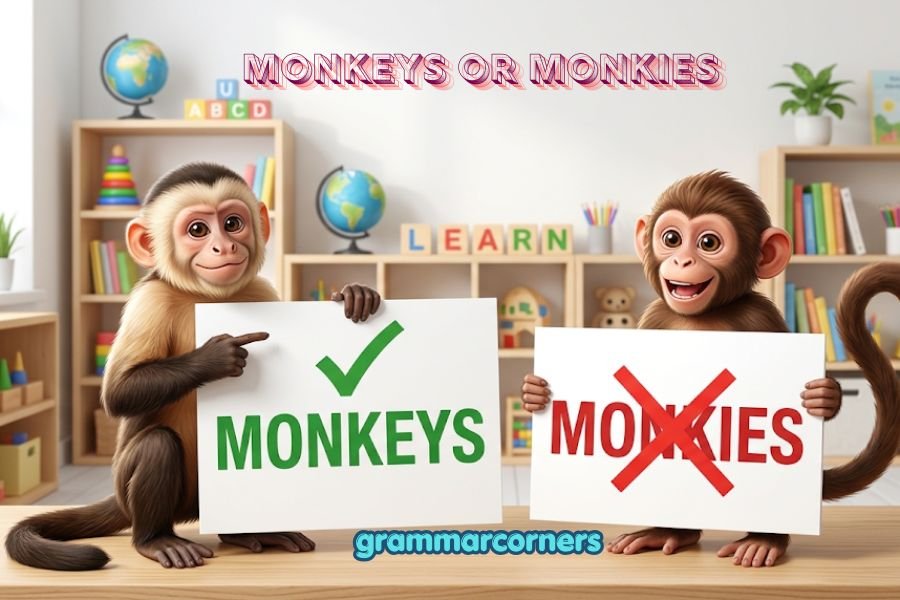
The good news is simple: monkeys is the correct spelling. Monkies is a common spelling mistake.
The word monkey follows a familiar English plural rule. Because it ends in a vowel followed by y, you normally keep the y and add -s. This gives us monkeys, not monkies.
Understanding this small spelling rule can help you avoid mistakes in schoolwork, emails, articles, social media posts, and professional writing. This guide explains the difference between monkeys and monkies, gives useful examples, and shows when to use each form.
Monkeys or Monkies – Quick Answer
Monkeys is the correct spelling.
Monkies is incorrect in standard English.
The singular noun is monkey, and its plural form is monkeys.
Examples
- One monkey is sitting in the tree.
- Two monkeys are playing together.
- The zoo has several monkeys.
- We watched a group of monkeys in the forest.
A simple way to remember this is:
monkey → monkeys
Do not change the y to ie.
Comparison Table
| Singular | Correct Plural | Incorrect Plural |
|---|---|---|
| monkey | monkeys | monkies |
| donkey | donkeys | donkies |
| turkey | turkeys | turkies |
| journey | journeys | journies |
| valley | valleys | vallies |
The spelling monkies may look reasonable because some English words ending in consonant + y change y to ies. However, monkey does not follow that rule.
The Origin of Monkeys
The word monkey has a long history in English. It appeared in English in the late Middle Ages and is related to forms found in other European languages.
Over time, monkey became the standard English word for these primates. The plural was formed using the normal plural ending -s, producing monkeys.
The spelling mistake monkies likely comes from applying the wrong plural rule.
English has an important spelling pattern involving words that end in y:
- consonant + y → usually change y to ies
- vowel + y → usually keep y and add s
For example:
- baby → babies
- city → cities
- party → parties
But:
- boy → boys
- toy → toys
- key → keys
- monkey → monkeys
In monkey, the letter before y is e, which is a vowel. Therefore, the correct plural is monkeys.
British English vs American English Spelling
There is no British-American spelling difference between monkeys and monkies.
Both British English and American English use monkeys as the standard plural.
| English Variety | Singular | Correct Plural | Incorrect Form |
|---|---|---|---|
| American English | monkey | monkeys | monkies |
| British English | monkey | monkeys | monkies |
| Canadian English | monkey | monkeys | monkies |
| Australian English | monkey | monkeys | monkies |
| General international English | monkey | monkeys | monkies |
This is different from words such as colour/color or centre/center, where British and American spelling can vary.
With monkey, there is no such regional spelling difference.
Which Spelling Should You Use?
Use monkeys in virtually every standard English situation.
For American English
Use:
The monkeys are climbing the trees.
For British English
Use:
The monkeys are climbing the trees.
For Professional Writing
Use monkeys in:
- Business documents
- School assignments
- Academic writing
- Websites
- News articles
- Reports
- Emails
- Presentations
Avoid monkies unless you are intentionally reproducing a spelling mistake, a username, a brand name, or a fictional name.
Quick Rule
Remember:
monkey + s = monkeys
Not:
monkey → monkies
Common Mistakes with Monkeys
The most common mistake is changing the final y to ie.
Incorrect
The monkies escaped from the zoo.
Correct
The monkeys escaped from the zoo.
Another mistake is adding an apostrophe.
Incorrect
The monkey’s are eating bananas.
Correct
The monkeys are eating bananas.
Here, monkeys means more than one monkey.
The form monkey’s is possessive or can be a contraction in a different grammatical context.
More Common Errors
| Incorrect | Correct |
|---|---|
| monkies | monkeys |
| monkey’s are | monkeys are |
| three monkey | three monkeys |
| many monkey | many monkeys |
| the monkies | the monkeys |
The key is to recognize that monkey takes the regular plural ending -s.
Monkeys in Everyday Examples
Knowing the correct spelling is useful in many types of writing.
In an Email
We visited the wildlife park and saw several monkeys.
In a News Article
Several monkeys were observed near the forest edge.
On Social Media
These monkeys are incredibly playful!
Formal Writing
Researchers observed the behavior of monkeys in their natural habitat.
In School Writing
Monkeys are intelligent animals that belong to the primate group.
a Conversation
I saw two monkeys at the zoo yesterday.
In every example, monkeys is the correct plural form.
Monkeys – Google Trends & Usage Data
Searches for “monkeys or monkies” usually come from people checking spelling. The correct word, monkeys, is naturally far more common because it is the standard plural form.
Search interest can also vary by country and context. People may search for the spelling when writing:
- School assignments
- Animal reports
- Search queries
- Social media posts
- Articles
- Wildlife content
- English-learning exercises
The important point is that search frequency does not determine whether a spelling is correct. A misspelling can appear thousands of times online and still remain incorrect.
For professional and educational writing, choose monkeys.
Monkeys or Monkies: Side-by-Side Comparison
| Feature | Monkeys | Monkies |
|---|---|---|
| Correct spelling | Yes | No |
| Singular form | Monkey | Monkey |
| Standard plural | Yes | No |
| Used in American English | Yes | No |
| Used in British English | Yes | No |
| Suitable for formal writing | Yes | No |
| Common spelling mistake | No | Yes |
| Example | Five monkeys | Five monkies |
The answer is clear: monkeys is the standard English plural.
FAQs About Monkeys or Monkies
1. Is it monkeys or monkies?
Monkeys is correct. Monkies is a spelling mistake.
2. Why is monkeys spelled with a y?
Because monkey ends with a vowel followed by y. The plural is formed by adding -s without changing the y.
3. Is monkies ever correct?
Not as the standard plural of monkey. It may appear as an intentional name, username, title, or other proper name, but standard English uses monkeys.
4. Do British people spell it monkies?
No. British English also uses monkeys.
5. Why do some words ending in y change to ies?
Words ending in a consonant + y often change y to ies when pluralized. For example, baby → babies. But words ending in a vowel + y, such as monkey, normally keep the y: monkey → monkeys.
6. What is the singular of monkeys?
The singular is monkey.
7. What is the easiest way to remember the spelling?
Remember this pattern:
monkey → monkeys
The y stays because the letter before it is a vowel.
Conclusion
When choosing between monkeys or monkies, the answer is straightforward: monkeys is the correct spelling, while monkies is a common mistake. The singular word is monkey, and its plural is formed by simply adding -s.
The reason for the confusion is the English spelling rule involving words ending in y. Words such as baby and city change y to ies because they end in a consonant followed by y. However, monkey ends in a vowel followed by y, so the y remains when the word becomes plural.
This rule applies consistently in both British and American English. Whether you are writing an email, school assignment, article, report, or social media post, use monkeys.
So, if you are unsure, remember the simple formula: one monkey, two monkeys. Never use monkies as the standard plural spelling.