Choosing between a semicolon or colon can be confusing. Both punctuation marks can connect ideas, introduce information, and make writing flow more smoothly. Yet they do different jobs.
If you have ever stopped while writing an email and wondered whether to use a semicolon or colon, you are not alone. Many writers use these marks interchangeably, even though each follows clear grammar rules.
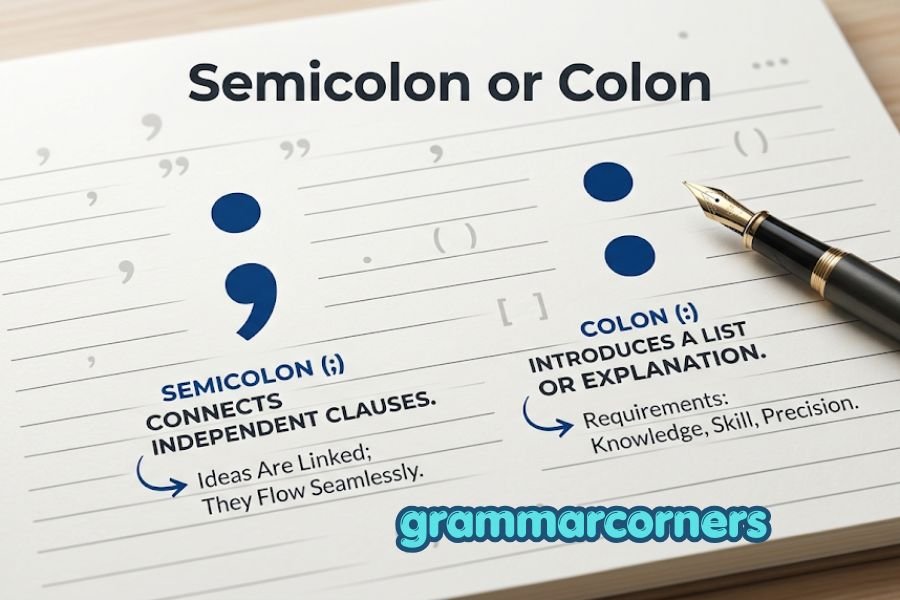
The easiest way to remember the difference is this: a semicolon connects closely related complete thoughts, while a colon introduces or explains what comes next.
For example:
- Semicolon: I wanted to go for a walk; it started raining.
- Colon: I needed three things: water, food, and a jacket.
People search for “semicolon or colon” because the two marks look similar and can both appear between independent clauses. Understanding when to use each one can make your writing clearer, more professional, and easier to read.
This guide explains the difference between a semicolon and a colon, shows common mistakes, and provides simple examples for everyday and formal writing.
Semicolon or Colon – Quick Answer
The quick answer is:
Use a semicolon (;) to connect closely related independent clauses. Use a colon (:) to introduce an explanation, example, list, quotation, or result.
Semicolon examples
I was tired; I finished my work anyway.
Both sides of the semicolon can stand as complete sentences:
- I was tired.
- I finished my work anyway.
Another example:
She loves reading; her brother prefers movies.
Colon examples
She packed three things: a phone, a charger, and a notebook.
The colon introduces the list.
Another example:
He had one goal: to finish the race.
Here, the colon introduces an explanation of the goal.
Simple rule
| Punctuation | Main purpose | Example |
|---|---|---|
| Semicolon (;) | Connects related complete thoughts | It was late; we kept working. |
| Colon (:) | Introduces or explains information | We bought three items: bread, milk, and eggs. |
A useful memory trick is:
Semicolon = connection.
Colon = introduction.
The Origin of Semicolon or Colon
The words semicolon and colon have long histories connected to punctuation and writing.
The word semicolon comes from the Greek word kōlon, meaning a part or member, combined with semi, meaning half. The idea is that a semicolon creates a pause stronger than a comma but weaker than a full stop.
The colon also comes from Greek kōlon. In ancient writing, the term referred to a section or part of a sentence.
Punctuation developed over centuries as writers needed better ways to show pauses, relationships, and sentence structure. Early manuscripts did not use punctuation in the same consistent way modern English does.
As printing became more common, punctuation marks became more standardized. The semicolon and colon eventually developed distinct roles in English grammar.
Today, the two marks may look similar, but their functions are different:
- ; connects related ideas.
- : points forward to information that explains, identifies, or expands on what came before.
There are therefore no British-versus-American spelling differences for these punctuation marks. The main differences are usage and style, not spelling.
British English vs American English Spelling
Unlike words such as colour/color or organise/organize, semicolon and colon are spelled the same in British and American English.
The punctuation rules are also broadly similar in both varieties of English.
However, writers and style guides can differ slightly in how frequently certain constructions are used.
Comparison table
| Feature | British English | American English |
|---|---|---|
| Semicolon | ; | ; |
| Colon | : | : |
| Word “semicolon” | semicolon | semicolon |
| Word “colon” | colon | colon |
| Connect related independent clauses | Yes | Yes |
| Introduce lists | Yes | Yes |
| Introduce explanations | Yes | Yes |
| Major spelling difference | None | None |
British English example
The meeting was important; everyone attended.
American English example
The meeting was important; everyone attended.
The punctuation is identical.
One area where style can vary is the use of a colon before a list. Both British and American English permit this, but writers may choose different styles based on the publication or organization.
For professional writing, it is best to follow the style guide required by your workplace, school, publisher, or publication.
Which Spelling Should You Use?
There is no spelling choice between semicolon and colon. Both words have the same spelling in British and American English.
The real question is which punctuation mark should you use?
Use a semicolon when:
- You want to connect two closely related complete sentences.
- You do not want to use a period.
- You are separating complicated items in a list that already contains commas.
Example:
The weather was cold; we decided to stay home.
Use a colon when:
- You are introducing a list.
- You are introducing an explanation.
- You are introducing an example.
- You are emphasizing what comes next.
Example:
She brought everything she needed: a coat, gloves, and boots.
For US audiences
Use standard American punctuation rules and follow your required style guide.
For UK and Commonwealth audiences
The same basic distinction applies. Follow the style guide used by your organization or publication.
For global audiences
The safest approach is simple and consistent punctuation. Avoid using a semicolon or colon merely because it looks sophisticated.
Common Mistakes with Semicolon or Colon
Writers often confuse these punctuation marks because both can appear between parts of a sentence.
Mistake 1: Using a colon between two unrelated complete sentences
Incorrect:
I went to the store: I bought some milk.
This is not the clearest use of a colon.
Better:
I went to the store; I bought some milk.
Or:
I went to the store. I bought some milk.
Mistake 2: Using a semicolon to introduce a basic list
Incorrect:
I need three things; bread, milk, and eggs.
Better:
I need three things: bread, milk, and eggs.
The colon introduces the list.
Mistake 3: Using a semicolon after a dependent clause
Incorrect:
Because it was raining; we stayed home.
Better:
Because it was raining, we stayed home.
A semicolon normally joins independent clauses, not a dependent clause and an independent clause.
Mistake 4: Using a colon where no introduction exists
Incorrect:
My favorite color is: blue.
Better:
My favorite color is blue.
The colon is unnecessary because blue is not being introduced as a separate explanation or list.
Mistake 5: Confusing the symbols
Remember:
Semicolon: ;
Colon: :
The semicolon has a comma underneath a period. The colon has two dots.
Semicolon or Colon in Everyday Examples
Both punctuation marks appear in emails, news articles, social media posts, academic writing, and business documents.
In emails
Semicolon:
I have completed the report; I will send it this afternoon.
Colon:
Please bring the following items: your ID, notebook, and laptop.
In news writing
Semicolon:
The storm caused major damage; thousands of residents lost power.
Colon:
Officials issued a warning: residents should avoid unnecessary travel.
In social media
Semicolons can connect short, related thoughts:
I wanted to relax; my weekend had other plans.
Colons can create emphasis:
My weekend plan: sleep, eat, repeat.
In formal writing
Semicolons are useful when two independent clauses are closely connected:
The evidence was limited; further research was necessary.
Colons can introduce an explanation:
The conclusion was clear: further research was necessary.
In academic writing
The experiment produced one unexpected result: the sample reacted differently under high temperatures.
In business writing
We have one priority: improving customer service.
The key is not to use these marks simply to make writing look formal. Choose the punctuation based on the relationship between the ideas.
Semicolon or Colon – Google Trends & Usage Data
Search interest for “semicolon or colon” reflects a common grammar question: writers often know both punctuation marks but are unsure about their exact functions.
Google Trends can help show relative search interest by country, language, and time period. However, Trends reports relative search interest rather than exact search volume, so it should not be treated as a precise count of searches.
Interest in punctuation questions is especially relevant in English-speaking and English-learning regions, including countries where English is widely used in education, business, and online communication.
Searches can also rise when students, professionals, bloggers, and language learners need quick grammar answers.
The important takeaway is that “semicolon or colon” is primarily a usage question, not a spelling question. Unlike British and American spelling pairs, there is no different spelling to choose between the two terms.
Semicolon vs Colon: Comparison Table
| Point | Semicolon (;) | Colon (:) |
|---|---|---|
| Basic function | Connects related ideas | Introduces information |
| Can join independent clauses? | Yes | Sometimes, when the second part explains or expands the first |
| Introduces a list? | Usually no | Yes |
| Introduces an explanation? | No | Yes |
| Introduces an example? | No | Yes |
| Creates a strong connection? | Yes | Yes |
| British spelling | semicolon | colon |
| American spelling | semicolon | colon |
| Symbol | ; | : |
Compare these sentences
Semicolon:
The restaurant was busy; we decided to wait.
Colon:
We had one choice: wait for a table.
The first sentence connects two related thoughts. The second introduces an explanation of the choice.
FAQs About Semicolon or Colon
1. What is the difference between a semicolon and a colon?
A semicolon connects closely related independent clauses. A colon introduces information such as a list, explanation, example, or result.
2. Is a colon stronger than a semicolon?
Not exactly. They have different functions. A colon points forward to information, while a semicolon emphasizes the relationship between two complete thoughts.
3. Can I use a semicolon instead of a colon?
Usually not when you are introducing a list or explanation. For example, write:
I bought three things: apples, oranges, and bananas.
A semicolon would not be appropriate there.
4. Can a colon connect two complete sentences?
Yes, when the second sentence or clause directly explains, expands on, or illustrates the first.
Example:
She knew the answer: she had studied all night.
5. Is “semicolon” spelled differently in British English?
No. Semicolon has the same spelling in British and American English.
6. Is “colon” spelled differently in American English?
No. Colon is spelled the same in British and American English.
7. Which punctuation mark should I use before a list?
A colon is normally the appropriate choice when a complete clause introduces a list.
Example:
We need four things: paper, pens, folders, and envelopes.
Conclusion
Understanding semicolon or colon becomes much easier when you focus on function rather than appearance. A semicolon connects two closely related complete thoughts, while a colon introduces information that follows, such as a list, explanation, example, or clarification.
For example, compare these sentences:
The store was closing; we hurried inside.
and:
We needed two things: bread and milk.
The semicolon connects related ideas. The colon introduces information.
There is also no British-versus-American spelling issue here. Semicolon and colon are spelled the same in both varieties of English. The main difference is how the punctuation marks are used.
When writing emails, essays, reports, articles, or social media posts, choose the mark that matches the sentence structure. If two complete thoughts are closely connected, consider a semicolon. If the second part introduces or explains the first, consider a colon.
Once you remember semicolon = connection and colon = introduction, choosing between them becomes much easier.