Halloween brings many fun traditions, but some phrases can cause surprising spelling confusion. One example is “trunk or treats.” Is that the correct phrase, or should you say “trunk or treat”?
If you have seen schools, churches, neighborhoods, or community groups advertise a Halloween event, you may have noticed both forms. This makes people wonder whether “trunk or treat” and “trunk or treats” describe different activities.
The quick answer is simple: “trunk or treat” is the standard form for the Halloween event. It describes an organized activity where children go from decorated car to decorated car to collect candy. The event is usually held in a parking lot rather than from house to house.
The plural-looking “trunk or treats” sometimes appears in casual writing, advertisements, or social media. However, it is not normally the preferred name of the event.
In this guide, you will learn the meaning, origin, spelling, British and American English differences, common mistakes, everyday examples, and search trends surrounding trunk or treats.
Trunk or Treats – Quick Answer
The standard name is trunk or treat, not trunk or treats.
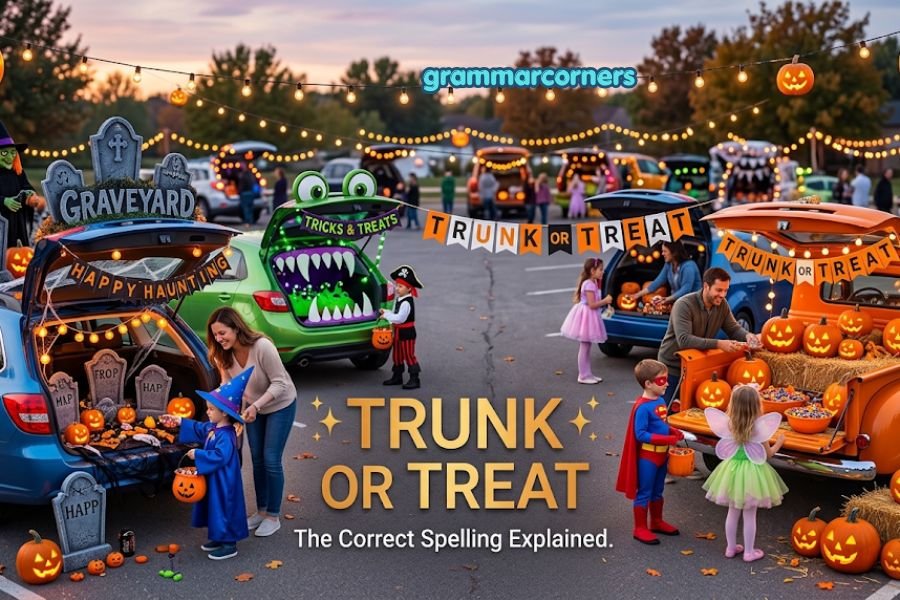
Trunk or treat is a Halloween event where children collect candy from decorated car trunks. Families usually gather in a parking lot, and each participating vehicle becomes a candy stop.
Example
Our school is hosting a trunk or treat on Friday evening.
Another example:
We are decorating our car for the annual trunk or treat.
The phrase is modeled on trick or treat. The main difference is where children collect their candy:
- Trick or treat: children visit homes.
- Trunk or treat: children visit decorated vehicles.
- Trunk or treats: informal variation that is sometimes used, but it is less standard.
The phrase trunk or treat can also be written trunk-or-treat, especially when it works as a compound modifier, such as “a trunk-or-treat event.” Major references use both “trunk-or-treat” and “trunk-or-treating” for the activity.
The Origin of Trunk or Treats
The expression trunk or treat is a modern Halloween phrase based on the older expression trick or treat.
The word trunk refers to the storage compartment at the rear of a car in American English. The word treat refers to something enjoyable given to someone, especially candy during Halloween.
The activity developed in the United States during the 1990s. Its exact creator is not known. Historical accounts indicate that churches and community groups helped develop trunk-or-treat events as an alternative to traditional door-to-door trick-or-treating.
The idea is simple:
House → House → House
becomes:
Car trunk → Car trunk → Car trunk
Participants meet in one central location, decorate their vehicles, and hand out candy to children. Over time, schools, churches, community organizations, and other groups began organizing these events.
Why Is It Called Trunk or Treat?
The name is a playful variation of trick or treat.
Traditional Halloween:
“Trick or treat!”
Trunk-or-treat version:
“Trunk or treat!”
The phrase highlights the most important difference: children receive treats from vehicle trunks rather than from individual houses.
The term trunk or treating is also used for the activity itself. Wiktionary, for example, lists “trunk or treat” as a noun and “trunk or treat” as a verb describing participation in the activity.
British English vs American English Spelling
The phrase is strongly associated with American English and North American Halloween culture.
The biggest vocabulary difference is the word trunk.
| Feature | American English | British English |
|---|---|---|
| Rear car storage | trunk | boot |
| Common event name | trunk or treat | trunk or treat when referring to the American event |
| Hyphenated form | trunk-or-treat | trunk-or-treat may be understood |
| Activity | trunk-or-treating | trunk-or-treating |
| Alternative British wording | — | community Halloween event |
In American English, trunk means the enclosed storage space at the back of a car.
In British English, the usual word is boot.
However, this does not mean you should change the event name to “boot or treat.” That expression is not the established name of the tradition.
For example:
American English: The church is hosting a trunk or treat.
For a British audience, you could explain the phrase:
A trunk or treat is an American-style Halloween event where children collect sweets from decorated car trunks.
This gives readers enough context without changing the established name.
Which Spelling Should You Use?
For most situations, use trunk or treat.
For American Readers
Use:
trunk or treat
Example:
The community center will host a trunk or treat on October 31.
This is the clearest choice for American audiences.
For UK and Commonwealth Readers
You can still use trunk or treat when discussing the American tradition. Because “trunk” is less common in British English, add a short explanation if your audience may not know the term.
For example:
Trunk or treat is an American Halloween event where children collect sweets from decorated cars.
For a Global Audience
The safest approach is to use the standard phrase and explain it once.
For example:
Trunk or treat is a Halloween event where children go from car to car collecting candy from decorated trunks.
This avoids confusion and makes the article understandable to international readers.
Common Mistakes with Trunk or Treats
Several mistakes appear when people write this phrase.
1. Using “trunk or treats” as the event name
Less preferred:
We are attending a trunk or treats tonight.
Better:
We are attending a trunk or treat tonight.
The standard event name is trunk or treat.
2. Writing “trunk of treats”
Incorrect:
Our school is having a trunk of treats.
Correct:
Our school is having a trunk or treat.
“Trunk of treats” changes the meaning of the established phrase.
3. Confusing it with trick or treat
These activities are related but not identical.
Trick or treat usually means visiting houses.
Trunk or treat usually means visiting decorated vehicles in a central location.
4. Assuming “trunk or treat” is always hyphenated
The phrase does not always need hyphens.
As an event name or noun phrase:
We attended a trunk or treat.
As a compound modifier:
We attended a trunk-or-treat event.
Both forms can appear depending on grammatical use and style.
5. Changing it to “boot or treat”
British English uses boot for the rear storage area of a car, but boot or treat is not the established name of this Halloween activity.
Trunk or Treats in Everyday Examples
Understanding the phrase is easier when you see it in real writing.
In an Email
We invite all families to join our annual trunk or treat event this Saturday. Please decorate your vehicle and bring candy for the children.
In a School Announcement
The school will host a trunk or treat in the main parking lot on Friday evening.
On Social Media
🎃 Getting our car ready for trunk or treat! We can’t wait to see everyone’s decorations.
In News Writing
Local community groups are organizing trunk-or-treat events for families during Halloween weekend.
In Formal Writing
The community organized a trunk-or-treat program as an alternative to traditional door-to-door Halloween activities.
As a Verb
The phrase can also appear in trunk or treating:
The children went trunk or treating with their families.
The noun form trunk or treat remains the clearest choice when naming the event.
Trunk or Treats – Google Trends & Usage Data
Search interest for trunk or treat is highly seasonal because the activity is closely connected to Halloween.
Interest normally rises during October, with the strongest attention occurring near Halloween. This makes sense because schools, churches, parents, and community organizations begin searching for events, decorations, activities, and safety ideas during the weeks before October 31.
The phrase is particularly associated with the United States and Canada, where trunk-or-treating has become an established alternative to traditional trick-or-treating.
Searches can also come from people looking for:
- Trunk or treat ideas
- Trunk or treat decorations
- Trunk or treat themes
- Trunk or treat events near me
- Halloween trunk decorations
- Trunk or treat games
- Trunk or treat candy ideas
Because search interest changes throughout the year, exact Google Trends numbers can vary by date and location. The reliable pattern is strong seasonal interest in October and much lower interest during most of the rest of the year.
Why Does “Trunk or Treats” Appear in Searches?
People naturally add -s to “treat” because children receive multiple treats.
However, the established event name follows the structure of trick or treat, where “treat” remains singular.
For SEO and professional writing, trunk or treat is therefore the stronger primary keyword.
Trunk or Treat vs. Trunk or Treats: Comparison Table
| Variation | Status | Best Use |
|---|---|---|
| trunk or treat | Recommended | Standard event name |
| trunk-or-treat | Acceptable | Compound modifier |
| trunk-or-treating | Recommended | Describing the activity |
| trunk or treats | Informal/less preferred | Casual usage or search variation |
| trunk of treats | Incorrect for the event | Avoid |
| boot or treat | Not standard | Avoid as the event name |
The key takeaway is simple: Use “trunk or treat” when naming the Halloween event.
FAQs About Trunk or Treats
1. Is “trunk or treats” correct?
It can be understood, but trunk or treat is the standard and preferred name for the Halloween event.
2. What does trunk or treat mean?
It is a Halloween activity where children collect candy from decorated car trunks, usually at a central location such as a school, church, or parking lot.
3. Is trunk or treat the same as trick or treat?
No. Traditional trick-or-treating usually involves going from house to house. Trunk or treat involves going from decorated vehicle to decorated vehicle.
4. Should trunk or treat be hyphenated?
It depends on how you use it. Trunk or treat works well as the event name, while trunk-or-treat event can use hyphens as a compound modifier.
5. When did trunk or treat start?
The tradition developed in the United States during the 1990s. Its exact origin is uncertain, although churches and community groups played an important role in its early development.
6. Is trunk or treat an American tradition?
It is strongly associated with the United States and is also practiced in Canada. The phrase may be understood elsewhere, but it is primarily a North American Halloween term.
7. What is trunk or treat called in British English?
There is no widely established British replacement for the phrase. British English normally uses boot instead of trunk for a car’s rear storage compartment, but “boot or treat” is not the standard name.
Conclusion
The correct and most widely preferred form is trunk or treat, not trunk or treats. It describes a modern Halloween activity in which children collect candy from decorated vehicle trunks, usually at a school, church, community center, or parking lot. The tradition developed in the United States during the 1990s and became increasingly popular as an alternative to traditional door-to-door trick-or-treating.
The confusion comes mainly from the word treats. Because children receive many pieces of candy, it may seem natural to make “treat” plural. However, the established event name is trunk or treat, following the familiar pattern of trick or treat.
For professional writing, websites, school announcements, event flyers, and SEO content, use trunk or treat as your main form. Use trunk-or-treat when it functions as a compound modifier, such as “trunk-or-treat event.” If writing for British or international readers, briefly explain that “trunk” means the rear storage area of a car.