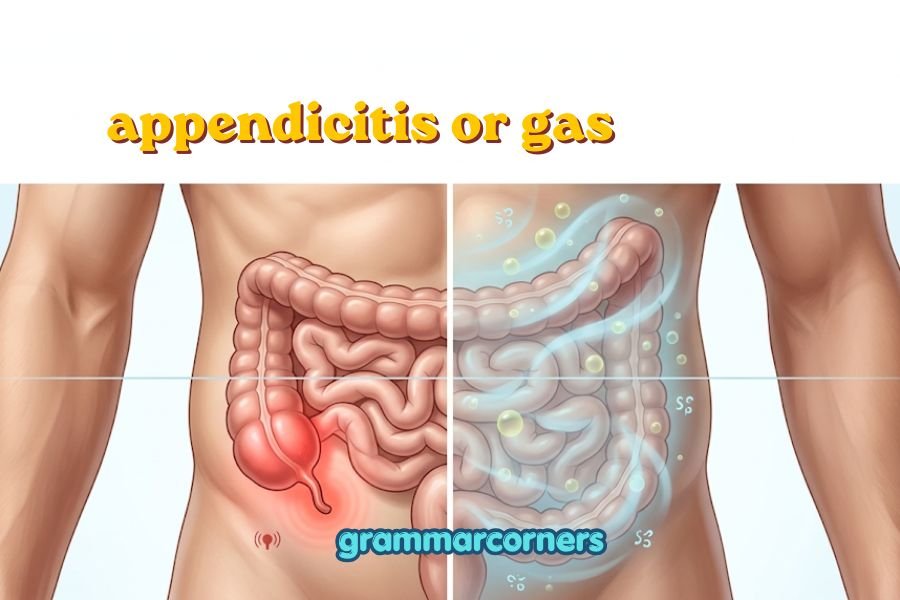
Abdominal pain can be confusing. One minute, you may think you have trapped gas; the next, you may wonder if something more serious is happening. This is why so many people search for “appendicitis or gas” when they suddenly develop stomach pain.
The two conditions can feel similar at first. Both may cause abdominal discomfort, bloating, nausea, and changes in bowel movements. However, appendicitis can become a medical emergency if the inflamed appendix ruptures. Gas pain is usually temporary and often improves when gas passes or after a bowel movement.
The most important clues are where the pain is, how it changes, how severe it becomes, and what other symptoms appear. Appendicitis commonly starts near the belly button and moves toward the lower-right abdomen, while gas pain can occur in different parts of the abdomen and often comes and goes.
Important: You cannot reliably diagnose appendicitis at home. Severe, worsening, or persistent abdominal pain should be assessed by a healthcare professional.
Appendicitis or Gas – Quick Answer
If abdominal pain is mild, moves around, feels crampy, and improves after passing gas or having a bowel movement, gas may be more likely.
If the pain gets steadily worse, becomes constant, settles in the lower-right abdomen, or occurs with fever, nausea, vomiting, or loss of appetite, appendicitis is a concern and you should seek medical care promptly.
| Symptom | Appendicitis | Gas |
|---|---|---|
| Pain location | Often begins near the belly button and moves to lower right | Can occur anywhere and may move |
| Pain pattern | Usually becomes constant and worse | Often comes and goes |
| Bloating | May occur | Common |
| Passing gas | Usually does not resolve the underlying pain | May bring relief |
| Fever | Can occur | Not typical with simple gas |
| Nausea/vomiting | Common | Can occur but is less typical |
| Appetite | Often reduced | Usually less affected |
| Movement | Pain may worsen with movement or coughing | May not have the same pattern |
| Risk | Can become an emergency | Usually harmless, but severe gas-like pain can have other causes |
These are clues, not a diagnosis. Appendicitis can sometimes present differently, particularly in children, older adults, and during pregnancy.
The Origin of “Appendicitis or Gas”
Unlike a spelling question, “appendicitis or gas” is not a phrase with competing British and American spellings. It is a health-related search phrase comparing two possible causes of abdominal discomfort.
The word appendicitis comes from appendix, referring to the appendix, combined with -itis, a medical suffix meaning inflammation. Thus, appendicitis literally refers to inflammation of the appendix.
The appendix is a small, finger-shaped pouch attached to the large intestine in the lower-right area of the abdomen. Appendicitis occurs when the appendix becomes inflamed and can become infected.
The word gas has a different linguistic history. In medicine and everyday speech, it refers to air and other gases in the digestive tract. Intestinal gas is a normal part of digestion, but trapped gas can stretch the bowel and cause pressure, bloating, or pain.
Therefore, the phrase “appendicitis or gas” is best understood as a comparison between a potentially serious medical condition and a usually less serious digestive symptom.
British English vs American English Spelling
There is no major British-versus-American spelling difference for the key terms in this phrase.
Both British English and American English use:
- appendicitis
- gas
- appendix
- abdominal pain
| Term | British English | American English |
|---|---|---|
| Inflammation of appendix | appendicitis | appendicitis |
| Digestive gas | gas | gas |
| Organ | appendix | appendix |
| Stomach-area pain | abdominal pain | abdominal pain |
| Emergency department | A&E / emergency department | emergency department / ER |
The differences are more noticeable in related medical vocabulary. For example, British English commonly uses “tummy” in everyday language, while American English more often uses “belly” or “stomach.”
The medical meaning remains the same.
Which Spelling Should You Use?
For websites, blogs, health articles, and medical content, use appendicitis and gas regardless of whether your audience is American, British, or international.
For a global audience, the phrase “appendicitis or gas” is clear and easy to understand.
If you are writing for a U.S. audience, you might say:
“Could this abdominal pain be appendicitis or gas?”
For a British audience, you might write:
“Could this tummy pain be appendicitis or trapped wind?”
This is primarily a vocabulary difference rather than a spelling difference. In British everyday speech, wind is commonly used for intestinal gas, while gas is widely understood as well.
For medical accuracy, however, appendicitis should always be spelled correctly.
Common Mistakes with “Appendicitis or Gas”
Mistake 1: Assuming all right-sided pain is appendicitis
Right-sided abdominal pain can have many causes. Appendicitis is one possibility, but gallstones, kidney stones, bowel problems, and other conditions can also cause abdominal pain.
Mistake 2: Assuming passing gas rules out appendicitis
Passing gas may make ordinary gas pain feel better, but symptom patterns overlap. Relief from gas does not provide a reliable medical diagnosis.
Mistake 3: Waiting for severe pain
Appendicitis does not always begin with extreme pain. It can start with relatively vague abdominal discomfort and become worse over several hours.
Mistake 4: Believing appendicitis always starts on the right
Classic appendicitis often begins around the belly button before moving to the lower-right abdomen, but not everyone has the textbook pattern. The location can also vary during pregnancy.
Mistake 5: Trying to diagnose appendicitis by pressing the abdomen
Home “tests” are not reliable. A healthcare professional may perform a physical examination and may order blood tests, urine tests, ultrasound, CT, or MRI depending on the situation.
Appendicitis or Gas in Everyday Examples
Examples in an Email
“I have had increasing pain in the lower-right side of my abdomen and feel nauseated. I am concerned it could be appendicitis rather than gas.”
Examples in a Health Article
“Appendicitis and gas can cause abdominal discomfort, but the pattern of pain and accompanying symptoms may be different.”
Example on Social Media
“Can gas cause sharp stomach pain? Yes, but worsening lower-right abdominal pain should not automatically be blamed on gas.”
Example in Formal Writing
“Persistent or worsening abdominal pain requires medical assessment because appendicitis can resemble other gastrointestinal conditions during its early stages.”
The safest approach is to describe symptoms and their progression rather than claiming that a particular symptom proves the cause.
Appendicitis or Gas – Google Trends & Usage Data
Search interest in health topics can change over time, especially when people experience common symptoms and look for explanations online. Searches combining appendicitis, gas, stomach pain, and similar terms reflect a common concern: people want to know whether abdominal discomfort is harmless or requires medical attention.
Google Trends uses relative search-interest data rather than providing a simple worldwide count of every search. Interest can vary by country, season, news coverage, and health awareness.
Research examining online interest in appendicitis-related terminology has also found that “appendicitis” is a commonly searched term compared with related phrases such as “inflamed appendix” and “ruptured appendix.”
For SEO purposes, related search intent includes phrases such as:
- appendicitis or gas
- appendix pain or gas
- gas pain vs appendicitis
- how to tell if it is appendicitis or gas
- appendicitis symptoms
- lower-right abdominal pain
- can gas feel like appendicitis
- what does appendicitis feel like
Because Google Trends values change continuously, exact popularity numbers should be checked directly in Google Trends before publishing a time-sensitive statistics section.
Appendicitis or Gas – Key Differences at a Glance
| Question | More suggestive of gas | More concerning for appendicitis |
|---|---|---|
| Does the pain move? | Often | Often becomes more localized |
| Does it come and go? | Often | Usually becomes persistent |
| Does passing gas help? | May help | Usually does not resolve the underlying problem |
| Is there bloating? | Common | Can occur |
| Is there fever? | Not typical | Can occur |
| Is there vomiting? | Less typical | Can occur |
| Is appetite reduced? | Usually not a major feature | Common |
| Does pain worsen over time? | Usually not progressively | Often |
| Is pain focused in lower-right abdomen? | Possible, but not typical | Common pattern |
| Does movement worsen pain? | Not usually the main pattern | Can make pain worse |
Remember that symptoms overlap. Only a medical evaluation can determine whether abdominal pain is appendicitis, gas, or another condition.
When Appendicitis Becomes an Emergency
Untreated appendicitis can cause the appendix to rupture. A ruptured appendix can lead to peritonitis, an abscess, and potentially life-threatening infection.
Seek urgent medical attention if you have:
- severe abdominal pain
- pain that is getting worse
- persistent lower-right abdominal pain
- abdominal pain with fever
- repeated vomiting
- significant loss of appetite with abdominal pain
- severe pain when moving or coughing
- a swollen or very tender abdomen
- confusion, difficulty breathing, or signs of severe illness
The NHS advises urgent assessment for abdominal pain that gradually worsens or moves to the lower-right side. Severe abdominal pain or signs that could indicate sepsis require emergency care.
Do not wait for the pain to become unbearable before seeking help.
How Doctors Tell the Difference
Doctors do not diagnose appendicitis simply by asking whether the pain feels like gas.
They usually consider:
- Where the pain began.
- Where it is now.
- How quickly it developed.
- Whether it is getting worse.
- Whether you have fever, nausea, vomiting, diarrhea, or constipation.
- Your medical history and physical examination.
- Blood and urine test results.
- Imaging such as ultrasound, CT, or MRI when appropriate.
Imaging can help doctors determine whether the appendix is inflamed and can also identify other causes of abdominal pain.
Treatment: Gas vs Appendicitis
Treatment depends on the actual cause.
Gas: Simple gas commonly improves on its own. Treatment may involve addressing foods or habits that contribute to gas, depending on the cause. Persistent or severe gas symptoms should be evaluated because they can sometimes occur with other digestive conditions.
Appendicitis: Doctors commonly treat appendicitis with an appendectomy, which removes the appendix. Some selected mild cases may be treated with antibiotics, but treatment decisions require medical evaluation.
Do not attempt to treat suspected appendicitis as ordinary gas at home.
FAQs About Appendicitis or Gas
1. Can appendicitis feel like gas?
Yes. Early appendicitis can resemble gas or other digestive discomfort. The pain may later become more localized and severe, often in the lower-right abdomen.
2. How can I tell if it is gas or appendicitis?
Gas pain often moves around, comes and goes, and may improve after passing gas. Appendicitis often becomes more constant and progressively worse. However, these signs cannot confirm the diagnosis at home.
3. Does gas pain happen on the right side?
Yes. Gas can cause pain on either side of the abdomen and can sometimes mimic appendicitis.
4. Does appendicitis always cause fever?
No. Fever can occur with appendicitis, but its absence does not rule appendicitis out. Other symptoms and the progression of pain also matter.
5. Can you still pass gas with appendicitis?
Symptoms vary. Some people with appendicitis can pass gas, while others may have difficulty passing gas. Therefore, passing gas alone cannot safely rule out appendicitis.
6. When should I go to the emergency room?
Seek emergency care for severe or rapidly worsening abdominal pain, especially when accompanied by significant tenderness, vomiting, fever, confusion, difficulty breathing, or other signs of serious illness.
7. Can I diagnose appendicitis at home?
No. Symptoms can overlap with gas, kidney stones, bowel problems, infections, and other conditions. Doctors may need an examination, laboratory tests, and imaging to determine the cause.
Conclusion
When people search for “appendicitis or gas,” they are usually trying to answer one important question: Is this abdominal pain harmless, or do I need medical care?
Gas commonly causes bloating, pressure, cramps, and discomfort that may move around the abdomen. It can improve after passing gas or having a bowel movement. Appendicitis, however, often follows a different pattern. Pain may begin around the belly button, move toward the lower-right abdomen, become constant, and worsen over time. Nausea, vomiting, loss of appetite, and fever may also occur.
Still, there is no reliable home test that can distinguish the two in every case. Appendicitis can become dangerous if the appendix ruptures, so persistent, severe, or worsening abdominal pain should not be dismissed as gas.
If you are experiencing severe or worsening abdominal pain right now, especially lower-right pain with vomiting or fever, seek urgent medical evaluation rather than relying on an online comparison.