If you are writing about a person, food, culture, or something connected to El Salvador, you may wonder: Is it Salvadoran or Salvadorian? Both forms can appear in English, but they are not equally common or preferred. This small spelling difference can be confusing because English uses several different patterns for forming words that describe nationality.
The confusion often appears when writing about Salvadoran people, Salvadoran food, Salvadoran culture, or the country of El Salvador. You may also see “Salvadorian” in older writing, informal sources, or by analogy with words such as “Canadian” and “Brazilian.”
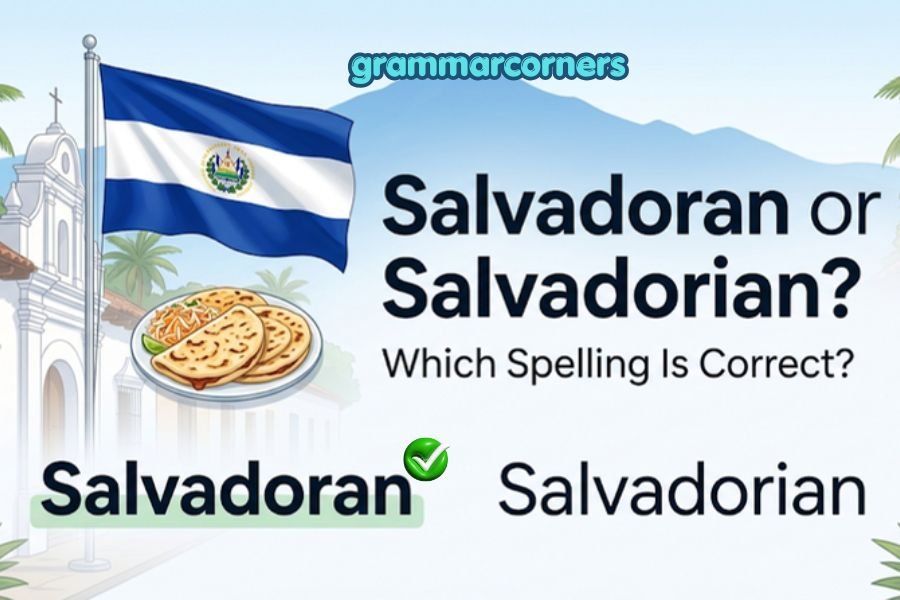
The good news is that the answer is simple: Salvadoran is the standard and most widely preferred English form. “Salvadorian” is understandable and does occur, but it is much less common.
This guide explains the difference between Salvadoran and Salvadorian, where the terms come from, which form to use in different varieties of English, common mistakes, everyday examples, and what usage data tells us.
Salvadoran or Salvadorian – Quick Answer
Salvadoran is the preferred English word for something or someone from El Salvador.
Examples:
- She is Salvadoran.
- He enjoys Salvadoran food.
- Salvadoran culture has many rich traditions.
- They traveled to El Salvador and learned about Salvadoran history.
Salvadorian is also found in English, but it is less common. For professional, academic, journalistic, and general writing, Salvadoran is usually the better choice.
| Term | Status | Example |
|---|---|---|
| Salvadoran | Preferred and common | Salvadoran food |
| Salvadorian | Used, but less common | Salvadorian culture |
So, if you are unsure, choose Salvadoran.
The Origin of Salvadoran or Salvadorian
The country is called El Salvador, which means “The Savior” in Spanish. The modern country name comes from the Spanish name Provincia de Nuestro Señor Jesucristo, el Salvador del Mundo, meaning “Province of Our Lord Jesus Christ, the Savior of the World.”
English needs an adjective and noun to describe people and things associated with the country. Salvadoran became the standard English form.
The ending -an is common in English nationality words. Examples include:
- American
- Mexican
- Canadian
- Cuban
- African
- Australian
The form Salvadorian developed as an alternative, probably influenced by English nationality words ending in -ian, such as Canadian, Brazilian, and Italian.
However, English does not always follow one fixed rule for nationality adjectives. Different historical and linguistic influences determine whether a country uses -an, -ian, -ese, -ish, or another ending.
For El Salvador, Salvadoran is now the dominant standard form in English.
British English vs American English Spelling
Unlike some spelling differences between British and American English, such as colour/color or centre/center, Salvadoran and Salvadorian are not mainly a British-versus-American spelling issue.
Both British and American English can use Salvadoran. The major difference is frequency and individual usage rather than a formal national spelling rule.
| English variety | Preferred/common form | Alternative |
|---|---|---|
| American English | Salvadoran | Salvadorian |
| British English | Salvadoran | Salvadorian |
| Canadian English | Salvadoran | Salvadorian |
| Australian English | Salvadoran | Salvadorian |
| International English | Salvadoran | Salvadorian |
The important point is that Salvadoran does not need to be changed to Salvadorian when writing British English.
For example:
- US: Salvadoran cuisine
- UK: Salvadoran cuisine
- Canada: Salvadoran cuisine
- Australia: Salvadoran cuisine
The same spelling works naturally across these varieties.
Which Spelling Should You Use?
For most readers, Salvadoran is the safest and clearest choice.
For American English
Use Salvadoran in everyday, academic, business, and professional writing.
Example:
“Many Salvadoran Americans celebrate their cultural heritage through food and festivals.”
For British English
Use Salvadoran as well. There is no need to replace it with “Salvadorian” simply because you are writing for a British audience.
For International English
Salvadoran is also the strongest choice because it is widely recognized and standard.
For formal writing
Use Salvadoran in:
- News articles
- Academic papers
- Government documents
- Business writing
- School assignments
- Travel articles
- Encyclopedic writing
If you are quoting a source that uses “Salvadorian,” keep the original wording when appropriate.
Common Mistakes with Salvadoran or Salvadorian
Mistake 1: Assuming Salvadorian is the only correct form
Some writers create “Salvadorian” because it resembles other nationality words ending in -ian.
Better: Salvadoran
Mistake 2: Treating Salvadoran as an American-only spelling
Salvadoran is not restricted to American English.
Correct: Salvadoran can be used in both American and British English.
Mistake 3: Confusing the country and nationality
The country is:
El Salvador
The adjective and noun commonly used in English are:
Salvadoran
Example:
- Correct: She is from El Salvador.
- Correct: She is Salvadoran.
- Correct: He enjoys Salvadoran cuisine.
Mistake 4: Writing “El Salvadoran”
“El Salvador” is the country’s name. “Salvadoran” is the adjective or demonym.
Correct: Salvadoran people
Incorrect: El Salvadoran people
Mistake 5: Assuming every nationality follows the same pattern
English nationality names have developed through history and contact with other languages. There is no universal rule saying every country must form its nationality with -an or -ian.
Salvadoran or Salvadorian in Everyday Examples
Knowing which form to use becomes easier when you see it in context.
In an email
“Our team is working with a Salvadoran community organization on the project.”
In a news article
“The report examined the experiences of Salvadoran immigrants.”
On social media
“I tried Salvadoran pupusas for the first time today!”
In formal writing
“The study examines Salvadoran history and cultural traditions.”
In a travel article
“Visitors can enjoy Salvadoran food, beaches, and historic sites.”
Talking about people
“My neighbor is Salvadoran.”
Talking about culture
“Salvadoran music reflects a variety of cultural influences.”
A Talking about food
“Pupusas are one of the best-known Salvadoran foods.”
In each example, Salvadoran is the natural standard choice.
Salvadoran or Salvadorian – Google Trends & Usage Data
Search behavior can help explain why people encounter both forms online.
Salvadoran is considerably more established in mainstream English usage. It appears frequently in news reporting, government publications, academic writing, dictionaries, and major reference sources.
Salvadorian still appears in search results because it is an understandable alternative and has been used by English speakers. Search engines may therefore show both forms.
However, search frequency should not be treated as the only measure of correctness. A word can receive searches because people are unsure about its spelling.
For professional writing, the stronger rule is to follow established English usage rather than simply choosing the form that appears in a search query.
The practical takeaway is straightforward:
Use Salvadoran when you want the standard, widely accepted English form.
Salvadoran vs Salvadorian Comparison Table
| Feature | Salvadoran | Salvadorian |
|---|---|---|
| Refers to El Salvador | Yes | Yes |
| Refers to a person | Yes | Yes |
| Refers to culture | Yes | Yes |
| Refers to food | Yes | Yes |
| Common in English | Very common | Less common |
| Preferred in formal writing | Yes | Usually avoid |
| Used in American English | Yes | Sometimes |
| Used in British English | Yes | Sometimes |
| Best choice for most writers | Yes | No |
FAQs About Salvadoran or Salvadorian
1. Is Salvadoran or Salvadorian correct?
Salvadoran is the preferred and more common English form. Salvadorian is also used, but it is less common.
2. Is Salvadoran the official nationality word?
Salvadoran is the standard English demonym used for people and things associated with El Salvador.
3. Can I say Salvadorian?
Yes. “Salvadorian” is understandable and appears in English, but Salvadoran is generally the better choice.
4. Do British people say Salvadoran?
Yes. Salvadoran is used in British English as well as American English.
5. Is Salvadoran food or Salvadorian food correct?
Salvadoran food is the preferred form.
For example: “We had delicious Salvadoran food for dinner.”
6. What do you call someone from El Salvador?
A person from El Salvador is commonly called a Salvadoran.
7. Why does Salvadorian exist?
Salvadorian likely developed by analogy with other English nationality words ending in -ian. Although it is used, Salvadoran became the more established English form.
Conclusion: Salvadoran or Salvadorian?
When choosing between Salvadoran or Salvadorian, the simplest answer is to use Salvadoran. It is the standard, widely recognized English form for describing people, culture, food, history, and other things connected with El Salvador.
“Salvadorian” is not meaningless or impossible to understand. It appears in English usage and may be encountered in articles, conversations, and online content. However, it is much less common than Salvadoran and is generally not the best choice when you want polished, professional English.
This is also not primarily a British-versus-American spelling difference. Salvadoran works naturally in both varieties of English and in international writing.
So whether you are writing a school assignment, news article, email, travel guide, or social media post, remember the simple rule: El Salvador → Salvadoran.
If you want the safest and most natural choice for modern English, choose Salvadoran.