Have you ever stopped while writing an email and wondered, “Should I sends this or sent this?” You are not alone. Sents or send is a common English grammar question because the two words come from the same verb but are used at different times.
The good news is simple: sends is the base form and present-tense form of the verb, while sent is its past tense and past participle. For example, “I will sends the email tomorrow” is correct, while “I sent the email yesterday” is correct.
The confusion usually happens when English learners use sends after words such as “have,” “has,” or “had,” or use sents after “did.” Understanding a few basic grammar rules can solve these mistakes quickly.
This guide explains sents vs. sends, their history, common mistakes, everyday examples, and how to choose the correct form in professional and casual writing.
Sents or Send – Quick Answer
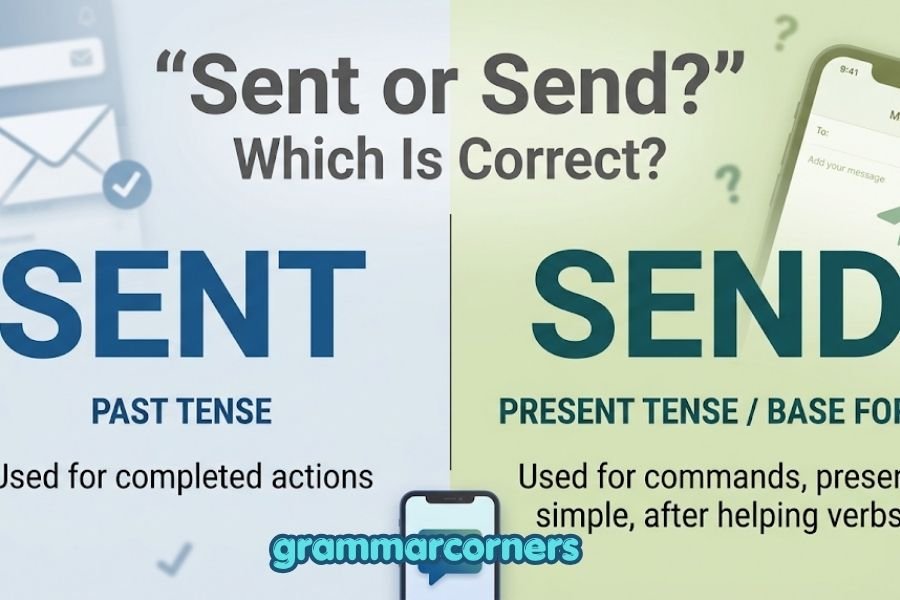
Sends and sent are both correct, but they have different grammatical functions.
- Send = present tense, base form, or infinitive
- Sent = past tense and past participle
Examples
Send:
- Please send me the document.
- I will send the email tonight.
- Did you send the message?
- I usually send reports on Monday.
Sent:
- I sent the document yesterday.
- She sent me a message.
- They sent the package last week.
- I have sent the email already.
A useful rule is:
If the action happens now or in the future, use “send.” If it already happened, use “sent.”
However, remember one important exception: after did, use send, not sent.
- Correct: Did you send the email?
- Incorrect: Did you sent the email?
“Sent” is an irregular past form of “send.” Major dictionaries list sent as the past tense and past participle of send.
The Origin of Sent or Send
The word send has a very long history in English. It comes from Old English sendan, meaning “to dispatch,” “cause to go,” or “send forth.” It is related to similar Germanic words, including German senden and Dutch zenden.
The verb existed in English before the 12th century. Over time, it developed many meanings, including sending a person, delivering a message, transmitting something, and causing something to move.
Sent developed as the irregular past form of send. English has many irregular verbs that do not form their past tense by simply adding -ed.
For example:
| Present | Past |
|---|---|
| send | sent |
| go | went |
| come | came |
| take | took |
| write | wrote |
This is why sended is normally incorrect in standard modern English. Although historical records show sended as an alternative past form, modern standard English uses sent.
So, there is no British-versus-American spelling difference between send and sent. The difference is grammatical, not geographical.
British English vs American English Spelling
Unlike words such as colour/color or centre/center, send and sent are spelled the same in British and American English.
The important difference is tense and sentence structure, not regional spelling.
| Meaning | British English | American English |
|---|---|---|
| Present/base form | send | send |
| Past tense | sent | sent |
| Past participle | sent | sent |
| -ing form | sending | sending |
| Third-person singular | sends | sends |
British English examples
- I will send the letter tomorrow.
- I sent the letter yesterday.
- Have you sent the letter?
American English examples
- I will send the letter tomorrow.
- I sent the letter yesterday.
- Have you sent the letter?
The forms are identical.
Therefore, you do not need to choose between British send and American sent. Instead, choose the form that matches the tense and grammatical structure of your sentence.
Which Spelling Should You Use?
You should use both “send” and “sent,” depending on what you mean.
Use “send” for present or future actions
Examples:
- I send invoices every Friday.
- Please send me the details.
- I will send the file later.
- Did you send the invitation?
Notice the last example. Even though the question asks about a past action, did already marks the past tense. Therefore, the main verb returns to its base form: send.
Use “sent” for completed past actions
Examples:
- I sent the email yesterday.
- She sent the payment last week.
- We sent the package on Monday.
Use “sent” after have, has, and had
Examples:
- I have sent the report.
- She has sent the documents.
- They had sent the invitation before we arrived.
Quick rule
Will → send
I will send it.
Did → send
Did you send it?
Have/has/had → sent
I have sent it.
Simple past → sent
I sent it yesterday.
Common Mistakes with Sent or Send
Because send is an irregular verb, several mistakes appear frequently.
Mistake 1: “I have send it.”
❌ I have send the email.
✅ I have sent the email.
After have or has, use the past participle sent.
Mistake 2: “Did you sent it?”
❌ Did you sent the message?
✅ Did you send the message?
After did, use the base form send.
Mistake 3: “I will sent it.”
❌ I will sent the file.
✅ I will send the file.
After will, use the base form.
Mistake 4: “I send it yesterday.”
❌ I send it yesterday.
✅ I sent it yesterday.
The word “yesterday” indicates a completed past action, so sent is required.
Mistake 5: “She has send me a photo.”
❌ She has send me a photo.
✅ She has sent me a photo.
Remember: has + past participle = has sent.
Mistake 6: “I had send the email.”
❌ I had send the email.
✅ I had sent the email.
The past perfect uses had + sent.
Sent or Send in Everyday Examples
Understanding send vs. sent becomes easier when you see the words in realistic situations.
In emails
Present/future:
I will send the revised document this afternoon.
Past:
I sent the revised document this morning.
Present perfect:
I have sent the revised document.
In text messages
- Can you send me the address?
- I already sent it.
- I’ll send you the photo later.
- Did you send her a message?
In professional writing
- The company will send an official response tomorrow.
- The manager sent the report to the client.
- We have sent the requested documents.
The social media
- Send me the link!
- I sent you a DM.
- Can you send that post to me?
In news and formal writing
The verb appears frequently in reports involving communication, transportation, government, business, and technology. For example:
- The government sent emergency supplies.
- Officials will send an update later.
- The organization has sent a statement to reporters.
The Oxford Learner’s Dictionary also gives examples of send for communicating information, arranging someone’s movement, and causing something to move or change.
Sent or Send – Google Trends & Usage Data
Searches for “sent or send” are mainly connected to English grammar and tense confusion. People commonly search variations such as:
- sent or send
- send or sent
- did I send or sent
- have sent or have send
- I sent or I send
- did you send or did you sent
These searches are especially useful to English learners, students, job applicants, and people checking emails or other professional writing.
Grammar-related searches for this question tend to appear across international English-learning audiences, including countries where English is widely studied as a second language. Some third-party SEO sources report particular interest from countries such as India, Pakistan, the Philippines, and parts of Europe.
Because Google Trends reports relative search interest rather than a fixed number of searches, it is better to describe the trend by topic and geography than to claim an exact worldwide search volume without a specific Trends export.
The key point is that sent and send are not competing spellings. They are different grammatical forms of the same verb.
Sent vs. Send – Comparison Table
| Word | Grammar | When to use | Example |
|---|---|---|---|
| send | Base/present | Present actions | I send emails every day. |
| send | Infinitive | After “to” | I want to send it. |
| send | After modal verbs | Will, can, should, must | I will send it. |
| send | After “did” | Past questions/negatives | Did you send it? |
| sent | Simple past | Completed past action | I sent it yesterday. |
| sent | Past participle | After have/has/had | I have sent it. |
| sending | Present participle | Continuous forms | I am sending it now. |
| sends | Third-person present | He/she/it | She sends emails daily. |
Easy memory trick
Think of the sentence:
“I send it today. I sent it yesterday.”
That simple contrast can help you remember the difference.
FAQs About Sent or Send
1. Is “sent” the past tense of “send”?
Yes. Sent is the simple past tense and past participle of send.
- Present: I send it.
- Past: I sent it.
2. Is “send” correct for the future?
Yes.
- I will send the document tomorrow.
- I am going to send the message later.
3. Should I say “Did you send” or “Did you sent”?
The correct form is “Did you send?”
After did, use the base form of the verb.
✅ Did you send it?
❌ Did you sent it?
4. Should I say “I have sent” or “I have send”?
The correct form is “I have sent.”
Have + past participle = have sent.
5. Is “sended” a correct word?
In standard modern English, sended is not the normal past tense of send. Use sent instead. Historical English records do contain sended as an alternative form, but it is not the standard form today.
6. Is “send” the same in British and American English?
Yes. Both British and American English use send, sent, sending, and sends in the same way.
7. Which is correct: “I sent you” or “I send you”?
Both can be correct, but they mean different things.
- I sent you the file. = I already delivered it.
- I send you the file. = present/general use, though it may sound unusual depending on context.
For a completed action, “I sent you” is usually the correct choice.
Conclusion
The difference between sent or send is simple once you understand verb tense. Send is the base form and is used for present actions, infinitives, and after auxiliary verbs such as will, can, should, and did. Sent is the past tense and past participle of send, so it describes completed actions and follows have, has, and had.
For example, say “I will send the email,” but say “I sent the email yesterday.” Likewise, say “Did you send the file?” rather than “Did you sent the file,” because did already carries the past tense.
There is no British-versus-American spelling difference here. Both varieties of English use send and sent in exactly the same grammatical way.
If you remember just one rule, remember this: send = base/present form; sent = past and past participle. Once you connect each form to the correct sentence structure, choosing between them becomes easy.