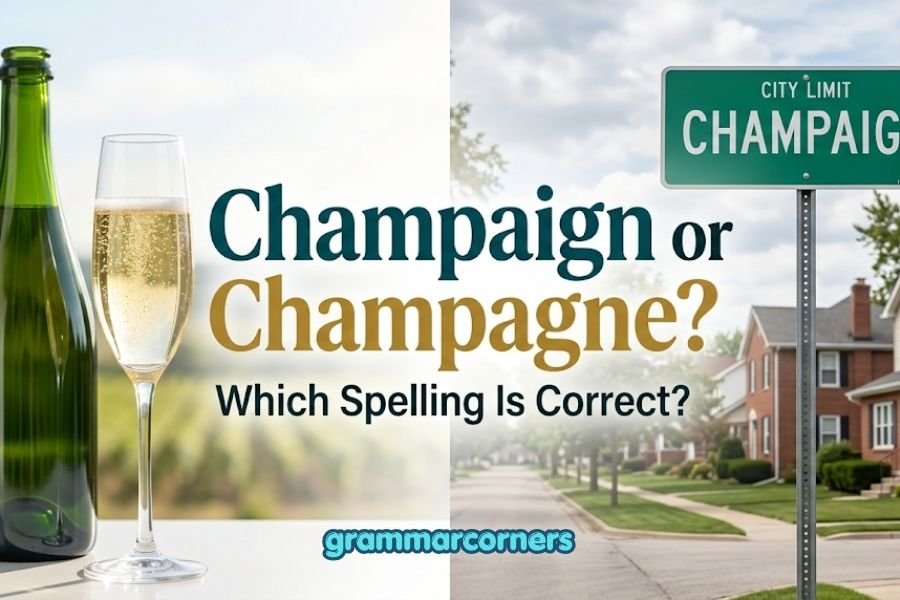
If you have ever written “champaign” when you meant the sparkling drink, you are not alone. The words champaign or champagne look almost identical, but they have very different meanings. This spelling confusion often happens because both words sound similar when spoken quickly.
The correct spelling for the famous sparkling wine is champagne. The word Champaign, with a capital “C,” is mainly a proper name, especially associated with Champaign, Illinois, a city in the United States.
Knowing the difference matters when you are writing an email, ordering a drink, creating a social media post, or producing professional content. One small spelling change can completely alter the meaning of your sentence.
This guide explains champaign or champagne, including their origins, British and American usage, common mistakes, everyday examples, and usage trends. By the end, you will know exactly which spelling to use and when.
Champaign or Champagne – Quick Answer
Champagne is the correct spelling when you mean the sparkling wine from France’s Champagne region.
Champaign is usually a proper noun, most commonly referring to Champaign, Illinois.
| Word | Meaning | Example |
|---|---|---|
| Champagne | Sparkling wine | We opened a bottle of champagne. |
| Champaign | A city in Illinois or a proper name | She lives in Champaign, Illinois. |
Easy way to remember
Think:
- Champagne = wine
- Champaign = place
For example:
We celebrated with champagne.
But:
He moved to Champaign, Illinois.
The two words should not normally be used interchangeably.
The Origin of Champaign or Champagne
The words champaign and champagne have related historical roots, but modern English uses them differently.
Where does “champagne” come from?
Champagne comes from the name of the Champagne region in northeastern France. The region became famous for producing sparkling wine, and the name eventually became strongly associated with that wine.
The regional name ultimately traces back to Latin campania, meaning open or level countryside.
Over time, the French regional name developed into Champagne.
Where does “champaign” come from?
Champaign is an English word that historically referred to open countryside or level land. It comes from the same general Latin root associated with a plain or open country.
Today, however, most English speakers encounter Champaign as part of a place name, particularly Champaign, Illinois.
Why do they look so similar?
The similarity is not a coincidence. Both forms have historical connections to words describing open or level land.
However, their meanings have developed differently in modern English:
- champagne → the French region and its famous sparkling wine
- Champaign → a proper name, especially the Illinois city
British English vs American English Spelling
There is no major British-versus-American spelling difference between champagne and Champaign.
Unlike words such as colour/color or realise/realize, this is not a case where British English prefers one spelling and American English prefers another.
Both British and American English use:
- champagne for the sparkling wine
- Champaign for the Illinois place name
Comparison Table
| Meaning | British English | American English |
|---|---|---|
| French sparkling wine | champagne | champagne |
| Champagne region | Champagne | Champagne |
| Illinois city | Champaign | Champaign |
| General open countryside, historical/literary | champaign | champaign |
The important difference is meaning and capitalization, not British versus American spelling.
Which Spelling Should You Use?
Your choice depends entirely on what you mean.
Use “champagne” for the wine
Use lowercase champagne when referring to the drink in ordinary writing.
Example:
They served champagne at the wedding.
However, when discussing the protected geographical name or region, Champagne is capitalized.
Example:
The wine comes from the Champagne region of France.
Use “Champaign” for the Illinois city
Use Champaign when referring to the city in Illinois.
Example:
The conference will take place in Champaign.
Use “champaign” only in its specific historical/literary sense
The lowercase word champaign can describe open or level countryside, but this use is uncommon in everyday modern English.
For most writers, the practical rule is:
Wine → champagne
Illinois city → Champaign
Common Mistakes with Champaign or Champagne
Because the words look and sound similar, several mistakes are common.
Mistake 1: Writing “champaign” for the drink
❌ We celebrated with a bottle of champaign.
✅ We celebrated with a bottle of champagne.
Mistake 2: Writing “champagne” for the city
❌ She studies in Champagne, Illinois.
✅ She studies in Champaign, Illinois.
Mistake 3: Forgetting capitalization
When referring to the Illinois city, capitalize the name.
❌ He moved to champaign.
✅ He moved to Champaign.
Mistake 4: Assuming it is a British/American spelling issue
It is not.
❌ British: champaign
❌ American: champagne
That is an incorrect way to understand the difference.
Both varieties of English use champagne for the wine.
Mistake 5: Confusing pronunciation with spelling
Because the words sound similar, it can be easy to spell one when you mean the other.
If you are writing about a celebration, wedding, or sparkling wine, champagne is almost certainly the word you need.
Champaign or Champagne in Everyday Examples
Seeing the words in context makes the distinction easier.
In an email
Correct:
We will serve champagne during the celebration.
For the city:
Our meeting is scheduled in Champaign, Illinois.
In news writing
Wine:
The restaurant added several champagne options to its menu.
Place:
Officials in Champaign announced a new community project.
On social media
Wine:
Celebrating another great year with champagne! 🥂
Place:
Excited to visit Champaign this weekend!
In formal writing
Wine:
The event concluded with a champagne reception.
Place:
The university is located in Champaign, Illinois.
In academic writing
If you are discussing the city, use Champaign consistently.
If you are discussing the French wine region or product, use Champagne or champagne, depending on the intended meaning and style.
Champaign or Champagne – Google Trends & Usage Data
Search behavior for “champaign or champagne” is largely driven by spelling confusion. The much more common search term is champagne, because it refers to a globally recognized beverage and French wine region.
Champagne tends to have strong worldwide recognition, especially in countries where sparkling wine and French culture are popular.
Champaign, by contrast, has a much narrower meaning. Searches are often connected with Champaign, Illinois, including its university, businesses, local news, events, and travel information.
Usage also depends heavily on context:
| Search/Usage Context | More Likely Term |
|---|---|
| Sparkling wine | champagne |
| Wedding celebration | champagne |
| French wine | champagne / Champagne |
| French region | Champagne |
| Illinois city | Champaign |
| University/local news | Champaign |
| Spelling question | champaign or champagne |
Because search interest changes over time and differs by country, Google Trends should be treated as a snapshot of search behavior rather than a dictionary of correct spelling.
Champaign vs Champagne: Side-by-Side Comparison
| Feature | Champaign | Champagne |
|---|---|---|
| Common meaning | City/proper name | Sparkling wine |
| Capitalization | Usually capitalized as a place name | Lowercase for the drink; uppercase for the region |
| Associated with Illinois | Yes | No |
| Associated with French wine | No | Yes |
| Common everyday word | Less common | Very common |
| Example | Champaign, Illinois | A glass of champagne |
| Pronunciation | Similar | Similar |
The biggest difference is meaning, not pronunciation.
FAQs About Champaign or Champagne
1. Is it “champaign” or “champagne”?
Champagne is correct when you mean the sparkling wine. Champaign is mainly used as a proper name, especially for Champaign, Illinois.
2. Is “champaign” a real word?
Yes. Champaign is a historical/literary English word for open or level countryside. It is also used as a proper name, most notably for the Illinois city.
3. Why is champagne spelled with an “e”?
The spelling comes from the French name Champagne, which refers to the French region historically associated with the wine.
4. Is Champaign the same as Champagne?
No. Champaign and Champagne have different modern meanings. Champaign commonly refers to the Illinois city, while champagne refers to the sparkling wine.
5. Is Champaign, Illinois spelled with an “e”?
No. The city is spelled Champaign, ending in -aign.
6. Should champagne be capitalized?
When referring to the drink in general, champagne is normally lowercase. Champagne is capitalized when referring to the French region or its geographical designation.
7. Which is correct: “a glass of champaign” or “a glass of champagne”?
The correct sentence is:
A glass of champagne.
Champaign is incorrect when referring to the sparkling wine.
Conclusion
The difference between champaign or champagne is simple once you connect each spelling with its meaning. Champagne is the spelling you want when talking about the famous French sparkling wine. It can also refer to the Champagne region of France, where the wine originates. Champaign, on the other hand, is most commonly seen as a proper name, especially Champaign, Illinois.
The two words are historically related, which helps explain why they look so similar. However, they are not interchangeable in modern English. British and American English generally use the same spellings, so this is not a transatlantic spelling difference.
For everyday writing, remember one easy rule: champagne is the drink, while Champaign is the Illinois city. If you keep that distinction in mind, you can avoid one of the most common spelling mistakes involving these similar-looking words.