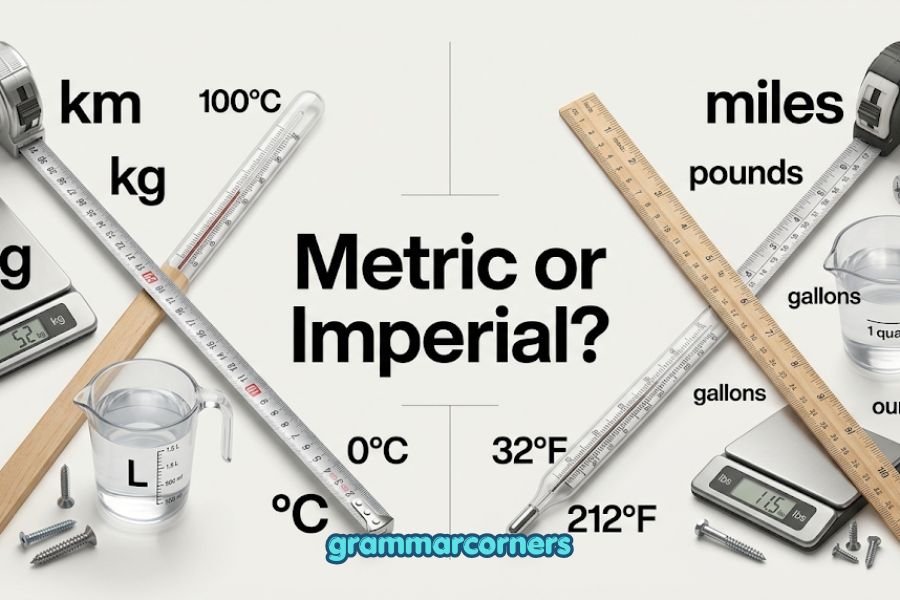
When someone asks “metric or imperial?”, they are usually trying to answer a practical question: Which measurement system is correct, easier, or more widely accepted? The answer depends on where you live, what you are measuring, and who will read or use the information.
The metric system uses units such as millimeters, centimeters, meters, kilometers, grams, kilograms, and liters. It is based on the International System of Units (SI), which is the modern international standard for measurement.
The imperial system uses units such as inches, feet, yards, miles, ounces, pounds, and gallons. However, there is an important detail: British Imperial units and U.S. customary units are not always identical. For example, a U.S. gallon is smaller than an Imperial gallon.
People search for “metric or imperial” when buying products, following recipes, checking height or weight, traveling, reading technical information, or converting measurements. Understanding the difference helps you avoid mistakes and choose the right system for your audience.
Metric or Imperial – Quick Answer
Metric is the standard choice for most of the world, while imperial or U.S. customary measurements remain common in everyday life in the United States and in some situations in the United Kingdom.
The metric system is decimal-based, making conversions straightforward:
- 1 meter = 100 centimeters
- 1 kilometer = 1,000 meters
- 1 kilogram = 1,000 grams
- 1 liter = 1,000 milliliters
Imperial-style measurements include:
- 12 inches = 1 foot
- 3 feet = 1 yard
- 1,760 yards = 1 mile
- 16 ounces = 1 pound
The United States officially recognizes SI and has a national policy that makes metric the preferred measurement system for trade and commerce, although U.S. customary units remain widely used.
Metric vs Imperial: Quick Comparison
| Measurement | Metric | Imperial/U.S. customary |
|---|---|---|
| Length | meter | foot, inch, yard, mile |
| Weight/Mass | gram, kilogram | ounce, pound |
| Volume | liter, milliliter | pint, quart, gallon |
| Temperature | Celsius | Fahrenheit |
| Common example | 5 km | 3.1 miles |
Important: “Imperial” and “U.S. customary” should not always be treated as exactly the same system.
The Origin of Metric or Imperial
The word metric comes from the Greek metron, meaning “measure.” The metric system developed in France during the late 18th century. Its decimal structure was designed to make measurement and conversion easier.
The modern metric system evolved into the International System of Units (SI). NIST describes SI as the modern metric system and notes that it has become the dominant measurement system in science and international commerce.
The word imperial relates to an empire. The British Imperial system was formally established through the British Weights and Measures Act of 1824. It standardized many traditional British units.
There is also a major historical distinction between British Imperial measurements and American measurements. The United States developed its own customary system from earlier English units.
For example:
- 1 U.S. gallon ≈ 3.785 liters
- 1 Imperial gallon ≈ 4.546 liters
So, when someone says “imperial,” it is important to know which country’s measurement conventions they mean.
British English vs American English Spelling
Unlike words such as colour/color or centre/center, the words metric and imperial are normally spelled the same in British and American English.
The bigger differences appear in the names of individual units.
For example:
| Concept | British English | American English |
|---|---|---|
| Metric length | metre | meter |
| Metric volume | litre | liter |
| Metric weight | kilogram | kilogram |
| Temperature | Celsius | Celsius |
| Imperial-style length | metre/foot/inch | meter/foot/inch |
| Large distance | kilometre | kilometer |
| Fuel economy | miles per gallon | miles per gallon |
The spelling difference between metre/meter and litre/liter is an English-language difference, not a difference between measurement systems.
Examples
British English:
The bottle contains two litres of water.
American English:
The bottle contains two liters of water.
Both sentences describe the same metric measurement.
For international technical writing, using the correct SI symbols can also reduce confusion. NIST provides guidance on SI units and their proper usage.
Which Spelling Should You Use?
The best choice depends on your audience.
For American readers
Use American spellings such as:
- meter
- kilometer
- liter
For everyday measurements, U.S. readers commonly encounter:
- inches
- feet
- miles
- pounds
- ounces
- Fahrenheit
However, metric units are also common in science, medicine, manufacturing, and many technical fields in the United States. NIST states that SI is the preferred measurement system for U.S. trade and commerce.
For British readers
Use British spellings such as:
- metre
- kilometre
- litre
The UK is officially metric for most regulated trade, although imperial measurements remain familiar in everyday situations. For example, people commonly discuss road distances in miles and personal height in feet and inches.
For a global audience
Metric is usually the safest primary system.
If your readers are international, you can provide both:
The package weighs 10 kg (22 lb).
This gives readers the information they need without forcing them to convert the measurement.
Common Mistakes with Metric or Imperial
Here are some common mistakes to avoid.
1. Treating Imperial and U.S. customary units as identical
They are not always identical.
A British Imperial gallon and a U.S. gallon have different volumes.
2. Assuming the United States does not use metric
The U.S. uses metric extensively in science, medicine, engineering, manufacturing, and trade. SI is also the preferred system for U.S. trade and commerce.
3. Confusing mass and weight
In everyday speech, people often say “weight” when they mean mass. In technical contexts, these are different physical concepts.
4. Mixing units unnecessarily
Writing:
The table is 2 meters long and 4 feet wide.
is possible, but it creates unnecessary conversion work.
Choose one system unless there is a good reason to provide both.
5. Assuming British Imperial gallons equal U.S. gallons
They do not.
- 1 U.S. gallon ≈ 3.785 L
- 1 Imperial gallon ≈ 4.546 L
This difference matters when discussing fuel, recipes, liquids, and vehicle specifications.
Metric or Imperial in Everyday Examples
In emails
For an international business email:
The shipment weighs 25 kg and measures 80 cm × 60 cm × 50 cm.
For a primarily American audience:
The shipment weighs 55 lb and measures approximately 31.5 × 23.6 × 19.7 inches.
In news
News organizations often choose units based on their audience.
A U.S. publication may report a person’s height in feet and inches, while an international publication may use centimeters or meters.
On social media
People often mix systems casually:
“The hike was 10 km!”
or:
“I walked 6 miles today.”
Both are understandable, but the preferred system depends on the audience.
In formal writing
For scientific and technical writing, SI units are generally preferred because they provide an internationally standardized system. NIST identifies SI as the modern metric system and provides formal guidance for its use.
In the United Kingdom
Metric units are required for most regulated commercial transactions, although certain Imperial units remain permitted in specific circumstances.
Metric or Imperial – Google Trends & Usage Data
Search interest for “metric or imperial” is closely tied to practical questions rather than a simple spelling preference.
People commonly search the phrase when they need to:
- Convert measurements.
- Understand product specifications.
- Follow recipes from another country.
- Compare U.S. and international measurements.
- Understand height, weight, distance, or volume.
- Decide which system to use in writing.
The strongest geographic interest can vary over time because the search term is often triggered by specific events, products, recipes, travel, and educational questions.
The broader usage pattern is easier to understand by looking at national measurement practices. Most countries use SI as their primary measurement framework. The United States officially supports SI while continuing to use U.S. customary units extensively in everyday life.
The United Kingdom provides another interesting example. It has adopted metric measurement for most regulated trade, but Imperial units remain deeply familiar in everyday language, particularly for road distances, body height, and certain traditional products.
Therefore, search interest in “metric or imperial” often reflects the need to bridge these different measurement habits.
Metric vs Imperial: Side-by-Side Table
| Feature | Metric | Imperial / U.S. customary |
|---|---|---|
| Main principle | Decimal-based | Traditional unit relationships |
| Common length | meter | inch, foot, yard, mile |
| Common mass/weight | gram, kilogram | ounce, pound |
| Common volume | liter | pint, quart, gallon |
| Temperature | Celsius | Fahrenheit |
| Scientific use | Very common | Limited compared with SI |
| International use | Dominant | Less common |
| U.S. everyday use | Increasing/specialized | Very common |
| UK everyday use | Official primary system | Still common in selected contexts |
| Easy decimal conversion | Yes | Usually no |
| Best for global technical writing | Yes | Usually no |
FAQs About Metric or Imperial
1. Is metric or imperial better?
Metric is generally better for international communication, science, engineering, and simple conversions. Imperial or U.S. customary units may be more convenient for audiences accustomed to them.
2. Does the UK use metric or imperial?
The UK officially uses metric units for most regulated trade, but Imperial units remain common in everyday life. Miles, feet, inches, and pints are still familiar examples.
3. Does the USA use metric or imperial?
The United States uses both. U.S. customary units dominate many everyday situations, while metric units are widely used in science, medicine, engineering, manufacturing, and international trade.
4. Is metric the same as SI?
Almost, in everyday conversation. SI stands for the International System of Units and is the modern standardized form of the metric system.
5. Is Imperial the same as U.S. customary?
No. They share historical roots, but some units have different definitions and sizes.
6. Should I use metric or imperial on my website?
If your website targets a global audience, use metric as the primary system. You can add Imperial or U.S. customary conversions when they help your readers.
7. Which system is easier to learn?
Metric is usually easier because it uses powers of 10. For example, 1 meter equals 100 centimeters and 1 kilogram equals 1,000 grams.
Conclusion
The answer to “metric or imperial” depends mainly on your audience and purpose. Metric is the better default for international, scientific, technical, and professional communication. It is based on SI and provides a consistent decimal structure that makes conversions easier.
Imperial measurements, however, remain important. Americans commonly use U.S. customary units such as inches, feet, miles, pounds, and gallons in everyday life. The United Kingdom is largely metric for official trade but continues to use familiar Imperial measurements in areas such as road distances and personal height.
One of the biggest mistakes is assuming that all Imperial-style units are identical everywhere. U.S. customary and British Imperial measurements can differ, especially for volume.
For a global audience, the best professional approach is often to use metric first and provide an Imperial or U.S. customary conversion when useful. This keeps your information clear, accurate, and accessible to readers around the world.